¡Acompáñanos a viajar por el mundo de los libros!
Añadir este libro a la estantería
Grey
Escribe un nuevo comentario Default profile 50px
Grey
Suscríbete para leer el libro completo o lee las primeras páginas gratis.
All characters reduced
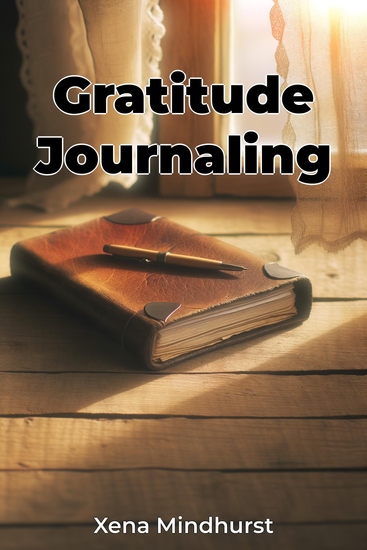
Gratitude Journaling - cover

Gratitude Journaling

Xena Mindhurst

Traductor A AI

Editorial: Publifye

  • 0
  • 0
  • 0

Sinopsis

Gratitude Journaling: Cultivating Mental Well-Being Through Daily Reflection reveals how a simple daily practice can reshape your brain and emotional health. Rooted in psychology and neuroscience, the book explores how structured gratitude exercises boost mental resilience, reduce anxiety, and strengthen relationships. Central to its thesis is neuroplasticity—the brain’s ability to rewire itself through repeated positive focus. By journaling consistently, readers train their minds to act as a "cognitive filter," prioritizing constructive narratives over negativity. Supported by research, the text cites striking findings: regular practice correlates with a 10-15% rise in life satisfaction and measurable drops in stress-related brain activity.

 
Blending science with practicality, the book progresses from debunking myths (like confusing gratitude with toxic positivity) to offering adaptable journaling frameworks. Early chapters trace gratitude’s philosophical roots, while later sections link it to modern benefits like improved sleep and workplace harmony. Unique features include trauma-informed strategies for maintaining practice during crises and self-assessment tools for personalization. Unlike generic self-help guides, it grounds advice in interdisciplinary evidence—fMRI studies, behavioral economics, and cross-cultural data—without prescribing rigid rules. The conversational tone and real-world examples, like using journaling to reframe setbacks, make complex concepts accessible. By merging academic rigor with actionable steps, this book stands as a pragmatic toolkit for anyone seeking lasting emotional balance through science-backed reflection.
Disponible desde: 26/01/2025.
Longitud de impresión: 55 páginas.

Otros libros que te pueden interesar

  • Little Turtle’s War: The History and Legacy of the 18th Century Conflict Between the United States and Native Americans in the Northwest Territory - cover

    Little Turtle’s War: The History...

    Charles River Editors

    • 0
    • 0
    • 0
    The new United States was faced with a fundamental problem: to expand, it had to settle lands to the west of the Appalachian Mountains, ceded to it by the British. However, the mountains were occupied by Native American groups who had no desire to make way for white settlers. The treaty had created a vast frontier for the fledgling nation, and any American settlers pushing west along it were bound to encounter hostile natives. 
    The conflicts that followed consisted mostly of the Native Americans suffering defeat in the face of a better-equipped adversary, interspersed with binding treaties, which, on the side of the federal government, proved not very binding at all. Occasionally, however, there arose a Native American leader of such ability that such defeats were temporarily reversed, and Little Turtle, the war chief of the Miami tribe, was one such man. Under his leadership, a confederation of Miami and other tribes inflicted the worst defeat ever suffered by an American army in the newly independent nation. Almost a quarter of the Army’s total strength was lost in a single battle, but while later Native American leaders such as Sitting Bull and Crazy Horse have become legends, Little Turtle is not as well-remembered. This is particularly odd, given that he actually defeated the American military and helped shape the development of the nascent United States and its military. Before Little Turtle’s War, it was believed that the U.S. did not need a professional army; that ordinary citizens would take up arms in times of threat and serve in militias as they had done in the fight against the British. After this war, the U.S. government was forced to recognize the need for a professional standing army.
    Ver libro
  • The Beautiful Death of Ozzy Osbourne - cover

    The Beautiful Death of Ozzy...

    Keith Kahn-Harris

    • 0
    • 0
    • 0
    Pioneering metal writer Keith Kahn-Harris presents a moving, visionary exploration of Ozzy Osbourne, and of metal music and culture: the potent legacy Ozzy left us. 
    What is a ‘good death’? 
    How about this: After years of terrible health, you gather friends and admirers for one last, glorious party. A couple of weeks later, you slip away, surrounded by your loving family. Then, the world comes to mourn. That is how Birmingham’s favourite son, Ozzy Osbourne, died. 
    By his death in June 2025 – at an age few believed he’d reach – Ozzy was much-loved, far beyond the metal world. Once a feared, demonic figure to some (and a joke to others), his Back to the Beginning farewell concert at Villa Park raised millions for charity. 
    In concise, arresting chapters moving from Death to Life via Art, Politics, Sex, Bodies, Voice, Family, Myth and more, Kahn-Harris explores how Ozzy – of all people! – attracted such generosity of spirit. The answer, he finds, is deeply embedded within the story and culture of metal – and has lessons for us all. 
    Blending biography with criticism, Kahn-Harris traces the history of metal music—its styles and genres—to show how dying can become a social story of meaning rather than mere spectacle. This latest, popular study is heavy with insight, offering the best kind of cultural reading for anyone ready to pre-order an up-coming book that treats Ozzy’s myth with clear-eyed care. 
    For fans of Howard Jacobson (Shylock is My Name), and Jessica Cohen (What Makes an Apple?). 
    HarperCollins 2026
    Ver libro
  • What is Queer Food? - How We Served a Revolution - cover

    What is Queer Food? - How We...

    John Birdsall

    • 0
    • 0
    • 0
    A celebrated food writer's expansive, audacious excavation of the development of modern queer identity and food culture. 


    Food in America and Europe has long been shaped, twisted, and upended by queer creatives. Beloved food writer John Birdsall fills the gap between the past and present, channeling the twin forces of criticism and cultural history to propel readers into the kitchens, restaurants, swirling party-houses, and humming interior lives of James Baldwin, Alice B. Toklas, Truman Capote, Esther Eng, and others who left an indelible mark on the culinary world from the margins. Queer food is brunch quiche à la Craig Claiborne, Richard Olney's ecstatic salade composée, and Rainbow Ice-Box Cake from Ernest Matthew Mickler's White Trash Cooking. It's the intention surrounding a meal, the circumstances behind it, the people gathered around the table. 


    With cinematic verve and prose that dazzles, What Is Queer Food? is a monumental work: a testament to food's essential link to a modern queerness that reveals how, like fashion or tastes in music, food has become a language of LGBTQ+ identity.
    Ver libro
  • Gathering - Women of Colour on Nature - cover

    Gathering - Women of Colour on...

    Durre Shahwar, Nasia Sarwar-Skuse

    • 0
    • 0
    • 0
    Gathering brings together essays by women of colour across the UK writing about their relationships with nature, in a genre long-dominated by male, white, middle-class writers. In redressing this imbalance, this moving collection considers climate justice, neurodiversity, mental health, academia, inherited histories, colonialism, whiteness, music, hiking and so much more.
    These personal, creative, and fierce essays will broaden both conversations and horizons about our living world, encouraging readers to consider their own experience with nature and their place within it.
    Ver libro
  • On Hunting - A Definitive Study of the Mind Body and Ecology of the Hunter in the Modern World - cover

    On Hunting - A Definitive Study...

    Lt. Col. Dave Grossman, Linda K....

    • 0
    • 0
    • 0
    Hunting is our heritage, our heart, and our future.
    
    Where does hunting fit in the modern world? To many, it can seem outdated or even cruel, but as On Hunting affirms, hunting is holistic, honest, and continually relevant. Authors Grossman, Miller, and Cunningham dive deep into the ancient past of hunting and examine its position today, demonstrating that we cannot understand humanity without first understanding hunting. Readers will
    
    
    ·       discover how hunting formed us,
    
    
    ·       examine hunting ethics and their adaptation to modernity,
    
    
    ·       understand the challenges, traditions, and reverence of today's hunter,
    
    
    ·       identify hunting skills and their many applications outside the field,
    
    
    ·       learn why hunting is critical to ecological restoration and preservation, and
    
    
    ·       gain inspiration to share hunting with others.
    
    
    Drawing from ecology, philosophy, and anthropology and sprinkled with campfire stories, this wide-ranging examination has rich depths for both nonhunters and hunters alike. On Hunting shows that we need hunting still—and so does the wild earth we inhabit.
    Ver libro
  • Popularizing the Past - Historians Publishers and Readers in Postwar America - cover

    Popularizing the Past -...

    Nick Witham

    • 0
    • 0
    • 0
    Popularizing the Past tells the stories of five postwar historians who changed the way ordinary Americans thought about their nation’s history. 
      
    What’s the matter with history? For decades, critics of the discipline have argued that the historical profession is dominated by scholars unable, or perhaps even unwilling, to write for the public. In Popularizing the Past, Nick Witham challenges this interpretation by telling the stories of five historians—Richard Hofstadter, Daniel Boorstin, John Hope Franklin, Howard Zinn, and Gerda Lerner—who, in the decades after World War II, published widely read books of national history. 
      
    Witham compellingly argues that we should understand historians’ efforts to engage with the reading public as a vital part of their postwar identity and mission. He shows how the lives and writings of these five authors were fundamentally shaped by their desire to write histories that captivated both scholars and the elusive general reader. He also reveals how these authors’ efforts could not have succeeded without a publishing industry and a reading public hungry to engage with the cutting-edge ideas then emerging from American universities. As Witham’s book makes clear, before we can properly understand the heated controversies about American history so prominent in today’s political culture, we must first understand the postwar effort to popularize the past.
    Ver libro