¡Acompáñanos a viajar por el mundo de los libros!
Añadir este libro a la estantería
Grey
Escribe un nuevo comentario Default profile 50px
Grey
Suscríbete para leer el libro completo o lee las primeras páginas gratis.
All characters reduced
Emotional Regulation Tactics - cover

Emotional Regulation Tactics

Xena Mindhurst

Traductor A AI

Editorial: Publifye

  • 0
  • 0
  • 0

Sinopsis

Emotional Regulation Tactics offers a science-backed guide to transforming overwhelming emotions into resilience, blending neurobiology with practical strategies. Central to its approach is demystifying how the brain’s amygdala triggers fight-or-flight responses and how the prefrontal cortex can be trained to regain control—a dynamic the book likens to "recalibrating mental smoke alarms." Unlike generic self-help guides, it grounds techniques like cognitive reappraisal and mindfulness-based stress reduction in decades of research, showing readers how to rewire neural pathways through deliberate practice. The book challenges the myth that emotional stability is innate, positioning it instead as a skill anyone can develop with tools like the crisis-tested STOP method (Stop, Breathe, Observe, Proceed).

 
Structured as a three-part journey, the text progresses from explaining the science of emotions to teaching immediate interventions and long-term resilience habits. Case studies and exercises—such as emotion-tracking journals—bridge theory and daily life, while addressing critiques (e.g., mindfulness as a superficial fix) adds nuance. What sets it apart is its balance of accessibility and rigor: complex concepts like distress tolerance are distilled into relatable analogies, avoiding jargon without oversimplifying.

 
By integrating insights from cognitive-behavioral therapy, social psychology, and neuroimaging studies, the book equips readers to navigate stress, reframe triggers, and adapt strategies across cultural contexts. It acknowledges systemic stressors but focuses on actionable personal agency, making it ideal for overwhelmed professionals, caregivers, or anyone seeking to harness emotional energy for growth.
Disponible desde: 27/01/2025.
Longitud de impresión: 60 páginas.

Otros libros que te pueden interesar

  • From Enlightenment To Revolution - Pitt Burke & Robespierre 1766-1794 - cover

    From Enlightenment To Revolution...

    Maximillian Robespierre, Edmund...

    • 0
    • 0
    • 0
    History is often concentrated into short bursts of change, with long periods of shifting before and waves of alteration afterwards. Nowhere is this more obvious than the thirty year interregnum between the Enlightenment and the Industrial Revolution. In this period, three figures stand tall; Pitt, the elder stateman who saw the need for genuine constitutionalism; Burke, the consummate parliamentarian, speaking for the glory of empire; and Robespierre, the legendary and controversial frontman of the French Revolution.William Pitt The Elder speaks about the need for key changes to the body politic. The first speech here predates the interregnum, being from 1738, when he was merely thirty, and covers a key factor in Britain’s colonial problems for the next two centuries, being the complete internal corruption of the army.Edmund Burke represents the height of Royalist sympathy as the age of revolution gets underway. He speaks on the need for conciliation with America after the disaster of the Stamp Act and revolution, on the need to punish Warren Hastings for treating his Asian holdings as his own empire to fill with his own corruption, and on the end of an era with the passing of Marie Antoinette.Finally, the age of revolution, both industrial and political, has begun. Robespierre argues for the dignity of man; for rejecting the divinity of royal authority in favour of that of the human spirit; against the death penalty, as being below the dignity of a truly humanist state; on enemies, internal and external, who push the people to reject their own interests for those of the powerful. This is but a small selection of the man’s incredible output - in 1791 alone, he gave three hundred and twenty-eight speeches.Spitting bile and flame in his last speech, which closes this volume, Robespierre truly inaugurates the era when revolution against centuries-old powers brought their end, and their nations found their renewal.
    Ver libro
  • Philosophy in Ancient Greece: The History and Legacy of the Greeks’ Philosophical Schools of Thought - cover

    Philosophy in Ancient Greece:...

    Editors Charles River

    • 0
    • 0
    • 0
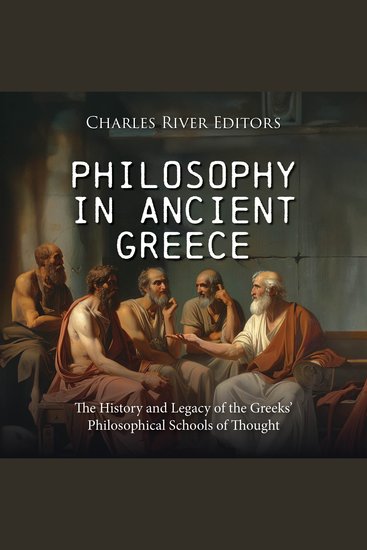
    In virtually all fields of human endeavor, ancient Greece was so much at the forefront of dynamism and innovation that the products of its most brilliant minds remain not only influential but entirely relevant to this day. In the field of medicine, the great physician Hippocrates not only advanced the practical knowledge of human anatomy and caregiving but changed the entire face of the medical profession. The great philosophers of Athens, men like Aristotle, Socrates, and Plato, interrogated themselves with startling complexity about the nature of good and evil, questioned the existence of divinity, advocated intelligent design, and went so far as to argue that all life was composed of infinitesimal particles.  
    	Although the school of philosophy started by Socrates and championed by Plato and Aristotle continues to be the most famous, other schools of thought began to branch, including the Epicureans and Cynics. In the 3rd century B.C., Stoicism arose in response to and under the influence of these older schools, combining many of the best theories from each into a more cohesive whole. With a greater flexibility and more practical application to everyday life, Stoicism quickly became a very popular school of thought, a growth made exponential by its introduction to the Romans.  
    Today, very few have heard of him, but he became a major philosophical and religious figure through the publication of his thoughts, travels, and miracles by Philostratus the Elder (c. 170-247 A.D.), written about a century after Apollonius of Tyana’s death. Philostratus the Elder’s works were based on the works of other writers (Maximus of Aegae, Damis, and Moeragenes), and miracles attributed to Apollonius were often compared to those of Jesus, who lived around the same time. 
    Ver libro
  • Introduction to Internal Family Systems - A Step-by-Step Guide to Mastering IFS Therapy - cover

    Introduction to Internal Family...

    Harper Susan Evergreen

    • 0
    • 0
    • 0
    Introduction to Internal Family Systems: A Step-by-Step Guide to Mastering IFS TherapyJourney into the captivating realm of the Internal Family Systems model with our audio guide, 'Introduction to Internal Family Systems.' This comprehensive exploration delves deep into a therapeutic method that promises personal growth, healing, and unparalleled self-awareness.Embark on a historic voyage, tracing the roots of IFS from its inception to its contemporary recognition in the world of therapy. Let our narrator guide you through the core concepts, painting vivid pictures of the Self, parts, burdens, and their delicate dance of interaction.Harness the power of practical IFS techniques, from immersive visualization exercises to illuminating dialogue methods, all crafted to enrich your understanding and pave your path to healing. Witness first-hand the far-reaching applications of IFS—stretching beyond therapy rooms, influencing arenas like business leadership, team dynamics, education, and personal growth.Be moved by real-world stories, as compelling case studies showcase the transformative might of IFS, juxtaposed with other therapeutic models, giving you a holistic grasp of its transformative potential.Whether you're a therapist, a student of psychology, or someone simply on a quest for self-discovery, let this audio guide be your compass. Tune in and unlock profound insights, embrace the vastness of the human psyche, and stride confidently towards a future of internal harmony and healing.Get your copy now, plug in those headphones, and embark on an auditory expedition that promises to reshape the way you perceive yourself and the world.
    Ver libro
  • One Nation Under the Influence - America's Drug Habit and How We Can Overcome It - cover

    One Nation Under the Influence -...

    Kevin A. Sabet

    • 0
    • 0
    • 0
    We are in the midst of the worst drug crisis in American history. What are we going to do about it?Around 100,000 Americans died of a drug overdose last year—nearly double the number who died in Vietnam. More than 1,000,000 have perished since 2000, thanks largely to an explosion of fentanyl and other addictive opioids. But fentanyl, abundant methamphetamine, and other lethal drugs are not the only things that are killing us: our policy is. So far, America has lacked the will to do better. That must change, and this book tells us how.No one is immune, which is why Kevin Sabet has authored this remarkable book. Sabet, dubbed the "the quarterback of the new anti-drug movement" by Salon, has spent most of his life battling the destructive effects of drugs. In One Nation Under the Influence, he asks hard questions and provides clear answers, taking listeners from the streets of San Francisco and New York to the southern border, up to Canada, and across to Europe to show how we can chart a necessary way forward. The solutions are out there, if only we have the will to apply them.
    Ver libro
  • A Rare Recording of President John F Kennedy’s Cuban Missile Crisis Speech - cover

    A Rare Recording of President...

    President John Fitzgerald Kennedy

    • 0
    • 0
    • 0
    On October 22, 1962, President John F. Kennedy gave a televised address informing the American public that the Soviet Union had installed missiles in Cuba. Kennedy announced a US naval blockade around the island to prevent further delivery of such weapons, essentially declaring that any missile launched from Cuba against the Western Hemisphere would be considered an attack by the Soviet Union, and would prompt a full US retaliatory response. Kennedy demanded the removal of the missiles from Cuba and warned of serious consequences if the Soviets did not comply.
    Ver libro
  • The Race to the Future - 8000 Miles to Paris – The Adventure that Accelerated the Twentieth Century - cover

    The Race to the Future - 8000...

    Kassia St. Clair

    • 0
    • 0
    • 0
    The racers battle over steep inclines, through narrow mountain passages, and across the arid Gobi Desert. Competitors endure torrential rain and choking dust. There are barely any roads, and petrol is almost impossible to find. 


    More than its many adventures, the Peking-to-Paris Motor Challenge took place on the precipice of a new world. As the twentieth century dawned, imperial regimes in China and Russia were crumbling, paving the way for the rise of communist ones. The electric telegraph was rapidly transforming modern communication, and with it, the news media, commerce, and politics. Suspended between the old and the new, the Peking-to-Paris, as bestselling historian Kassia St. Clair writes, became a critical tipping point. 


    A gripping, immersive narrative of the race, The Race to the Future sets the drivers' derring-do (and occasional cheating) against the backdrop of a larger geopolitical and technological race to the future. Interweaving events from the fall of the Qing dynasty to the departure of the horse economy and the rise of gendered marketing, St. Clair shows how the Peking-to-Paris provided an impetus for profound social, cultural, and industrial change, while masterfully capturing the mounting tensions between nations and empires—all building up to the cataclysmic event that changed everything: the First World War.
    Ver libro