¡Acompáñanos a viajar por el mundo de los libros!
Añadir este libro a la estantería
Grey
Escribe un nuevo comentario Default profile 50px
Grey
Suscríbete para leer el libro completo o lee las primeras páginas gratis.
All characters reduced
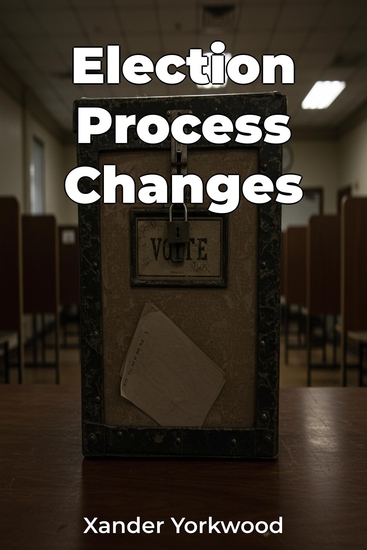
Election Process Changes - cover

Election Process Changes

Xander Yorkwood

Traductor A AI

Editorial: Publifye

  • 0
  • 0
  • 0

Sinopsis

Election Process Changes delves into the dynamic realm of European elections, scrutinizing recent modifications to electoral laws and technologies. It addresses a critical question: are these changes fortifying democratic integrity or inadvertently creating vulnerabilities? The book uniquely navigates this complex landscape by blending historical context with contemporary analysis, highlighting that while some adaptations enhance participation, others risk disenfranchisement. It examines the influence of international bodies like the Venice Commission, setting a stage for understanding how electoral frameworks are shaped.

 
The book progresses systematically, first identifying challenges like cybersecurity threats and disinformation campaigns. Then, through case studies, notably Romania's 2024 presidential election, it illustrates the practical impacts of contested reforms, drawing from court records and election monitoring reports. Did you know declining voter turnout is one of the most concerning elements that have been observed? Or that disinformation campaigns could potentially influence electoral outcomes?

 
Ultimately, Election Process Changes synthesizes these findings to offer recommendations for bolstering electoral integrity, making it an invaluable resource for anyone seeking to understand the future of European democracy.
Disponible desde: 17/02/2025.
Longitud de impresión: 74 páginas.

Otros libros que te pueden interesar

  • A Measure Short of War - A Brief History of Great Power Subversion - cover

    A Measure Short of War - A Brief...

    William C. Wohlforth, Jill Kastner

    • 0
    • 0
    • 0
    In 2016, the United States was stunned by evidence of Russian meddling in the US presidential elections. But it shouldn't have been. Subversion—domestic interference to undermine or manipulate a rival—is as old as statecraft itself. The basic idea would have been familiar to Sun Tzu, Thucydides, Elizabeth I, or Bismarck. 


    It came as a surprise in 2016 because the sole superpower had fallen asleep at the wheel. But what's really new? Have we entered a new age of vulnerability? To answer these questions, and to protect ourselves against future subversion, we need a clear-eyed understanding of what it is and how it works. 


    In A Measure Short of War, Jill Kastner and William C. Wohlforth provide just that, taking the listener on a compelling ride through the history of subversion, exploring two thousand years of mischief and manipulation to illustrate subversion's allure, its operational possibilities, and the means for fighting back against it. With vivid examples from the ancient world, the great-power rivalries of the nineteenth century, epic Cold War struggles, and more, A Measure Short of War shows how prior technological revolutions opened up new avenues for subversion, and how some democracies have been fatally weakened by foreign subverters while others have artfully defended themselves—and their democratic principles.
    Ver libro
  • Strategic Strikes - Mastering Your Communications in the Cage Match of Public Opinion - cover

    Strategic Strikes - Mastering...

    Patrick Riccards

    • 1
    • 0
    • 0
    Strategic Strikes is not for the faint-hearted communicator. Patrick Riccards offers a blunt, battle-tested guide to mastering communications when the stakes are high and the plan’s gone to hell.
    Ver libro
  • The Cost of Conviction - How Our Deepest Values Lead Us Astray - cover

    The Cost of Conviction - How Our...

    Steven Sloman

    • 0
    • 0
    • 0
    When you are faced with a decision, do you consider the best outcome, or do you consider your deepest values about which actions are appropriate? The Cost of Conviction contrasts these two primary strategies for making decisions: consequentialism, the former, or prioritizing one's sacred values, the latter. Steven Sloman argues that, while both modes of decision making are necessary tools for a good decision maker, people err by deploying sacred values more often than they should, especially when it comes to sociopolitical issues. In this book, Sloman provides a new understanding of today's societal ills and grounds that understanding in science. 


    The book begins by covering the philosophical and conceptual background of the two decision-making strategies, then takes a deep dive into the psychology of decision making. Drawing on historical and current examples of the use of the two strategies, the author provides a thorough overview of the psychology of decision making, including work on judgment, conscious and unconscious decision-making processes, the roles of emotion, and even an analysis of habit and addiction. 


    With its unique emphasis on sacred values, The Cost of Conviction is an eye-opening must-listen for all decision makers, especially those who wish to understand judgment, social decision making, and leadership.
    Ver libro
  • Demosthenes 354-324BCE - History's Greatest Orator - cover

    Demosthenes 354-324BCE -...

    Demosthenes, Dinarchus

    • 0
    • 0
    • 0
    Demosthenes is generally acknowledged as the greatest orator in history. He overcame a stammer and the theft of his inheritance by his legal guardians to become as foundational to oratory as his contemporaries Plato and Aristotle are to philosophy. 
    Much like a major contemporary political figure, he overcame a stammer on his journey to greatness, with “inarticulate and stammering pronunciation.” He was known as “a water drinker”; a stern and serious presence at all times. 
    His great battle was against the waning of Athenian democracy, which slowly disintegrated into oligarchy and treason over his lifetime. As a legislator, ambassador, and leader he fought against the inexorable rise of Philip of Macedon and, later, Philip’s son Alexander. Fighting for the peace, democracy and equality that Athenian ancestors brought to all Greece, his tale ends in ruin as Athens finally falls, after more than thirty years trying to hold the line. 
     In historical terms, many of the patterns, descriptions and arguments presented here will seem eerily familiar, like listening to Songs In The Key Of Life for the first time. Every part of it has been reused a thousand times by people ever since its creation, so you are intimately familiar with the style, even if you have never come across it before. 
    After a prestigious career of public service, the tide turned against him. An accusation of bribery leads to his most famous speech, On The Crown. This defense of his career as the tides turned against him has been described as “the greatest speech of the greatest orator in the world.” 
    After his conviction, he escaped from prison and went on the run. He was exiled,  brought back, then sentenced to death; eventually, fleeing the city again, this time to the island of Kalaureia (modern-day Poros). Discovered by Archias, he asked for time to write a letter to his family, and took poison from a reed.
    Ver libro
  • Spirit of the Laws The: Book Summary & Analysis - cover

    Spirit of the Laws The: Book...

    Briefly Summaries

    • 0
    • 0
    • 0
    This is a concise summary and analysis of The Spirit of the Laws, by Montesquieu.
     
    It is not the original book and is not affiliated with or endorsed by 
    Montesquieu.
     
    Ideal those seeking a quick and insightful overview.
     
    The Spirit of the Laws is a groundbreaking exploration of political theory, law, and governance. It examines the principles that shape governments, emphasizing the balance of power, the importance of justice, and the role of social and cultural factors in shaping legal systems. From dissecting the separation of powers to analyzing the influence of climate and geography on societies, this work remains a cornerstone of modern political thought and a vital resource for understanding the foundations of democracy and human rights.
    Ver libro
  • China - Fragile Superpower - cover

    China - Fragile Superpower

    Susan L. Shirk

    • 0
    • 0
    • 0
    Susan L. Shirk, a former Deputy Assistant Secretary of State responsible for China, knows many of today's Chinese rulers personally and has studied them for three decades. She offers invaluable insight into how they think—and what they fear. In this revealing book, you will see the world through the eyes of men like President Hu Jintao and former President Jiang Zemin. We discover a fragile communist regime desperate to survive in a society turned upside down by miraculous economic growth and a stunning new openness to the greater world. Theirs is a regime afraid of its own citizens, and this fear motivates many of their decisions when dealing with the US and other foreign nations. In particular, the fervent nationalism of the Chinese people, combined with their passionate resentment of Japan, and attachment to Taiwan, have made relations with these two regions a minefield. It is here, Shirk concludes, in the tangled interactions between Japan, Taiwan, China, and the United States, that the greatest danger lies. 


    Shirk argues that rising powers such as China tend to provoke wars in large part because other countries mishandle them. Unless we understand China's brittle internal politics and the fears that motivate its leaders, we face the very real possibility of avoidable conflict with China.
    Ver libro