¡Acompáñanos a viajar por el mundo de los libros!
Añadir este libro a la estantería
Grey
Escribe un nuevo comentario Default profile 50px
Grey
Suscríbete para leer el libro completo o lee las primeras páginas gratis.
All characters reduced
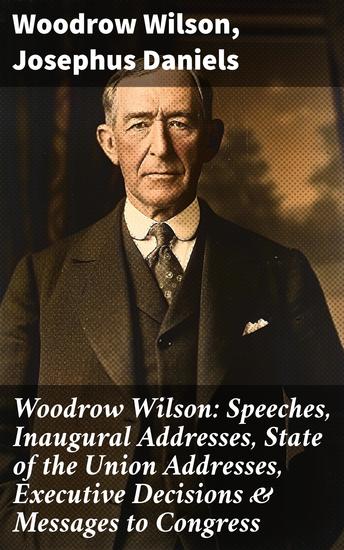
Woodrow Wilson: Speeches Inaugural Addresses State of the Union Addresses Executive Decisions & Messages to Congress - Shaping American Governance Through Oratory - cover

Woodrow Wilson: Speeches Inaugural Addresses State of the Union Addresses Executive Decisions & Messages to Congress - Shaping American Governance Through Oratory

Woodrow Wilson, Josephus Daniels

Editorial: Good Press

  • 0
  • 0
  • 0

Sinopsis

Woodrow Wilson: Speeches, Inaugural Addresses, State of the Union Addresses, Executive Decisions & Messages to Congress is a compelling collection that grants readers intimate insight into the leadership and ideology of America's 28th president. This anthology traverses a wide range of literary styles'Äîfrom impassioned oratory to the more formal tones of state addresses'Äîwhich collectively reflect the multifaceted dimensions of Wilson'Äôs political career and his profound influence on the modern presidency. The selection illuminates key legislative milestones and pivotal moments in American history, offering a fascinating overview of a transformative era. Each piece captures the nuanced interplay between rhetoric and policy, marking significant contributions to both national and global political landscapes. The presence of both Woodrow Wilson and influential figure Josephus Daniels underscores the collaborative grounds that shape this work. Respectively, they were pivotal voices during a period marked by both domestic and international transformation. Their contributions to the Progressive Movement and involvement in critical pre- and post-World War I policies are seminal to this collection. This anthology draws on their courage and strategic foresight, enriching readers'Äô understanding of the era and the simultaneous economic, social, and diplomatic challenges they addressed. This collection offers an invaluable resource for anyone seeking to delve into the complexities of early 20th-century American politics through the authoritative voices of its navigators. Readers are invited to explore a dynamic era, enriched by a tapestry of perspectives and insights that highlight a shared commitment to progress and reform. The dialogues fostered between Wilson'Äôs speeches and Daniels'Äô reflections present an educational journey that is both enlightening and intellectually stimulating, making this anthology a must-read for historians, students, and anyone invested in the intricate art of governance and international diplomacy.
Disponible desde: 18/11/2023.
Longitud de impresión: 345 páginas.
Otros libros que te pueden interesar

  • My Personal Holocaust - Triumphing over the Devastation of Trauma Based Mind Control - cover

    My Personal Holocaust -...

    Carolyn Sherrow

    • 0
    • 0
    • 0
    A Journey from Darkness to Light 
    Carolyn Sherrow’s early life was marred by the darkness of ritual abuse and mind control. Yet, through the power of God’s relentless love, she found the strength to rise above her past. 
    In My Personal Holocaust, Sherrow describes her profound journey of faith, healing, and redemption. 
    In this deeply personal account, she shares how a dissociative disorder once bound her in fear but 
    ultimately led her closer to God. With the support of compassionate counselors and divine guidance, 
    she embarked on a path of spiritual and emotional restoration. 
    Her powerful story reminds us that with God, no wound is too deep to heal. 
    • Witness God’s miraculous healing in the midst of unimaginable pain. 
    • Learn how yielding to God’s gentle guidance can lead to profound transformation. 
    • Discover the importance of faith, prayer, and perseverance in the journey to wholeness. 
    Join Sherrow on this transformative journey—her story may help you rewrite your own. CAROLYN SHERROW practiced medicine as a physician assistant for twenty-three years. She has been published in the Pentecostal Evangel magazine, Chicken Soup for the Soul, and Bethany House anthologies. 
    A lifelong Colorado resident, Sherrow enjoys her flower and vegetable gardens.
    Ver libro
  • Convoy Escort Commander - A Memoir of the Battle of the Atlantic - cover

    Convoy Escort Commander - A...

    Sir Peter Gretton

    • 0
    • 0
    • 0
    Vice Admiral Sir Peter Gretton's book is a brilliant account of his career in the navy through World War Two: fighting in the Second Battle of the Narvik and guarding convoys in the Mediterranean and the North Atlantic, before being placed in charge of Escort Group B7, which he described as "the finest job in the Navy for a new commander." It was in this role that Gretton, and the seven warships under his command, were able to make their contribution to turning the tide against the U-boat threat. 


    On April 22, 1943, Gretton was in charge of the escort for Convoy ONS 5 during its journey across the North Atlantic. Over the course of the voyage they were attacked by over fifty U-boats, and although they lost thirteen ships they managed to sink six U-boats and seriously damage many more. The U-boats had never faced such fierce resistance to their lethal raids. What tactics had Gretton used to fend off Doenitz's terrifying submarine wolf packs? And how had these strategies developed over the course of the war? 


    Convoy Escort Commander demonstrates how Allied commanders searched for new methods to repel U-boat assaults, including using direction-finding radio and radar, employing special tactical formations, coordinating with air cover, and endeavoring to keep the convoy together and prevent straggling.
    Ver libro
  • The Story of B24 - From their pens to your ears genius in every story - cover

    The Story of B24 - From their...

    Arthur Conan Doyle

    • 0
    • 0
    • 0
    Arthur Conan Doyle was born in Edinburgh, Scotland on 22nd May 1859.  His childhood was blighted by his father’s heavy drinking which for some years broke up the family. Fortunately, wealthy uncles were willing to support them by paying for education and clothing.  
    He was accepted at the University of Edinburgh to study medicine and also began to write short stories the first, ‘The Haunted Grange of Goresthorpe’, was published in Blackwood’s Magazine.  Despite several other stories and some articles in the British Medical Journal his medical studies took priority. 
    When these finished he was appointed as Doctor on the Greenland whaler ‘Hope of Peterhead’ in 1880 and then, after graduation, as ship’s surgeon on the SS Mayumba on its voyage to West Africa. 
    1882 saw a move to Plymouth and his own independent practice. With few patients he resumed writing and completed his first novel, ‘The Mystery of Cloomber’, although most of his output was short stories based on his experiences at sea.  
    He married Louisa Hawkins in 1885. However, two years later he met and fell in love with Jean Elizabeth Leckie, though they remained platonic out of respect for, and loyalty to, his wife. 
    His literary career suddenly burst into life in November 1886 with ‘A Study In Scarlet’, the first of the fabulously successful Sherlock Holmes stories.  
    With two children to support he now revisited his haphazard commercial arrangements and curtailed everything save for commissions from the Strand Magazine.  
    As a sportsman he was remarkably proficient. He was goalkeeper for Portsmouth Association Football Club and played ten first-class cricket matches for the Marylebone Cricket Club as well as captain of the Crowborough Beacon Golf Club in East Sussex.  
    In 1891 tired of writing Holmes stories, he began a series of historical novels and even went so far as to apparently kill off Holmes in a lethal brawl with his arch-nemesis Moriarty. 
    Despite heavy and sustained criticism he continued to write in support of the Boer War, a fact he thought contributed to his knighthood in 1902.  The following year to great relief and acclaim he brought Sherlock Holmes back from the dead in his first outing for a decade. 
    Sadly, his wife Louisa died from TB in 1906 and, a year later, he at last married Jean.  
    During the War and for several years after family deaths had left him depressed. In a search for solace and answers he alighted upon spiritualism and, such was his interest, that he wrote several books on the subject. 
    On 7th July 1930 Conan Doyle was discovered in the hall of Windlesham Manor, his house in East Sussex, clutching his chest dying of a heart attack.  He was 71.
    Ver libro
  • Something Worth Saving - A Memoir of Secrets Betrayals Resilience and Love - cover

    Something Worth Saving - A...

    Mary Means

    • 0
    • 0
    • 0
    “Powerful, vivid, often stunning, along with a warm, friendly, reflective tone.  Amazing.” - Reader, Virginia 
    “… your courage gave me permission to reflect more honestly on my own experience.” - Reader, Michigan                                                                   
    “I can’t express fully what this book means to me. Your words gave voice to experiences I’ve struggled to articulate, and your courage gave me permission to reflect more honestly on my own experience. An honest conversation with my mother was possible because of the truth you shared in yours.” - Reader, Maine 
    What does it take to overcome deeply embedded family traumas, career-ending betrayals, and failed relationships? What is the personal cost of keeping secrets—and staying in the closet? These are questions that Mary Means explores in her memoir, as she navigates growing up as a young closeted lesbian in Georgia during the 1960s and learning to 
    love—and be loved—as an adult. Through the deaths of loved ones, the fear of discovery, and the budding of a legacy that would come to change lives across the nation, Something Worth Saving tells a story of resilience and self-discovery perfect for anyone who has ever struggled to maintain a flawless facade when inside they were crumbling. 
    Mary Means is an award-winning leader, founder of the Main Street revitalization movement that has brought vitality back to countless town centers. Her candor and vulnerability permeate her remarkable story.
    Ver libro
  • Driving Lessons - A Road Trip through American Travel Literature - cover

    Driving Lessons - A Road Trip...

    Christopher B. Strain

    • 0
    • 0
    • 0
    In Driving Lessons, Christopher B. Strain sets out on a quintessential American road trip, exploring not just the roads and byways of the country but the road trip's place in American culture. Strain dives into the well of American travel writing, illuminating fascinating aspects of the road trip, such as how race, class, and gender shape the experiences of road trippers. 


    In the summer of 1998, amid a professional crisis of confidence, Strain settled on a plan to reconnect with both himself and the country he studies. He purchased a 1972 Volkswagen Westfalia van and set off on his own cross-country odyssey. In the weeks that followed, he ruminated on his own ongoing journey alongside great journeys from the past and how they reveal the heart of the traveler as well as the landscape of the nation. 


    Visiting archives and landmarks across the United States, Strain's journey became a parallel to the stories he studied—an opportunity to see and experience the cities, national parks, and monuments that define United States history. Driving Lessons is a compelling blend of literary analysis and memoir, offering listeners an insightful and heartfelt reflection on the enduring power of the American road trip.
    Ver libro
  • A Dialogue Among Clever People - From their pens to your ears genius in every story - cover

    A Dialogue Among Clever People -...

    Leo Tolstoy

    • 0
    • 0
    • 0
    Leo Tolstoy was born in 1828 in the Russian province of Tula to a wealthy noble family. As a child, he had private tutors but he showed little interest in any formal education. When he went to the University of Kazan in 1843 to study oriental languages and law, he left without completing his courses.  Life now was relaxed and idle but with some writing also taking place.  Gambling debts forced an abrupt change of path and he joined the army to fight in the Crimean War.  He was commended for his bravery and promoted but was appalled at the brutality and loss of life.  He recorded these and other earlier experiences in his diaries which formed the basis of several of his works. 
    In 1852 ‘Childhood’ was published to immediate success and was followed by ‘Boyhood’ and ‘Youth’. 
    His experience in the army and the horrors he witnessed resulted in ‘The Cossacks’ in 1862 and the trilogy ‘Sevastopol Tales’. After the war he travelled around Europe, visiting London and Paris and meeting such luminaries as Victor Hugo and Charles Darwin.  
    It was now that Tolstoy began his masterpiece, ‘War and Peace’. Published in 1869 it was an epic work that changed literature. He quickly followed this with ‘Anna Karenina’.  
    These successes made Tolstoy rich and helped him accomplish many of his dreams but also brought problems as he grappled with his faith and the lot of the oppressed poor. These revolutionary views became so popular that the authorities now kept him under surveillance.  
    He led a life of asceticism and vegetarianism and put his socialist ideals into practice by establishing numerous schools for the poor and food programmes. He also believed in giving away his wealth, which caused much discord with his wife.  
    His writing continued to bring forth classics such as ‘The Death of Ivan Ilyich’ and many brilliant and incisive short stories such as ‘How Much Land Does A Man Need’.  
    In 1901 Tolstoy was excommunicated from the Church and controversially deselected for the Nobel Prize for Literature. 
    Whilst undertaking a pilgrimage by train in October 1910 with his daughter Aleksandra he caught pneumonia in the nearby town of Astapovo.  Leo Tolstoy died on November 9th, 1910, he was 82.
    Ver libro