¡Acompáñanos a viajar por el mundo de los libros!
Añadir este libro a la estantería
Grey
Escribe un nuevo comentario Default profile 50px
Grey
Suscríbete para leer el libro completo o lee las primeras páginas gratis.
All characters reduced
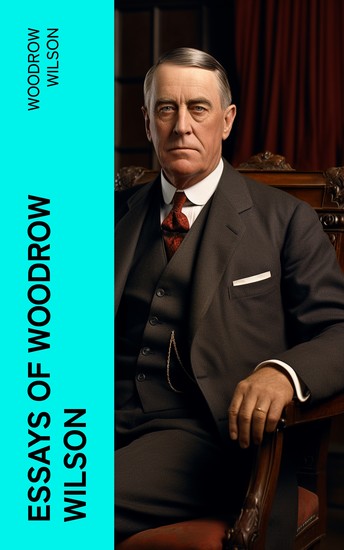
Essays of Woodrow Wilson - The New Freedom When A Man Comes To Himself The Study of Administration Leaders of Men The New Democracy - cover

Essays of Woodrow Wilson - The New Freedom When A Man Comes To Himself The Study of Administration Leaders of Men The New Democracy

Woodrow Wilson

Editorial: e-artnow

  • 0
  • 0
  • 0

Sinopsis

Woodrow Wilson, a disciple of Walter Bagehot, considered the United States Constitution to be cumbersome and open to corruption. He favored a parliamentary system for the United States and in the early 1880s wrote, "I ask you to put this question to yourselves, should we not draw the Executive and Legislature closer together? Should we not, on the one hand, give the individual leaders of opinion in Congress a better chance to have an intimate party in determining who should be president, and the president, on the other hand, a better chance to approve himself a statesman, and his advisers capable men of affairs, in the guidance of Congress." Essays presented in this book shed light to Wilsons's political thought and works.  Contents:  The New Freedom When A Man Comes To Himself The Study of Administration Leaders of Men The New Democracy
Disponible desde: 15/12/2023.
Longitud de impresión: 210 páginas.

Otros libros que te pueden interesar

  • Brainwashing - Forcibly Changing Someone's Beliefs or Attitudes - cover

    Brainwashing - Forcibly Changing...

    Cito Harder

    • 0
    • 0
    • 0
    Brainwashing is a process that manipulates an individual’s thoughts, beliefs, and perceptions, often without their conscious awareness. It is rooted in psychological principles that exploit the way the human mind processes information, reacts to stress, and seeks social belonging. By systematically breaking down existing thought patterns and replacing them with new ones, brainwashing can reshape an individual’s identity, morality, and loyalty. Understanding the psychology behind this phenomenon reveals why it is so effective and why some people are more susceptible than others. 
    At its core, brainwashing relies on cognitive dissonance, a psychological state that occurs when a person holds conflicting beliefs or values. When subjected to persistent pressure, individuals experience discomfort and seek to resolve the inconsistency. This vulnerability makes them more likely to accept new ideas, especially if rejecting them would lead to further psychological distress. Manipulators use this to their advantage, gradually shifting a person’s perception by presenting them with controlled information while isolating them from opposing viewpoints. Over time, the person internalizes the new ideology, often without realizing they have been influenced. 
    Another key psychological mechanism in brainwashing is the use of repetition. The more frequently an idea is presented, the more familiar and acceptable it becomes. Studies in cognitive psychology suggest that repeated exposure to a particular message strengthens neural pathways, making certain thoughts or beliefs more automatic. This is why propaganda, advertising, and even extremist ideologies rely heavily on repetition—constant reinforcement solidifies the desired mindset. The brain, overwhelmed by a lack of alternative perspectives, begins to default to the new beliefs as truth.
    Ver libro
  • The Lion and the Fox - Two Rival Spies and the Secret Plot to Build a Confederate Navy - cover

    The Lion and the Fox - Two Rival...

    Alexander Rose

    • 0
    • 0
    • 0
    From the New York Times bestselling author of Washington’s Spies, the thrilling story of the Confederate spy who came to Britain to turn the tide of the Civil War—and the Union agent resolved to stop him. 
     
    In 1861, soon after the outbreak of the Civil War, two secret agents—one a Confederate, the other his Union rival—were dispatched to neutral Britain, each entrusted with a vital mission. 
    The South’s James Bulloch, charming and devious, was to acquire a cutting-edge clandestine fleet intended to break President Lincoln’s blockade of Confederate ports, sink Northern merchant vessels, and drown the U.S. Navy’s mightiest ships at sea. The profits from gunrunning and smuggling cotton—Dixie’s notorious “white gold”—would finance the scheme. Opposing him was Thomas Dudley, a resolute Quaker lawyer and abolitionist. He was determined to stop Bulloch by any means necessary in a spy-versus-spy game of move and countermove, gambit and sacrifice, intrigue and betrayal. If Dudley failed, Britain would ally with the South and imperil a Northern victory. The battleground was the Dickensian port of Liverpool, whose dockyards built more ships each year than the rest of the world combined, whose warehouses stored more cotton than anywhere else on earth, and whose merchant princes, said one observer, were “addicted to Southern proclivities, foreign slave trade, and domestic bribery.” 
    From master of historical espionage Alexander Rose, The Lion and the Fox is the astonishing, untold tale of two implacable foes and their twilight struggle for the highest stakes.  
    Supplemental enhancement PDF accompanies the audiobook.
    Ver libro
  • The Art of War - A New Translation - cover

    The Art of War - A New Translation

    Sun Tzu, Filibooks

    • 0
    • 0
    • 0
    The Art of War dates to the fifth century B.C and is arguably the most famous military treatise ever written. 
    Throughout its history, The Art of War has been highly influential. Figures as diverse as Japanese daimyō Takeda Shingen, Chinese communist Mao Tse-Tung, and Finnish field marshal Carl Gustaf Emil Mannerheim have cited the book as inspirational. 
    During the Vietnam War the book served as an inspiration and guide for the Vietcong, which brought the book to the attention of the American military. 
    The focus of this reworking is to preserve the original intent of Sun Tzu as closely as possible.
    Ver libro
  • Sedition - How America's Constitutional Order Emerged from Violent Crisis - cover

    Sedition - How America's...

    Marcus Alexander Gadson

    • 0
    • 0
    • 0
    Since protestors ripped through the Capitol Building in 2021, the threat of constitutional crisis has loomed over our nation. The foundational tenets of American democracy seem to be endangered, and many citizens believe this danger is unprecedented in our history. But Americans have weathered many constitutional crises, often accompanied by the same violence and chaos experienced on January 6. However, these crises occurred on the state level. In Sedition, Marcus Alexander Gadson uncovers these episodes of civil unrest and examines how state governments handled them. 


    Sedition takes listeners through six instances of constitutional crisis: The Buckshot War, Dorr's Rebellion, Bleeding Kansas, the Brooks-Baxter War, a successful terrorist campaign to overthrow South Carolina's government during Reconstruction, and the Wilmington Insurrection of 1898. He chronicles these turbulent periods of violent anti-government conflict on the state level, explaining what it was like to experience coup d'états, rival governments fighting in the streets, and disputed elections that gave way to violence. As he addresses constitutional breakdown, Gadson urges Americans to pay increased attention to the risk of constitutional instability in their home states. His sweeping historical analysis provides new insights on the fight to protect democracy today.
    Ver libro
  • A Real Right to Vote - How a Constitutional Amendment Can Safeguard American Democracy - cover

    A Real Right to Vote - How a...

    Richard L. Hasen

    • 0
    • 0
    • 0
    Throughout history, too many Americans have been disenfranchised or faced needless barriers to vote. Part of the blame falls on the Constitution, which does not contain an affirmative right to vote. The Supreme Court has made matters worse by failing to protect voting rights and limiting Congress's ability to do so. The time has come for voters to take action and push for an amendment to the Constitution that would guarantee this right for all. 


    Drawing on troubling stories of state attempts to disenfranchise military voters, women, African Americans, students, former felons, Native Americans, and others, Richard Hasen argues that American democracy can and should do better in assuring that all eligible voters can cast a meaningful vote that will be fairly counted. He shows how a constitutional right to vote can deescalate voting wars between political parties that lead to endless rounds of litigation and undermine voter confidence in elections, and can safeguard democracy against dangerous attempts at election subversion. 


    The path to a constitutional amendment is undoubtedly hard, especially in these polarized times. A Real Right to Vote explains what's in it for conservatives who have resisted voting reform, and reveals how the pursuit of an amendment can yield tangible dividends for democracy long before ratification.
    Ver libro
  • The Collapse of Global Liberalism - And the Emergence of the Post Liberal World Order - cover

    The Collapse of Global...

    Philip Pilkington

    • 0
    • 0
    • 0
    In the 1990s, a vision emerged of a frictionless world of globalization in which the West would become ever richer on the basis of a tech-based service economy, all underpinned by a rules-based liberal international order. It became the basis for the mainstream politics of center-left and right. 
     
    Philip Pilkington argues that this vision was always delusional and is now dying. It is based on a doctrinaire and unrealistic form of liberalism and has given rise to hollowed-out financialized economies and disintegrating societies that can barely even reproduce their population or meet their energy needs. The US and UK find themselves ill-equipped to compete with China and other non-liberal states within an emerging post-liberal order in which what really matters is industrial capacity, realpolitik, and military strength. Only by abandoning our liberal delusions and advancing our own brand of hard-headed post-liberalism can the West survive. 
     
    No clearsighted observer of contemporary geopolitics can afford to miss this bracing diagnosis of the West's malaise and bold agenda for renewal.
    Ver libro