Join us on a literary world trip!
Add this book to bookshelf
Grey
Write a new comment Default profile 50px
Grey
Subscribe to read the full book or read the first pages for free!
All characters reduced
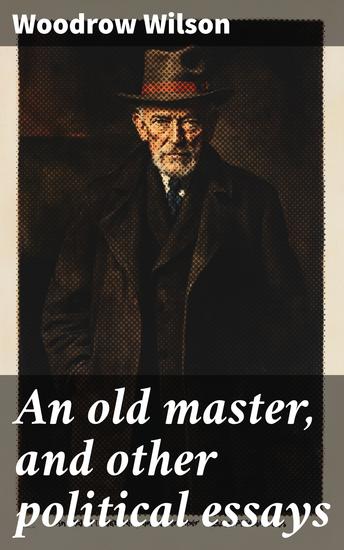
An old master and other political essays - cover

An old master and other political essays

Woodrow Wilson

Publisher: Good Press

  • 0
  • 0
  • 0

Summary

In "An Old Master, and Other Political Essays," Woodrow Wilson offers a compelling exploration of political theory and governance, reflecting on the complexities of democracy, leadership, and the societal role of individuals. Written in a clear yet eloquent style, these essays are imbued with Wilson's rich understanding of the political landscape during the early 20th century, a period marked by transformation and tumult. His examination not only addresses immediate political concerns but also delves into philosophical underpinnings, making this work a significant contribution to the genre of political essays in an era defined by both progressivism and traditionalism. Woodrow Wilson, the 28th President of the United States, was a scholar and politician greatly influenced by his academic background in political science. His presidency and the tumultuous global events of his time, including World War I, shaped his perspective and provided a fertile ground for his editorial reflections on governance. His blend of idealism and realism reflects his vision of a more equitable world order, which resonates throughout these essays. Readers seeking a nuanced understanding of early 20th-century political thought will find Wilson's essays both insightful and illuminating. Through an analysis of his ideas, one can appreciate their relevance as they echo in contemporary political discourse, making this book an essential read for scholars and enthusiasts of political philosophy alike.
Available since: 03/02/2025.
Print length: 140 pages.

Other books that might interest you

  • The Monroe Doctrine - cover

    The Monroe Doctrine

    Various

    • 0
    • 0
    • 0
    This program is read by an AI-based synthesized voice.
    Show book
  • The Wagner Group - Yevgeny Prigozhin's Mercenaries and Their Ties to Vladimir Putin - cover

    The Wagner Group - Yevgeny...

    Owen Wilson

    • 0
    • 0
    • 0
    Few military organisations have had a greater importance than the Wagner Group: at a cursory glance no more than a disreputable private mercenary group dedicated to committing war crimes yet also, astonishingly, the challengers of the Kremlin on 23-24 June, 2023-unheard of in over two decades of Vladimir Putin's rule. From its inception in 2014 this nebulous organisation operating from Russia was intentionally cloaked in questions. How was it able to operate alongside Russia's top government officials? How could it deploy the logistical systems of the Russian army up to and including ordering air attacks with fighter planes of the Russian Federation, despite the deep antipathy of Russia's powerful defence minister Sergei Shoigu? Why did the Kremlin provide such an ample helping hand to its leader, Yevgeny Prigozhin, for over a decade? In this compelling book, former Financial Times journalist Owen Wilson investigates the Wagner Group and their ties to Vladimir Putin. It skilfully sets out its history and the dramatic death of Yevgeny Prigozhin to cast a searching light on the person who ultimately stands behind the group.
    Show book
  • Setting Sights: Histories and Reflections on Community Armed Self-Defense - cover

    Setting Sights: Histories and...

    scott crow

    • 0
    • 0
    • 0
    Decades ago, Malcolm X eloquently stated that communities have the legitimate right to defend themselves “by any means necessary” with any tool or tactic, including guns. This wide-ranging anthology uncovers the hidden histories and ideas of community armed self-defense, exploring how it has been used by marginalized and oppressed communities as well as anarchists and radicals within significant social movements of the twentieth and twenty-first centuries. 
    Far from a call to arms, or a “how-to” manual for warfare, this volume offers histories, reflections, and questions about the role of firearms in small collective defense efforts and its place in larger efforts toward the creation of autonomy and liberation. 
    Featuring diverse perspectives from movements across the globe, Setting Sights includes vivid histories and personal reflections from both researchers and those who participated in community armed self-defense. Contributors include Dennis Banks, Kathleen Cleaver, Mable Williams, Subcomandante Marcos, Kristian Williams, George Ciccariello-Maher, Ashanti Alston, and many more.
    Show book
  • The Economic Consequences of the Peace - cover

    The Economic Consequences of the...

    John Maynard Keynes

    • 0
    • 0
    • 0
    "The Economic Consequences of the Peace" is a book written by John Maynard Keynes, a British economist, in 1919. The book was a critique of the Treaty of Versailles, which ended World War I and imposed harsh economic sanctions on Germany. 
    In the book, Keynes argued that the treaty would have disastrous economic consequences for Germany and for Europe as a whole. He believed that the sanctions would cripple Germany's economy and lead to political instability, which would in turn lead to further economic problems for the rest of Europe. 
    Keynes also criticized the economic policies of the Allied powers, particularly the United States, which he believed were contributing to a global economic depression. He argued that a more cooperative approach to international economics was needed, with countries working together to promote economic growth and stability. 
    "The Economic Consequences of the Peace" was a highly influential book that helped shape the field of international economics and influenced the development of Keynesian economics. The book's critique of the Treaty of Versailles was widely shared and helped to pave the way for a more conciliatory approach to Germany in the years that followed.
    Show book
  • The Russian FSB - A Concise History of the Federal Security Service - cover

    The Russian FSB - A Concise...

    Kevin P. Riehle

    • 0
    • 0
    • 0
    Since its founding in 1995, the FSB, Russia's Federal Security Service, has regained the majority of the domestic security functions of the Soviet-era KGB. Under Vladimir Putin, who served as FSB director just before becoming president, the agency has grown to be one of the most powerful and favored organizations in Russia. The FSB not only conducts internal security but also has primacy in intelligence operations in former Soviet states. Their activities include anti-dissident operations at home and abroad, counterintelligence, counterterrorism, criminal investigations of crimes against the state, and guarding Russia's borders. 


    In The Russian FSB, Kevin P. Riehle provides a brief history of the FSB's origins, placed within the context of Russian history, the government's power structure, and Russia's wider culture. He describes how the FSB's mindset and priorities show continuities from the tsarist regimes and the Soviet era. The book's chapters analyze origins, organizational structure, missions, leaders, international partners, and cultural representations such as the FSB in film and television. 


    Based on both English and Russian sources, this book is a well-researched introduction to understanding the FSB and its central role in Putin's Russia.
    Show book
  • Russia 2070 (Population): The Death of An Old Empire - cover

    Russia 2070 (Population): The...

    Andrew Kirby

    • 0
    • 0
    • 0
    Dive into the most comprehensive projection of Russia’s population and ethnic landscape by the year 2070. This meticulous analysis goes far beyond national totals, providing granular, region-by-region estimates for every Oblast, Okrug, and Autonomous Region. 
    Using a rigorous methodology that cross-references historic Census data, detailed Ethnologue sources, and current demographic trends, this report paints a striking portrait of the potential collapse and transformation of an old empire. Discover which regions face the most catastrophic population decline and how internal and external migration flows are set to reshape the ethnic map of the Russian Federation. 
    This is more than just a list of numbers. It’s a stark, data-driven look at the forces eroding Russian society. While based strictly on established demographic trends, the underlying context of this population crisis, including Russia's persistent Tier 3 ranking on the U.S. Department of State's human trafficking list—underscores the complex challenges threatening the nation’s stability. 
    Understand the future of Russia's people, one region at a time. The death of an empire starts with its population.
    Show book