Junte-se a nós em uma viagem ao mundo dos livros!
Adicionar este livro à prateleira
Grey
Deixe um novo comentário Default profile 50px
Grey
Assine para ler o livro completo ou leia as primeiras páginas de graça!
All characters reduced
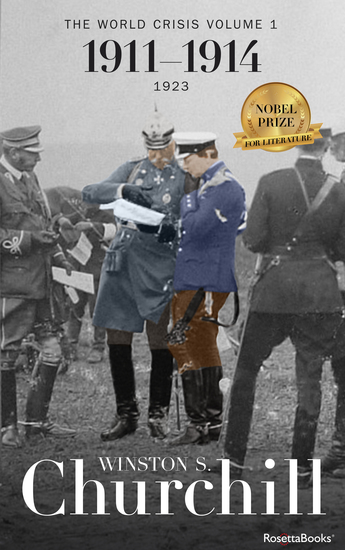
The World Crisis: 1911–1914 - cover
LER

The World Crisis: 1911–1914

Winston S. Churchill

Editora: RosettaBooks

  • 0
  • 1
  • 0

Sinopse

The causes of the Great War are examined in this first volume of the series that is “essential reading, as fresh and compelling as ever” (Jon Meacham, bestselling author of Franklin and Winston).   An absorbing history of the outbreak of World War I from a true insider’s point of view, the first volume of Winston S. Churchill’s five-volume The World Crisis is unsurpassed as both a historical and personal account of the earth-shaking events leading up to WWI. Beginning in 1911, when Churchill was First Lord of the Admiralty, this report is based on thousands of his personal letters and memos.   Churchill’s epic series opens with a chilling description of the Agadir Crisis, and provides an in-depth account of naval clashes in the Dardanelles, one of Churchill’s major military failures. It takes readers from the fierce bloodshed of the Gallipoli campaign to the tide-turning battles of Jutland and Verdun—as well as the United States’ entry into the combat theatre. Written in powerful prose by a great leader who would also go on to receive a Nobel Prize in Literature, The World Crisis, 1911–1914 provides a perspective you won’t find anywhere else: a dynamic insider’s account of events that would shape the outcome of modern history.   “Whether as a statesman or an author, Churchill was a giant; and The World Crisis towers over most other books about the Great War.” —David Fromkin, author of A Peace to End All Peace
Disponível desde: 23/09/2013.
Comprimento de impressão: 589 páginas.

Outros livros que poderiam interessá-lo

  • The Thirty Years War - cover

    The Thirty Years War

    Friedrich Schiller

    • 0
    • 0
    • 0
    In "The Thirty Years War," Friedrich Schiller intricately chronicles one of Europe's most tumultuous and transformative conflicts. Spanning the early 17th century, this detailed narrative weaves political intrigue, religious strife, and the relentless pursuit of power. Schiller brings to life the era's major figures and battles, revealing the war's profound impact on shaping modern Europe. With a blend of historical detail and literary elegance, he illuminates the deep complexities of this pivotal period.
    Ver livro
  • Raided by the Roman Soldiers (Gay Rough BDSM Erotica) - cover

    Raided by the Roman Soldiers...

    Archer Vale

    • 0
    • 0
    • 0
    I have a secret—something that’s consuming my life. 
    Strength…it’s what matters most in the military. If you’re skinny and weak like me, then you need allies. You need to prove your worth. 
    You go into the woods with more powerful men. 
    You open your mouth and thank them while they use you. 
    Then you go back to camp and cook their food. You make their beds. You fall to your knees and beg to do it all again tomorrow. 
    That’s how life is for boys like us. We’re born to be controlled. 
    It’s natural. 
    --- 
    CONTAINS EXPLICIT GAY SEXUAL CONTENT. 
    For exclusive stories, visit www.ArcherVale.com.
    Ver livro
  • Forty Years of Psychic Research - cover

    Forty Years of Psychic Research

    Hamlin Garland

    • 0
    • 0
    • 0
    Forty Years of Psychic Research by Hamlin Garland offers a comprehensive exploration of the fascinating realm of psychic phenomena spanning four decades. Garland meticulously examines various aspects of psychic research, delving into topics such as telepathy, clairvoyance, and mediumship, drawing upon both historical accounts and contemporary studies. Through a blend of empirical evidence and insightful analysis, Garland presents a nuanced portrait of the enigmatic world of psychic phenomena, shedding light on its implications for our understanding of consciousness and the nature of reality.
    Ver livro
  • Longing to Know - The Philosophy of Knowledge for Ordinary People - cover

    Longing to Know - The Philosophy...

    Esther Lightcap Meek

    • 0
    • 0
    • 0
    We don't often think about the act of knowing, but if we do, the question of what we know and how we know it becomes murky indeed. Longing to Know is a book about knowing: knowing how we know things, knowing how we know people, and knowing how we know God. 
    This book is for those who are considering Christianity for the first time, as well as Christians who are struggling with issues related to truth, certainty, and doubt. As such, it is a wonderful resource for evangelists, pastors, and counselors. This unique look at the questions of knowing is both entertaining and approachable. Questions for reflection make it ideal for students of philosophy and all those wrestling with the questions of knowledge.
    Ver livro
  • Salamis and Actium: The History of the Ancient World’s Most Famous Naval Battles - cover

    Salamis and Actium: The History...

    Editors Charles River

    • 0
    • 0
    • 0
    When the Spartans’ famous and sacrificial stand at the Battle of Thermopylae ended during the Second Persian War, the Athenian fleet was forced to fall back, and Xerxes’ massive Persian army marched unopposed into Greece before advancing on Athens. The Greek armies were scattered and unable to face the might of Persia, so Athens was forced to do the unthinkable: evacuate the entire population of the city to Salamis, from where the Athenians watched in horror as Xerxes’ troops plundered the defenseless city, set it aflame, and razed the Acropolis. 
    However, the Athenians remained belligerent, in part because according to the oracle at Delphi, “only the wooden wall shall save you.” Indeed, this would prove true when Themistocles managed to lure the Persian fleet into the straits of Salamis. There, on a warm day in September 480 BCE, hundreds of Greek and Persian ships faced each other in a narrow strait between the Attic peninsula of Greece and the island of Salamis. The battle that ensued would prove to be epic on a number of different levels, as it set a precedent for how later naval battles were fought in the ancient Mediterranean, turned the tide in the Greeks’ favor against the Persians in the Persian Wars, and ultimately played a role in Athens’ rise to a preeminent role in the Hellenic world. 
    As one of Rome’s most famous battles, the Battle of Actium has taken on a life of its own in popular memory. One of the longest-held myths about the battle is that Cleopatra, sensing defeat, began to sail away from the fight in the middle of the day, and the love struck Antony followed her with his own ship, abandoning his men in the middle of the fight. While that popular myth would be in keeping with explaining Cleopatra’s irresistible charm and magnetism, contemporary accounts of the battle do not suggest it was the case.
    Ver livro
  • Fighting in World War I: The History and Legacy of Warfare during the Great War - cover

    Fighting in World War I: The...

    Editors Charles River

    • 0
    • 0
    • 0
    World War I, also known in its time as the “Great War” or the “War to End all Wars”, was an unprecedented holocaust in terms of its sheer scale. Fought by men who hailed from all corners of the globe, it saw millions of soldiers do battle in brutal assaults of attrition which dragged on for months with little to no respite. Tens of millions of artillery shells and untold hundreds of millions of rifle and machine gun bullets were fired in a conflict that demonstrated man’s capacity to kill each other on a heretofore unprecedented scale, and as always, such a war brought about technological innovation at a rate that made the boom of the Industrial Revolution seem stagnant.  
    By 1918, all the great powers were fielding squadrons of fighting aircraft armed with machine-guns and bombs, to say nothing of light reconnaissance planes. Tanks, a common feature on the battlefield by 1918, had not previously existed outside of the realm of science fiction stories written by authors like H.G. Wells. Machine guns had gone from being heavy, cumbersome pieces with elaborate water-cooling systems to single-man-portable, magazine-fed affairs like the Chauchat, the Lewis Gun and the M1918 BAR.  
    These technological developments led to an imbalance. Before the introduction of the man-portable light machine gun (which took place in the second half of the war), not to mention tanks (which also joined the fight late in the game), defensive firepower vastly outweighed offensive capability. Massed batteries of artillery, emplaced heavy machine guns, barbed wire entanglements, and bewildering fortifications meant that ground could not be taken except at incredible cost.  
    Fighting in World War I analyzes the technological advancements in weaponry that produced the deadliest conflict in history up to that time, and the adjusting tactics that the combatants came up with on land, at sea, and in the air. 
    Ver livro