Join us on a literary world trip!
Add this book to bookshelf
Grey
Write a new comment Default profile 50px
Grey
Subscribe to read the full book or read the first pages for free!
All characters reduced
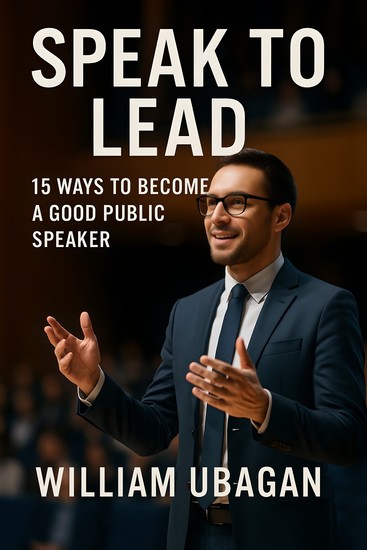
Speak to Lead - 15 Ways to Become a Powerful Public Speaker - cover

Speak to Lead - 15 Ways to Become a Powerful Public Speaker

William Ubagan

Publisher: ZRK Book Shop

  • 0
  • 0
  • 0

Summary

Public speaking is no longer optional—it's essential. Whether you're pitching an idea, leading a team, teaching a class, or inspiring a crowd, your ability to communicate with clarity and confidence can define your success.
 
In Speak to Lead, author and communication coach William Ubagan offers a powerful and practical guide to mastering the art of public speaking—not just to impress, but to influence. Through 15 essential strategies, this book walks you through everything you need to become a powerful speaker: from knowing your audience and organizing your message, to commanding the stage, managing nervousness, and adapting in real-time when things don’t go as planned.
 
This isn’t a textbook filled with theory—it’s a toolkit for real people with real goals. Whether you're a beginner terrified of speaking in public or an experienced communicator looking to sharpen your skills, you’ll find actionable advice, relatable stories, and transformative tips you can apply immediately.
 
You’ll learn how to:
 
Craft messages that resonate
 
Deliver with confidence and clarity
 
Engage and inspire any audience
 
Handle nerves and disruptions with grace
 
Lead through the power of your voice
 
If you’re ready to turn fear into focus, silence into strength, and hesitation into influence—this book is for you.
 
Speak to be heard. Speak to connect. Speak to lead.
Available since: 06/12/2025.
Print length: 183 pages.

Other books that might interest you

  • The Individualization of War - Rights Liability and Accountability in Contemporary Armed Conflict - cover

    The Individualization of War -...

    Dapo Akande, Jennifer Welsh,...

    • 0
    • 0
    • 0
    The rights and responsibilities of the individual are at the center of today's armed conflicts in a way that they have never been before. This process of "individualization," which challenges the primacy of the sovereign state, is driven by normative developments related to human rights that have elevated human-centric conceptions of security and created a new class of international crimes, as well as by technological and strategic developments that can both empower individuals as military actors and enable either the targeting or protection of particular individuals. 


    The Individualization of War examines the status of individuals in contemporary armed conflict in three main capacities: as subject to violence but deserving of protection; as liable to harm because of their responsibility for attacks on others; and as agents who can be held accountable for the perpetration of crimes. This book presents a novel conceptualization of the phenomenon of individualization, including how it is both practiced and contested. It then convenes a set of leading thinkers from the fields of moral philosophy, international law, and international relations to further our understanding of not only how individualization is manifest in armed conflict—in theory and in practice—but also how it generates tensions and challenges for today's scholars and practitioners.
    Show book
  • Elevate Your Inner Strength - Transform your mindset for outstanding results - cover

    Elevate Your Inner Strength -...

    Fenwick Dryden

    • 0
    • 0
    • 0
    Elevate Your Inner Strength: A Simplified Guide to Unleashing Your Potential and Transforming Your Mindset 
    Are you eager to advance your career and reinforce your knowledge? 
    Do you need a comprehensive guide that encompasses everything essential to unleash your potential? 
    Your quest ends here! 
    This guide is your ultimate companion for enhancing understanding, applying your abilities, and engaging in practical exercises. With this resource, you're on the path to success. 
    Updated for the latest exam structure. 
    Our guide stands out for its comprehensive coverage, crucial for achieving your goals. Concepts are examined in detail, ensuring a thorough mastery rather than a superficial overview. 
    Designed with clarity and straightforward language, our guide ensures seamless transitions between topics. Say goodbye to complicated jargon and hello to clear, precise, and technically sound content. 
    So, why wait? Click the BUY NOW button, secure your guide, and embark on your journey to success!
    Show book
  • Technology Turned Us Into Zombies - cover

    Technology Turned Us Into Zombies

    Raphael Terra

    • 0
    • 0
    • 0
    This audiobook has been recorded using Text to speech (TTS). 
     
    Generations blame each other for the state of the world. Kids eat a daily course of mobile phone apps and social media burgers. News is reduced to fake edible sound bites. Television and movie stars are modern day photoshopped gods. Illusion and delusion are all around us. Marketing magic created to control and manipulate the stupid masses. 
     
    Reality TV stars are elected and glorified to greater heights as charity and care workers are forgotten. Zombies walk the streets desperate to find a Wi-Fi hotspot and an awesome place to take a selfie. Kids today need to find safe havens from social media attacks where their grandparents needed to find bunkers to save them from bombs. Hard times no longer means poverty and starvation, it means not having the latest fashion, mobile phone, game console and followers. An older generation wonder what all these new gender designations mean and how anybody can be fluid. They wonder why these youngsters don't want to work for a living and despair should we ever have another world war. 
     
    Today the last generation look upon the so-called Millennials and wonder where they went wrong. In this book, we are going to find out that we are all Millennials and how to change.
    Show book
  • Playing through Pain - The Violent Consequences of Capitalist Sport - cover

    Playing through Pain - The...

    Daniel Sailofsky

    • 0
    • 0
    • 0
    For many fans and casual observers, professional sports and violence are deeply connected. Violence on the field has real consequences for players, notably in the form of life-altering injuries from concussions. Off the field, in the last several decades, scores of athletes have committed violent acts, from domestic abuse and sexual assault to animal abuse and murder. Beyond athletes, sport also serves as a site of political and structural violence, from the displacement and hyperpolicing of everyday people for mega-events to the "sportswashing" of environmentally harmful industries. 


    Daniel Sailofsky examines the endemic violence in professional sports and argues that—while related to masculinity, misogyny, and individual factors like alcohol consumption and gambling—it is most intimately tied to capitalism and to capitalist modes of consumption and profit. Sailofsky explains how capitalism creates the conditions for violence to thrive and uncovers how sports leaders—coaches, league officials, and team owners—obfuscate these relationships to avoid accountability. 


    From minor league baseball exploitation to spectator hooliganism, Sailofsky shows the connections between the business of sports and violence, but also, more importantly, he imagines new forms of sport that are not places of harm.
    Show book
  • Milton Friedman on Economics - Selected Papers - cover

    Milton Friedman on Economics -...

    Milton Friedman, Gary S. Becker

    • 0
    • 0
    • 0
    On his death in the autumn of 2006, Milton Friedman was lauded as "the grandmaster of free-market economic theory in the postwar era" by the New York Times and "the most influential economist of the second half of the 20th century" by the Economist. Winner of the Nobel Prize in Economics in 1976, Friedman was both a highly respected economist and a prominent public intellectual, the leader of a revolution in economic and political thought that argued robustly in favor of virtues of free markets and laissez-faire policies. 


    Milton Friedman on Economics: Selected Papers collects a variety of Friedman's papers on topics in economics that were originally published in the Journal of Political Economy. Opening with Friedman's 1977 Nobel Lecture, the volume spans nearly the whole of his career, incorporating papers from as early as 1948 and as late as 1990. An excellent introduction to Friedman's economic thought, Milton Friedman will be essential for anyone tracing the course of twentieth-century economics and politics.
    Show book
  • Byzantium and Constantinople: The History of the Ancient Greek City that Became the Byzantine Empire’s Capital - cover

    Byzantium and Constantinople:...

    Editors Charles River

    • 0
    • 0
    • 0
    Due to the importance of the Roman Empire and the offshoot Byzantine Empire, it’s often forgotten that Constantinople wasn’t chosen at random; in fact, the city already existed, and it lent its name to the empire that was subsequently centered there. Byzantium, known originally as Byzantion, was an ancient Greek city centuries before it became known as Constantinople, and the etymology of Byzantion/Byzantium is still unknown. It has been suggested that Byzantion is of Thracian origin and may be derived from the Thracian personal name Byzas, which means “he-goat.” Ancient Greek legend refers to King Byzas as the leader of the Megaran colonists and the founder of the city, but the earliest name for a city on the site is “Lygos,” which likely corresponds to an earlier Thracian settlement described by Pliny the Elder in his seminal work, Natural History: “On leaving the Dardanelles we come to the Bay of Casthenes, ...and the promontory of the Golden Horn, on which is the town of Byzantium, a free state, formerly called Lygos; it is 711 miles from Durazzo.” 
    Pliny went on to explain that Lygos was a Thracian settlement founded between the 13th and 11th centuries BCE. The site, however, was probably abandoned well before Megara founded Byzantion around 657 BCE across from Chalcedon on the Asiatic side of the Bosphorus. The city was briefly renamed Augusta Antonina in the early 3rd century CE by the Emperor Septimius Severus, who razed the city to the ground in 196 CE for supporting a rival contender in the civil war and had it rebuilt in honor of his son and successor, Marcus Aurelius Antoninus, known as Caracalla. This new name appears to have been quickly forgotten and abandoned, with the city reverting to Byzantium after the assassination of Caracalla in 217 CE, and that’s how it would be known when Constantine fatefully moved the seat of power there over a century later.
    Show book