¡Acompáñanos a viajar por el mundo de los libros!
Añadir este libro a la estantería
Grey
Escribe un nuevo comentario Default profile 50px
Grey
Suscríbete para leer el libro completo o lee las primeras páginas gratis.
All characters reduced
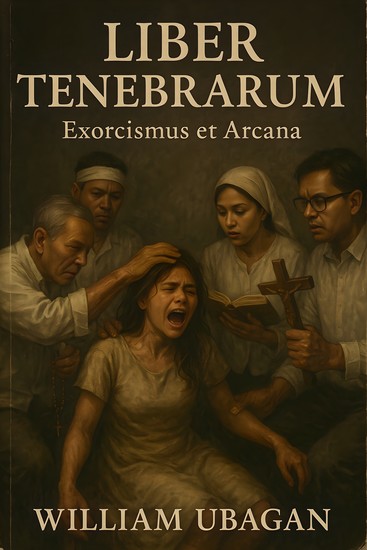
Liber Tenebrarum - Exorcismus et Arcana - cover

Liber Tenebrarum - Exorcismus et Arcana

William Ubagan

Editorial: ZRK Book Shop

  • 0
  • 0
  • 0

Sinopsis

Liber Tenebrarum: Exorcismus et Arcana is a harrowing esoteric novel rooted in real-life accounts of demonic possession, spiritual warfare, and the hidden world of ancient orations. Set in the mysterious and rural village of San Jose in the Philippines, this 15-chapter saga follows the haunting journey of Ramon, Nora, Aguilus, Marco, Lara, Marta, and Julio—ordinary souls thrust into an extraordinary battle against the forces of darkness.
 
Blending the realism of biblical narrative with actual exorcism rites in Latin and ancient tongues, this book plunges the reader into rituals long buried in secrecy. Every chapter unfolds with sacred incantations, spiritual confrontation, and revelations about the unseen war that rages around us.
 
Through faith, fear, and fire, Liber Tenebrarum dares to ask: when the darkness comes, who will stand between man and the abyss?
Disponible desde: 08/08/2025.
Longitud de impresión: 83 páginas.


Otros libros que te pueden interesar

  • The Chinese Great Leap Forward Famine - A Social and Political Catastrophe - cover

    The Chinese Great Leap Forward...

    Sarah Willards

    • 0
    • 0
    • 0
    The origins of the Great Leap Forward are deeply rooted in the political ambition and ideological vision of Mao Zedong, the founding leader of the People’s Republic of China. Following the success of the Communist revolution in 1949, Mao sought not only to rebuild a war-torn nation but to rapidly transform it into a socialist utopia capable of rivaling the industrial powers of the West. By the mid-1950s, China had already launched its First Five-Year Plan, modeled after the Soviet approach to centralized economic planning. Encouraged by early gains in heavy industry, Mao envisioned a second phase of development that would leap over traditional stages of economic growth. 
    At the heart of this vision was a push for mass mobilization. Mao believed that the sheer size of China's population could be harnessed as a revolutionary force capable of achieving miraculous feats. The Great Leap Forward, initiated in 1958, was designed to propel China into a modern communist society by emphasizing agricultural collectivization and rural industrialization simultaneously. Rather than relying on expert knowledge or slow-paced industrial planning, Mao favored decentralized enthusiasm and ideological commitment, trusting that the collective will of the people would overcome any technical limitations. 
    One of the most radical elements of this plan was the establishment of people’s communes, which replaced the traditional family unit and private farming with large-scale collective labor. Households were merged into communes comprising thousands of individuals, who would eat, sleep, and work under strict communal arrangements. The idea was to increase efficiency and free up labor for industrial production, especially in rural areas where backyard furnaces were set up to produce steel. This was accompanied by an aggressive campaign to eliminate what were seen as capitalist tendencies, including private plots and individual incentives.
    Ver libro
  • Arborist Review - Master Arboriculture with Ease: Comprehensive Audio Guide for Aspiring Arborists Seeking Certification and Practical Knowledge in Tree Care - cover

    Arborist Review - Master...

    Silas Thornfield

    • 0
    • 0
    • 0
    ⭐⭐ Simplified Guide & Explanations Included⭐⭐ 
    Are you aiming to excel in your career and expand your knowledge to successfully pass the Arborist Certification Exam 2024-2025? 
    Looking for a complete guide that equips you with everything needed to ace the Arborist Certification Exam 2024-2025? 
    Your search ends here! 
    This guide is your ultimate companion, helping you deepen your understanding, hone your skills, and engage in practical exercises. With this, you're set up for success. 
    Updated for the Arborist Certification Exam 2024-2025 Structure. 
    Key features of this enriched guide: 
    - Profound insights about the Arborist Certification Exam 2024-2025 
    - Detailed explanation of Arborist Certification 
    - Effective strategies for exam preparation and tackling 
    - Practice tests with answer keys in every section 
    Our guide stands out with comprehensive coverage, which is vital for your exam success. Concepts are not merely skimmed over; they are explored in depth. 
    Please note that this guide is not affiliated with any official arborist entity and serves as an independent resource for your benefit. 
    Designed with a clear structure and easy-to-understand language, our Arborist Certification Exam Guide 2024-2025 ensures smooth transitions between topics. Say goodbye to dense jargon and welcome clear, precise, and technically accurate content. 
    So, why wait? Click the BUY NOW button, secure your guide, and begin your journey to Arborist Certification Exam 2024-2025 success!
    Ver libro
  • Cactus Country - A Boyhood Memoir - cover

    Cactus Country - A Boyhood Memoir

    Zoë Bossiere

    • 0
    • 0
    • 0
    A STRIKING MEMOIR OF GENDERFLUIDITY, CLASS, AND THE AMERICAN SOUTHWEST 
     
    Newly arrived in the Sonoran Desert, eleven-year-old Zoë enters a world of giant beetles, thundering javelinas, and gnarled palo verde trees. In Cactus Country RV Park, Zoë has been given a fresh start and a new, shorter haircut. Although Zoë doesn’t have the words to express it, he experiences life as a trans boy—and here, others begin to see him as a boy, too. Zoë spends hot days chasing shade and freight trains with an ever-rotating pack of sunburned desert kids, and nights fending off his own questions about the body underneath his baggy clothes. 
     
    As Zoë enters adolescence, he must reckon with the sexism, racism, substance abuse, and violence endemic to the working-class men he’s grown close to, whose hard masculinity seems as embedded in the desert landscape as the cacti sprouting from parched earth. In response, Zoë adopts an androgynous style and new pronouns, but still cannot escape what it means to live in a gendered body, particularly when a fraught first love destabilizes their sense of self. But beauty flowers in this desert, too. Zoë persists in searching for answers, dreaming of a day they might leave the park behind to embrace whatever awaits beyond. 
     
    Equal parts harsh and tender, Cactus Country is a precisely rendered journey of self-determination that will resonate with anyone who’s ever had to fight to be themself. 
     
    “Cactus Country shimmers with the complexity of becoming. Zoë Bossiere writes their way into a truer story of selfhood, resisting the simpler narratives the world demanded. The result is lush, beautiful, and deeply liberating.”—Alex Marzano Lesnevich, author of The Fact of a Body
    Ver libro
  • Healthy Mental State Coaching sessions & meditations Self-help toolkit Stop overthinking - beat the negativity break the unhealthy pattern maintain balance Positive mindset happy lifestyle - cover

    Healthy Mental State Coaching...

    ThinkAndBloom

    • 0
    • 0
    • 0
    We all know that when you are in a bad mental state, you completely lose control in all areas of your life. Your physical health, emotions, and daily activities are affected. You cannot function as who you want to be. 
    It is important to take care of yourself to get your life in balance. This is an empowering state rather than you give your power away to things people circumstances. Learning the tools like meditations and following coaching sessions help you not to drill yourself down the road of negative thinking. 
    A healthy mental state is not simply the absence of mental health problems but is the ability to stay in positivity. When you are in a healthy mental lifestyle, you can let go of the stresses, anxieties, and worries of the day. You know how to manage your anger which we normally have during our day-to-day life. You can eliminate toxic thoughts and replace them with positive ones. You focus on your NOW rather than the past and the future. 
    In this course, we will Manage your angerRelease stress & anxietiesMaintain a peaceful stateIncrease mindfulness & awarenessFocus on the present momentAffirm your self-value and esteemBalance your mental bodyEmpower yourselfLet go of toxic throughPromote positive thinkingAnd much more 
    When you have tools to balance yourself quickly, you are the master of your life. You can cope with any challenges or situations and bounce back to balance quickly. You are able to realize your potential more than an average person can do. This has far more beneficial effects than any attribute in life.
    Ver libro
  • Orwell's Ghosts - Wisdom and Warnings for the Twenty-First Century - cover

    Orwell's Ghosts - Wisdom and...

    Laura Beers

    • 0
    • 0
    • 0
    For the seventy-fifth anniversary of 1984, Laura Beers explores George Orwell's still-radical ideas and why they are critical today. 


    George Orwell devoted his career to exposing social injustice and political duplicity, urging his readers to face hard truths about Western society and politics. Now, the uncanny parallels between the interwar era and our own—rising inequality, censorship, and challenges to traditional social hierarchies—make his writing even more of the moment. In Orwell's Ghosts, historian Laura Beers considers Orwell's full body of work—his six novels, three nonfiction works, as well as his brilliant essays—to examine what "Orwellian" means and to take it out of the hands of political pundits. She explores how Orwell's writing on free speech addresses the proliferation of "fake news," highlights his vivid critiques of capitalism, and, in contrast, analyzes his failure to understand feminism. Timely, wide-ranging, and thought-provoking, Orwell's Ghosts investigates how the writings of a lionized champion of truth and freedom can help us face the crises of modernity.
    Ver libro
  • France in World War II: The History of Nazi Germany’s Conquest of France and Its Liberation By the Allies - cover

    France in World War II: The...

    Editors Charles River

    • 0
    • 0
    • 0
    One of the most famous people in the world came to tour the city of Paris for the first time on June 28, 1940. Over the next three hours, he rode through the city’s streets, stopping to tour L’Opéra Paris. He rode down the Champs-Élysées toward the Trocadero and the Eiffel Tower, where he had his picture taken. After passing through the Arc de Triomphe, he toured the Pantheon and old medieval churches, though he did not manage to see the Louvre or the Palace of Justice. Heading back to the airport, he told his staff, “It was the dream of my life to be permitted to see Paris. I cannot say how happy I am to have that dream fulfilled today.” Four years after his tour, Adolf Hitler would order the city’s garrison commander, General Dietrich von Choltitz, to destroy Paris, warning his subordinate that the city "must not fall into the enemy's hand except lying in complete debris." 
    Of course, Paris was not destroyed before the Allies liberated it, but it would take more than 4 years for them to wrest control of France from Nazi Germany after they took the country by storm in about a month in 1940. That said, it’s widely overlooked today given how history played out that as the power of Nazi Germany grew alarmingly during the 1930s, the French sought means to defend their territory against the rising menace of the Thousand-Year Reich. As architects of the most punitive measures in the Treaty of Versailles following World War I, France was a natural target for Teutonic retribution, so the Maginot Line, a series of interconnected strongpoints and fortifications running along much of France's eastern border, helped allay French fears of invasion. 
    After the fall of France, the Vichy Regime maintained a quasi-independent French nation for some time after the Third Reich invasion until the Germans decided to include it in their occupation zone.
    Ver libro