Junte-se a nós em uma viagem ao mundo dos livros!
Adicionar este livro à prateleira
Grey
Deixe um novo comentário Default profile 50px
Grey
Assine para ler o livro completo ou leia as primeiras páginas de graça!
All characters reduced
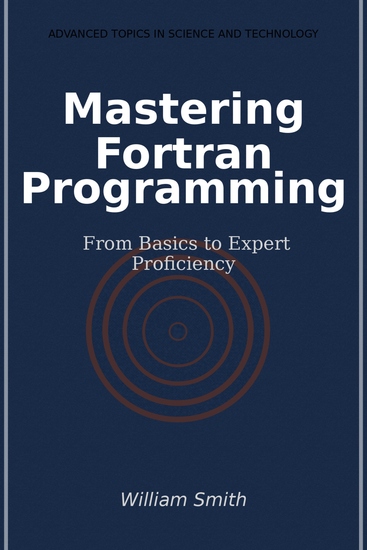
Mastering Fortran Programming - From Basics to Expert Proficiency - cover
LER

Mastering Fortran Programming - From Basics to Expert Proficiency

William Smith

Editora: HiTeX Press

  • 0
  • 0
  • 0

Sinopse

"Mastering Fortran Programming: From Basics to Expert Proficiency" is a comprehensive guide designed to equip readers with the knowledge and skills required to effectively use Fortran, one of the most enduring programming languages in scientific and numerical computing. This book meticulously covers everything from the fundamental principles and basic syntax to advanced topics like memory management, optimization, and modular programming. Each chapter is structured to progressively build the reader’s understanding, ensuring a solid grasp of both the theoretical and practical aspects of Fortran.
 
Whether you are a beginner looking to learn the essentials or an experienced programmer aiming to deepen your mastery of Fortran, this book offers invaluable insights and detailed explanations. With a focus on clarity, best practices, and real-world applications, "Mastering Fortran Programming" is an indispensable resource for anyone aspiring to excel in the field of scientific programming. Through this book, readers will gain the confidence and proficiency needed to develop, optimize, and maintain high-performance Fortran programs, ensuring sustained success in their computational endeavors.
Disponível desde: 28/07/2024.
Comprimento de impressão: 253 páginas.

Outros livros que poderiam interessá-lo

  • How to Make AI Useful - Moving Beyond the Hype to Real Progress in Business Society and Life - cover

    How to Make AI Useful - Moving...

    Anônimo

    • 0
    • 0
    • 0
    We’ve heard it all before: AI will upend industries, kill jobs and remake everything from healthcare to art. But between the hype and the hand-wringing lies a simpler, more pressing question: Is AI actually useful? And if so, useful for what, and for whom? 
    In How to Make AI Useful, MIT researcher Dr Bryan Reimer and Swedish futurologist Magnus Lindkvist cut through the noise. Blending decades of research, trendspotting and hands-on experience, they chart AI’s journey from dazzling gimmick to disruptive force—and now to indispensable tool. 
    This isn’t another book about robot overlords or utopian tech dreams. Instead, it’s a rough guide to AI’s messy middle—the phase where machines meet human complexity. From automating the tedious to amplifying creativity, Reimer and Lindkvist show how to harness AI’s potential for real progress, long after today’s bubble bursts.
    Ver livro
  • Threshold - How Smart Homes Change Us Inside and Out - cover

    Threshold - How Smart Homes...

    Heather Suzanne Woods

    • 0
    • 0
    • 0
    Smart homes are here—domestic spaces bristling with networked technologies that appear to enhance work, entertainment, logistics, health, and security. But these technologies may also extract a cost in attention, money, and privacy. In Threshold, communication and technology expert Heather Suzanne Woods applies rhetorical theory to answer the urgent question of how swiftly proliferating smart homes alter those who inhabit them. 


    Building on research into smart homes in the United States, Woods recounts how smart homes arose and predicts the trajectory of their future form. She pulls back the curtain on the technology, probes who is in control, and questions whether a home can be too smart. 


    Woods suggests a dynamic cultural framework for understanding smart homes that takes into account sociotechnical variables through which smart homes shape human life. Woods's framework reveals how smart homes both reflect social norms about technology as well as whet consumer appetites. 


    Written for homeowners, policymakers, technology enthusiasts, and scholars, Threshold interweaves critical analysis with matter-of-fact graphics that map relationships between digital tools and social life.
    Ver livro
  • The Phantom Cosmos - Decoding the Dark Energy That Expands the Universe - cover

    The Phantom Cosmos - Decoding...

    Dirk Fallon

    • 0
    • 0
    • 0
    The universe is a vast expanse filled with enigmas that have intrigued scientists and philosophers for millennia. In the wake of the Big Bang, the cosmos burst into existence, unleashing a torrent of energy and matter that set the stage for the formation of everything we know today. From the very first moments, the universe exhibited a complexity that would eventually lead to the emergence of galaxies, stars, and planets. Yet, amid this wondrous creation, a peculiar and subtle force began to assert its influence—one that would later be identified as dark energy. This mysterious component, largely invisible and poorly understood, is now believed to be responsible for the accelerating expansion of the universe, challenging our conventional understanding of gravity and the evolution of cosmic structures. 
    In the early epochs of the universe, conditions were extremely volatile and unpredictable. Subatomic particles collided with tremendous energy, and the nascent fabric of space-time was in constant flux. As the universe cooled and matter began to coalesce, forces that governed particle interactions and the formation of atoms started to take hold. It was during this formative period that the seeds of cosmic structure were planted, and the universe embarked on a long, gradual journey towards complexity. However, it was also during this time that the presence of dark energy, although not yet recognized, began to subtly influence the behavior of the cosmos. This influence was initially hidden in the chaotic interplay of energy and matter but would later emerge as one of the most critical factors in cosmic evolution.
    Ver livro
  • Exobiology - Life Beyond Earth - cover

    Exobiology - Life Beyond Earth

    Mike Crawford

    • 0
    • 0
    • 0
    The origins of life on Earth remain one of the most profound scientific mysteries. While no definitive answer exists, several compelling theories attempt to explain how life first emerged from non-living matter. Understanding these origins is crucial to the study of exobiology, as it provides insight into how life might arise elsewhere in the universe. 
    One widely accepted hypothesis is abiogenesis, which suggests that life arose from simple organic compounds through natural chemical processes. The famous Miller-Urey experiment in 1953 demonstrated that amino acids, the building blocks of life, could form under conditions similar to those of early Earth. These experiments, combined with discoveries of organic molecules in space, suggest that life’s precursors may have been abundant in the early solar system. 
    The conditions on early Earth were vastly different from today. Around 4 billion years ago, the planet was a harsh, volcanic world with a thick atmosphere composed of methane, ammonia, hydrogen, and water vapor. Lightning, ultraviolet radiation, and hydrothermal vents may have provided the necessary energy to drive complex chemical reactions, leading to the formation of self-replicating molecules like RNA. The RNA world hypothesis proposes that RNA, due to its ability to both store genetic information and catalyze chemical reactions, was a key player in the transition from simple molecules to living cells.
    Ver livro
  • UX Writing Essentials - A Simple Guide for All - cover

    UX Writing Essentials - A Simple...

    Atila Velo

    • 0
    • 0
    • 0
    A comprehensive guide to UX Writing that bridges foundational concepts with advanced insights, suitable for all backgrounds. This audiobook covers microcopy, brand voice, user journeys, research, and the evolving roles of ContentOps and AI. Designed for clarity and depth, it equips readers to navigate challenges, avoid pitfalls, and elevate digital communication across diverse contexts.
    Ver livro
  • The Universal Timekeepers - Reconstructing History Atom by Atom - cover

    The Universal Timekeepers -...

    David J. Helfand

    • 0
    • 0
    • 0
    Atoms are unfathomably tiny. It takes fifteen million trillion of them to make up a single poppy seed—give or take a few billion. And there's hardly anything to them: atoms are more than 99.9999999999 percent empty space. Yet scientists have learned to count these slivers of near nothingness with precision and to peer into their internal states. In looking so closely, we have learned that atoms, because of their inimitable signatures and imperturbable internal clocks, are little archives holding the secrets of the past. 


    David J. Helfand reconstructs the history of the universe—back to its first microsecond 13.8 billion years ago—with the help of atoms. He shows how, by using detectors and reactors, microscopes and telescopes, we can decode the tales these infinitesimal particles tell, answering questions such as: Is a medieval illustrated prayer book real or forged? How did maize cultivation spread from the highlands of central Mexico to New England? What was Earth's climate like before humans emerged? Where can we find clues to identify the culprit in the demise of the dinosaurs? When did our planet and solar system form? Can we trace the births of atoms in the cores of massive stars or even glimpse the origins of the universe itself?
    Ver livro