Join us on a literary world trip!
Add this book to bookshelf
Grey
Write a new comment Default profile 50px
Grey
Subscribe to read the full book or read the first pages for free!
All characters reduced
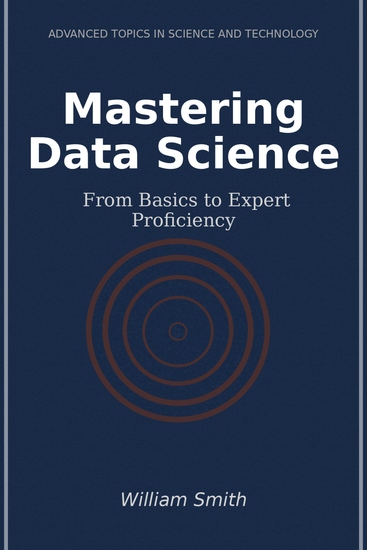
Mastering Data Science - From Basics to Expert Proficiency - cover

Mastering Data Science - From Basics to Expert Proficiency

William Smith

Publisher: HiTeX Press

  • 0
  • 0
  • 0

Summary

"Mastering Data Science: From Basics to Expert Proficiency" is an authoritative guide designed to provide a comprehensive understanding of data science, from its foundational principles to advanced techniques. This meticulously structured book covers essential topics such as data collection and preprocessing, exploratory data analysis, data visualization, and statistical foundations. It also delves deeply into machine learning, natural language processing, and time series analysis, ensuring that readers are well-equipped to handle diverse data challenges.What sets this book apart is its attention to detail and clarity, making complex concepts accessible to beginners while providing valuable insights for experienced practitioners. Each chapter is thoughtfully organized to build on previous knowledge, fostering a natural progression in learning. With practical examples and detailed explanations of modern tools and technologies, "Mastering Data Science" serves as an invaluable resource for anyone aspiring to excel in the dynamic and rapidly evolving field of data science.
Available since: 08/13/2024.
Print length: 373 pages.
Other books that might interest you

  • Mining - A Very Short Introduction - cover

    Mining - A Very Short Introduction

    Hannah S.R. Hughes, Karen A....

    • 0
    • 0
    • 0
    'If it can't be grown, it must be mined.' This fundamental truth underscores the global need for mining, and the reason why it has been carried out since prehistoric times. To supply the raw materials for buildings, industrial goods, vehicles, technology, and even art, minerals and rock must be removed from the Earth. 'Mining' describes this removal, but also covers the ore deposit exploration, developments of ore deposit models (geological, engineering and mineral economics-focused) and post-removal processing to extract the economically valuable materials, environmental protection, and social and corporate responsibility, in a construct known as the 'Mining Value Chain.' Mining continues to evolve due to the new emphasis on extracting a wider range of materials than ever before for green technologies, on using novel robotic and earth observation technology in exploration and mining, and on integrating environmental and social protection measures throughout the Mining Value Chain. Today's paradigms are 'sustainable' and 'responsible mining', mining that is profitable but protects the environment, human rights, and health. Mining: A Very Short Introduction covers this information and looks to the future to see where mining ideally will go.
    Show book
  • The Witch's Garden - Plants in Folklore Magic and Traditional Medicine - cover

    The Witch's Garden - Plants in...

    Sandra Lawrence

    • 0
    • 0
    • 0
    The Witch's Garden describes over fifty of the world's most powerful, harmful, legendary, and storied plants—from the screaming mandrake to calming St John's Wort, to predicting the weather with seaweed, the creation of salves for broken hearts, sore heads, protection from evil spirits, and to even induce immortality. 
     
    Wise women, apothecaries, witches, herbalists: whatever you like to call them, those who cultivate plants for their apparent mystical properties have existed for thousands of years. The Witch's Garden tells the story of our folkloric fascination with these magical specimens, documenting the beliefs and rituals surrounding the natural world. This book beautifully evokes the bewitching nature of mysterious plants.
    Show book
  • Slippery Beast - A True Crime Natural History with Eels - cover

    Slippery Beast - A True Crime...

    Ellen Ruppel Shell

    • 0
    • 0
    • 0
    What is it about eels? Depending on who you ask, they are a pest, a fascination, a threat, a pot of gold. Eels emerged some 200 million years ago, weathered mass extinctions and continental shifts, and were once among the world's most abundant freshwater fish. But since the 1970s, their numbers have plummeted. Because eels—as unagi—are another thing: delicious. 


    In Slippery Beast, journalist Ellen Ruppel Shell travels in the world of "eel people," pursuing a fascination with this mysterious creature. Despite centuries of study by thinkers from Aristotle to Leeuwenhoek to Sigmund Freud, much about eels remains unknown. Eels cannot be bred reliably in captivity and infant eels are unbelievably valuable. A pound of the tiny, translucent, bug-eyed "elvers" caught in the fresh waters of Maine can command $3,000 or more on the black market. Illegal trade in eels is an international scandal measured in billions of dollars every year. In Maine, federal investigators have risked their lives to bust poaching rings. 


    Ruppel Shell follows the elusive eel from Maine to the Sargasso Sea, stalking riversides, fishing holes, laboratories, restaurants, courtrooms, and America's first commercial eel "family farm." This is an enthralling, globe-spanning look at an animal that you may never come to love, but which will never fail to astonish you.
    Show book
  • Literary Theory for Robots - How Computers Learned to Write - cover

    Literary Theory for Robots - How...

    Dennis Yi Tenen

    • 0
    • 0
    • 0
    Literary Theory for Robots reveals the hidden history of modern machine intelligence, taking listeners on a spellbinding journey from medieval Arabic philosophy to visions of a universal language, past Hollywood fiction factories, and missile defense systems trained on Russian folktales. In this provocative reflection on the shared pasts of literature and computer science, former Microsoft engineer and professor of comparative literature Dennis Yi Tenen provides crucial context for recent developments in AI, which holds important lessons for the future of humans living with smart technology. 


    Intelligence expressed through technology should not be mistaken for a magical genie, capable of self-directed thought or action. Rather, in highly original and effervescent prose with a generous dose of wit, Yi Tenen asks us to read past the artifice—to better perceive the mechanics of collaborative work. Something as simple as a spell-checker or a grammar-correction tool, embedded in every word-processor, represents the culmination of a shared human effort, spanning centuries. 


    With its masterful blend of history, technology, and philosophy, Yi Tenen's work ultimately urges us to view AI as a matter of labor history, celebrating the long-standing cooperation between authors and engineers.
    Show book
  • The Decline and Fall of the Human Empire - Why Our Species Is on the Edge of Extinction - cover

    The Decline and Fall of the...

    Henry Gee

    • 0
    • 0
    • 0
    "Henry Gee presents a pithy, fascinating account of the stages of biological evolution. ... a meditative and friendly listening experience. —AudioFile on A (Very) Short History of Life on EarthWritten and read by the award-winning author of A (Very) Short History of Life on Earth: a history of humanity on the brink of decline.A Next Big Idea Club Must-Read SelectionWe are living through a period that is unique in human history. For the first time in more than ten thousand years, the rate of human population growth is slowing down. In the middle of this century population growth will stop, and the number of people on Earth will start to decline—fast. In this provocative book, award-winning science writer Henry Gee offers a concise, brilliantly-told history of our species—and argues that we are on a rapid, one-way trip to extinction. The Decline and Fall of the Human Empire narrates the dramatic rise of humanity, how a scattered range of small groups across several continents eventually inbred, interacted, fought, established stable communities and food supplies, and began the process of dominating the planet. The human story is relatively brief—the oldest fossils of H. Sapiens date to approximately 300,000 years ago—yet the spread of our species has been unstoppable…until recently. As Gee demonstrates, our population has peaked, and is declining; our environment is becoming inimical to human life in many locations; our core resources of water, arable land, and air are diminishing; and new diseases, simmering conflicts, and ambiguous technologies threaten our collective health. Can we still change our course? Or is our own extinction inevitable?There could be a way out, but the launch window is narrow.Unless Homo sapiens establishes successful colonies in space within the next two centuries, our species is likely to stay earthbound and will have vanished entirely within another ten thousand years, bringing the seven-million-year story of the human lineage to an end.With assured narration, dramatic stories, and his signature sprightly humor, Henry Gee envisions new opportunities for the future of humanity—a future that will reward facing challenges with ingenuity, foresight, and cooperation.A Macmillan Audio production from St. Martin’s Press.
    Show book
  • Design of Everyday Things The: Book Summary & Analysis - cover

    Design of Everyday Things The:...

    Briefly Summaries

    • 0
    • 0
    • 0
    This is a concise summary and analysis of The Design of Everyday Things, by Don Norman.
     
    It is not the original book and is not affiliated with or endorsed by Don Norman.
     
    Ideal those seeking a quick and insightful overview.
     
    The Design of Everyday Things explores the principles behind effective design, emphasizing the importance of user-friendly products and environments. It highlights how good design enhances usability and how poor design can create frustration. Through practical examples, the book shows how thoughtful design can improve the interaction between people and objects, making everyday life more intuitive and enjoyable.
    Show book