¡Acompáñanos a viajar por el mundo de los libros!
Añadir este libro a la estantería
Grey
Escribe un nuevo comentario Default profile 50px
Grey
Suscríbete para leer el libro completo o lee las primeras páginas gratis.
All characters reduced
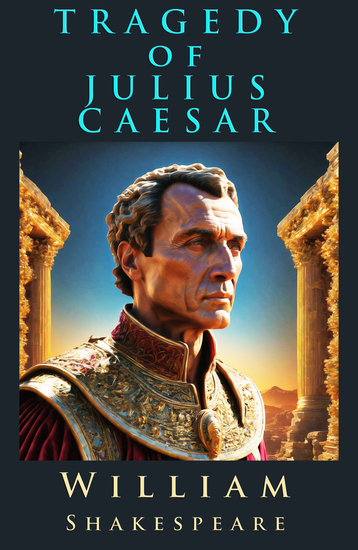
Tragedy of Julius Caesar - cover

Tragedy of Julius Caesar

William Shakespeare

Editorial: E-Kitap Projesi & Cheapest Books

  • 0
  • 0
  • 0

Sinopsis

The Tragedy of Julius Caesar is a tragedy by William Shakespeare, believed to have been written in 1599. It portrays the 44 BC conspiracy against the Roman dictator Julius Caesar, his assassination and the defeat of the conspirators at the Battle of Philippi. It is one of several plays written by Shakespeare based on true events from Roman history, which also include Coriolanus and Antony and Cleopatra.

Although the title is Julius Caesar, Julius Caesar is not the most visible character in its action; he appears in only five scenes. Marcus Brutus speaks more than four times as many lines, and the central psychological drama is his struggle between the conflicting demands of honor, patriotism, and friendship.

Characters & Synopsis:

Marcus Brutus is Caesar's close friend and a Roman praetor. Brutus allows himself to be cajoled into joining a group of conspiring senators because of a growing suspicion—implanted by Caius Cassius—that Caesar intends to turn republican Rome into a monarchy under his own rule.

The early scenes deal mainly with Brutus's arguments with Cassius and his struggle with his own conscience. The growing tide of public support soon turns Brutus against Caesar (this public support was actually faked; Cassius wrote letters to Brutus in different handwritings over the next month in order to get Brutus to join the conspiracy). A soothsayer warns Caesar to "beware the Ides of March", which he ignores, culminating in his assassination at the Capitol by the conspirators that day, despite being warned by the soothsayer and Artemidorus, one of Caesar's supporters at the entrance of the Capitol.

Caesar's assassination is one of the most famous scenes of the play, occurring in Act 3 (the other is Marc Antony's oration "Friends, Romans, countrymen.") After ignoring the soothsayer as well as his wife's own premonitions, Caesar comes to the Senate. The conspirators create a superficial motive for the assassination by means of a petition brought by Metellus Cimber, pleading on behalf of his banished brother. As Caesar, predictably, rejects the petition, Casca grazes Caesar in the back of his neck, and the others follow in stabbing him; Brutus is last. At this point, Caesar utters the famous line "Et tu, Brute?" ("And you, Brutus?", i.e. "You too, Brutus?"). Shakespeare has him add, "Then fall, Caesar," suggesting that Caesar did not want to survive such treachery, therefore becoming a hero.
Disponible desde: 04/02/2024.
Longitud de impresión: 200 páginas.
Otros libros que te pueden interesar

  • Maps You Can't Make - cover

    Maps You Can't Make

    Mariella Saavedra Carquin

    • 0
    • 0
    • 0
    Trauma takes up real space within us, and it can be so difficult to hold. How do we access that place of longing and loss, of fragmented memory and grief? How do we carry it as we walk in the world? There’s no map for this, no clear path through the internal landscape it reshapes, no easy way to make meaning of our lives in that disoriented state. Mariella Saavedra Carquin confronts hard truths in this powerful debut collection, pushing through layered complexities of immigration, race, and identity to find a way forward.
    Ver libro
  • The Pre-Raphaelite Poets - A poetic movement interestingly started by painters - cover

    The Pre-Raphaelite Poets - A...

    William Morris, Dante Gabriel...

    • 0
    • 0
    • 0
    The Pre-Raphaelite Brotherhood began as a group of painters, including Dante Gabriel Rossetti and William Holman Hunt, who wished to reject the stern and academic strictures of current painting and return to the simpler and more uncomplicated days before the Italian High Renaissance and the days of Raphael. 
    The movement was short lived but very influential and, as well, was taken up by a number of different arts. 
    For poetry, it was a major movement and, because of its depiction of pleasures of the flesh, was, at the time, heavily criticised.  One critic called it ‘The Fleshly School of Poetry’. However, the sensationalist aside, it unleashed works that had instant appeal.  The movement pushed back against contemporary writings which seemed full of tradition and the more mundane problems of society.  
    To exploit and gain attention for their ideas, the Brotherhood started their own periodical; The Germ, which, although it only lasted four numbers did much to bring them attention.  
    Its devotion to the Mediaeval, to symbols and a more naturalistic and detailed approach to poetry were refreshing, especially as the movement sprang up from a Victorian Society that believed morals should be strictly managed, or at least in public. 
    The Pre-Raphaelites as an organised group eventually went their own way but had behind them works which heavily influenced painting and literature for decades to come. 
    With poets of the calibre of Dante Gabriel Rossetti, his sister Christina Georgina Rossetti, William Morris, Charles Algernon Swinburne and George Meredith poetry of great beauty, tenderness and even rawness was placed on the page. 
     This volume comes to you from Portable Poetry, a specialized imprint from Deadtree Publishing.  Our range is large and growing and covers single poets, themes, and many compilations.
    Ver libro
  • Paper Crusade - cover

    Paper Crusade

    Michelle Penn

    • 0
    • 0
    • 0
    On a wasted island in perpetual sun, the Father practices magic, laments his lost kingdom and commands a ragtag army of three: the passionate and damaged Daughter, the winged Spirit and an indigenous being known only as C. Behind their uniforms — white suits and full-face paper masks — the soldiers seethe with rebellion.
    The arrival of the Boy, a hapless prince, and the Brother, the Father's rival, unleashes desire, betrayal, insanity and revenge — all of it witnessed by an irate sea.
    Paper Crusade is a bold reinvention of Shakespeare's play, The Tempest. Michelle Penn's vivid imagery and startling, sensual language create an unforgettable dystopia for our own time.
    Ver libro
  • Where Sat the Lovers - cover

    Where Sat the Lovers

    Carys D. Coburn

    • 0
    • 0
    • 0
    Imagine you're scared for your adult sibling. They're on the brink and you want to keep them safe. You think they're mentally ill but they think they're just leftwing.
    To make the right choices together you'll need to know the right things. The big question: how do you know if you know the right things?
    Where Sat the Lovers is about codes, hallucinations, Isaac Newton, war crimes, seeing meaning where there's none and vice versa. It's about facing an overwhelming world and trying to make sense of it all.
    Created by Carys D. Coburn with MALAPROP Theatre, it was first staged at Project Arts Centre, Dublin, as part of the 2021 Dublin Fringe Festival, directed by Claire O'Reilly.
    Ver libro
  • The Top 10 Poets – The African-American Women - Five poems each from some of the best African American female poets - cover

    The Top 10 Poets – The...

    Phyllis Wheatley, Frances E W...

    • 0
    • 0
    • 0
    The language of Poetry is an art that most of us attempt at some point in our lives.  Although its commonplace exposure has been somewhat marginalised in today’s often fast-paced lives we all recognise good verse that can empathise with our thoughts or open us up to experience new things in new ways, to better understand and to enjoy the many strands of our lives. 
    But finding a starting point can be overwhelming, even off-putting, so in this series we offer up our Top 10 classic poets, who brim with talent and verse, on a range of subjects and themes that we can all enjoy. 
    In this volume we collect together poets who, by the difference in the colour of their skin, were treated with such disdain and racism that it is difficult to believe that poetry of such tenderness, beauty and authority could exist.
    Ver libro
  • The Matter of Little Losses - Finding Grace to Grieve the Big (and Small) Things - cover

    The Matter of Little Losses -...

    Rachel Marie Kang, K.J. Ramsey

    • 0
    • 0
    • 0
    Life is full of love, but it is also full of loss. Like paper cuts to the heart, every big and seemingly insignificant loss—the loss of friendships, faith, dreams, health, community, and everything in between—grieves us more than we think it will, and often more than we let on. Why? Because they matter. 


    In this compassionate and deeply personal book, Rachel Marie Kang invites you to see and be seen in the midst of your sorrow, your suffering—your story. Through prose and poetry that gives voice to all the things we lose along the way, this gracious book will help you 


    ● ponder your loss without judgment 


    ● remember what was and make meaning of your memories 


    ● reflect on what is yet to be as you heal with hope 


    You don't have to bury your pain, and you don't have to pretend you're over it just because the world thinks you should be. Let Rachel walk hand in hand with you, giving space for sorrow and welcoming you as you find your way along the path to healing.
    Ver libro