Join us on a literary world trip!
Add this book to bookshelf
Grey
Write a new comment Default profile 50px
Grey
Subscribe to read the full book or read the first pages for free!
All characters reduced
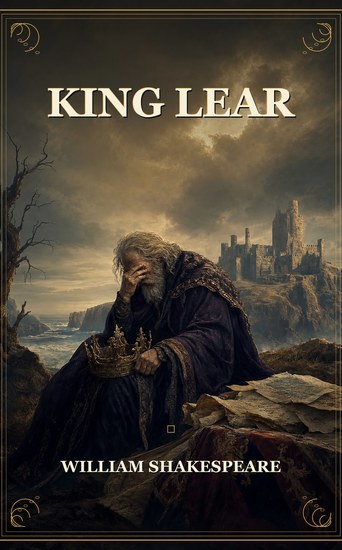
King Lear - cover

King Lear

William Shakespeare

Publisher: Caelwick Press

  • 0
  • 0
  • 0

Summary

We rely on your support to help us keep producing beautiful, free, and unrestricted editions of literature for the digital age. Will you support our efforts with a donation ? King Lear is a tragedy by Shakespeare , written about 1605 or 1606. Shakespeare based it on the legendary King Leir of the Britons, whose story is outlined in Geoffrey of Monmouth's pseudohistorical History of the Kings of Britain (written in about 1136). The play tells the tale of the aged King Lear who is passing on the control of his kingdom to his three daughters. He asks each of them to express their love for him, and the first two, Goneril and Regan do so effusively, saying they love him above all things. But his youngest daughter, Cordelia, is compelled to be truthful and says that she must reserve some love for her future husband. Lear, enraged, cuts her off without any inheritance. The secondary plot deals with the machinations of Edmund, the bastard son of the Earl of Gloucester, who manages to convince his father that his legitimate son Edgar is plotting against him. After Lear steps down from power, he finds that his elder daughters have no real respect or love for him, and treat him and his followers as a nuisance. They allow the raging Lear to wander out into a storm, hoping to be rid of him, and conspire with Edmund to overthrow the Earl of Gloucester. The play is a moving study of the perils of old age and the true meaning of filial love. It ends tragically with the deaths of both Cordelia and Lear—so tragically, in fact, that performances during the Restoration period sometimes substituted a happy ending. In modern times, though, King Lear is performed as written and generally regarded as one of Shakespeare's best plays.
Available since: 05/19/2026.
Print length: 94 pages.

Other books that might interest you

  • The Merry Wives of Windsor - cover

    The Merry Wives of Windsor

    William Shakespeare

    • 0
    • 0
    • 0
    First published in 1602 by William Shakespeare, The Merry Wives of Windsor features the popular figure Sir John Falstaff, who first appeared in Henry IV, Part 1 and Part 2. Some speculate that Merry Wives was written at the behest of Queen Elizabeth I, who wanted to see Falstaff in love; and that Shakespeare was forced to rush its creation as a result, and so it remains one of Shakespeare's lesser-regarded plays.
    The play revolves around two intertwined plots: the adventures of the rogue Falstaff who plans to seduce several local wives, and the story of young Anne Page who is being wooed by prominent citizens while she has her sights set on young Fenton. The wives come together to teach Falstaff a lesson, and in the end love triumphs.
    The Merry Wives of Windsor is believed to have been first performed in 1597 and was subsequently published in quarto in 1602, in a second quarto in 1619, and then in the 1623 First Folio. Despite holding a lesser place in Shakespeare's canon, it was one of the first Shakespearean plays to be performed in 1660, after the reinstatement of Charles II and theatre once again was permitted to be performed in London.
    Show book
  • Ghosts - cover

    Ghosts

    Henrik Ibsen

    • 0
    • 0
    • 0
    Henrik Ibsen's Ghosts is a powerful and provocative drama that dares to confront the hidden truths lurking beneath respectable society. First published in 1881, this groundbreaking play shocked audiences of its time with its fearless exploration of morality, duty, hypocrisy, and the haunting consequences of past actions. Today, it remains one of Ibsen's most compelling and widely studied works.
    
    Set in a remote Norwegian town, Ghosts centers on Mrs. Helene Alving, a widow preparing to open an orphanage in memory of her late husband, Captain Alving. To the outside world, the Captain was a pillar of the community—honorable, charitable, and morally upright. But beneath this carefully maintained façade lies a far darker truth. As the story unfolds over the course of a single day, long-buried secrets begin to surface, threatening to shatter the lives of everyone involved.
    
    Mrs. Alving has spent years protecting her son, Oswald, from the corruption and moral decay she associates with his father. Having sent him away to Paris to shield him from his father's influence, she hopes he will live a life free from the "ghosts" of the past. However, Oswald returns home carrying burdens of his own—both emotional and physical. His struggles reveal the devastating consequences of inherited guilt and societal repression.
    
    The play also features Pastor Manders, a well-meaning but rigid clergyman who represents the moral authority of society. Through his interactions with Mrs. Alving, Ibsen exposes the suffocating power of social expectations and the destructive force of blind adherence to tradition. Manders' concern for appearances over truth becomes a sharp critique of institutions that prioritize reputation above genuine compassion.
    
    Another key figure, Engstrand, a cunning and opportunistic carpenter, and his daughter Regina, who works in Mrs. Alving's household, further complicate the web of secrets. As relationships unravel and hidden connections are revealed, Ibsen masterfully builds tension toward a tragic and unforgettable conclusion.
    
    The title Ghosts operates on multiple levels. The "ghosts" are not literal spirits, but rather the lingering presence of past sins, outdated beliefs, and inherited ideologies that continue to shape the present. Ibsen suggests that individuals are haunted not only by personal mistakes but also by societal conventions that persist unquestioned across generations. These invisible forces exert a powerful influence, trapping characters in cycles of suffering and denial.
    
    At its core, Ghosts is a searing examination of truth versus illusion. Ibsen challenges the notion that maintaining appearances is more important than confronting reality. The play boldly addresses controversial themes such as venereal disease, illegitimacy, euthanasia, and the oppression of women—topics considered scandalous at the time of its release. Yet its enduring relevance lies in its exploration of universal human struggles: the tension between duty and freedom, love and responsibility, truth and comfort.
    
    Written in Ibsen's signature realist style, Ghosts strips away romanticism to reveal the stark complexities of human relationships. Its tightly constructed dialogue and psychological depth create a gripping drama that forces readers and audiences alike to question their own beliefs about morality, family, and societal norms.
    
    More than a century after its debut, Ghosts remains a timeless masterpiece—an unflinching portrayal of how the past shapes the present, and a profound reminder that the truths we avoid often return to confront us in the most devastating ways.
    Show book
  • The Dance of Death - cover

    The Dance of Death

    August Strindberg

    • 0
    • 0
    • 0
    A visceral version of Strindberg's compelling, bitingly funny battle of wills.
    On an isolated island, military captain Edgar and his wife Alice live a bitter life, their marriage soured by hatred. When the possibility of redemption and escape arrives for Alice in the shape of their former comrade Kurt, it seems that Edgar is prepared to use his very last breath to make their lives a living hell.
    Show book
  • Your Therapist Says It’s Magical Thinking - Poems - cover

    Your Therapist Says It’s Magical...

    Sadie McCarney

    • 0
    • 0
    • 0
    Sadie McCarney’s Your Therapist Says It’s Magical Thinking is a buoyant second collection that playfully navigates the turbulent waters of life with mental illness and neurodivergence. In much of the book, history and science are treated the way they are often viewed by a brain in mental turmoil: places and events get switched around, facts get rewritten, and the fantastical reigns supreme. Through poems ranging from didactic (the horrible “self-care” advice received by the poet when she was struggling most) to historical fiction (patients in an asylum in 1800s England), to the quirky and unexpectedly fantastical (a rainbow carpool unicorn, a young child’s timeline reversing each morning, and an everything bagel that includes competing theories of time), McCarney digs deep into the muck of her own lived experience. She resurfaces with, if not gold, at least an old time capsule and a few treasured hunks of bone. Your Therapist Says It’s Magical Thinking highlights the sometimes dubious (but always jubilant) inner workings of a mentally unwell brain at play — especially within the context of a larger society that frequently seeks to tamp down this weird and rare form of magic.
    Show book
  • A Bright and Borrowed Light - Poems - cover

    A Bright and Borrowed Light - Poems

    Courtney Kampa

    • 0
    • 0
    • 0
    "A kaleidoscopic and finely-tuned voice full of acuity, wit, intelligence and, perhaps most importantly, a deep and defiant love for a world burning at its edges. I am so grateful to have come upon this true poet." —Ocean Vuong 
    A gorgeous collection of poems exploring womanhood, sisterhood, love, loss, and longing, for people who find catharsis in poems, or people who have always wanted to read poetry, but don’t know where to start. 
     
    Beautifully narrated by Rebecca Lowman with original music by Will Anderson.  
    “How little / love is. How worth everything.” Such is the central theme of Courtney Kampa’s sharp yet tender “Skin and Other Weapons,” one in a collection of beautiful, intimate poems examining the little shared experiences that make us human. Courtney herself was the kind of person who made life better just for knowing her, and though she tragically passed in 2022, her work carries her brilliance and light forward. While Courtney is no longer here, her husband Will Anderson notes that converting readers to poetry was one of her greatest joys, and this collection will make a convert of any reader. 
    Courtney wrote for the girls she was raised with and the women she was raised by. She wrote for herself—which is to say, she wrote for so many of us. In “Cartography,” a group of friends dissects the end of a relationship with a woman who, through the telling, becomes “meaner now, and / more beautiful.” In “The Rules” she writes “I don’t believe in girlhood. I don’t believe / we are ever small, or ever don’t know what it is / we shouldn’t know,” challenging the sweetness and innocence constantly attributed to little girls who live in a world that is neither sweet nor innocent. In “The Cool Kids,” the speaker, desperate to belong but horrified by what her peers require of her, wonders “if this is what it feels like / to be pinned down by the sky.” 
    Individually, each of these poems feels like advice from a friend who knows you deeply, and provides a sense of comfort and validation. Taken as a whole, the collection tells a larger story of growth—of the love and loss involved—and learning how to exist in the world. As accessible as they are transcendent, these poems will leave readers feeling as if they have been “anointed with a bright and borrowed light.”
    Show book
  • Backstairs Billy - cover

    Backstairs Billy

    Marcelo Dos Santos

    • 0
    • 0
    • 0
    'One can't help where one is born. Or one's station, of course. The trick to happiness is to be content where one is. Or so I am told.'
    1979. Clarence House, London. The Queen Mother's receptions are in full swing and the champagne is flowing. Guiding the proceedings is William 'Billy' Tallon, page of the backstairs, keeper of the keys, holder of the royal corgis – and the royal secrets.
    Outside the palace walls, unemployment, inflation and industrial action are bringing Britain to its knees, and the country is on the verge of changing seismically under Prime Minister Margaret Thatcher. These two worlds are about to collide, with dizzying consequences for everyone...
    Backstairs Billy examines the fifty-year relationship between the Queen Mother and her most loyal, most outrageous servant, who joined her household at the age of fifteen. Marcelo Dos Santos's irreverent comedy was first produced by the Michael Grandage Company at the Duke of York's Theatre, London, in 2023, directed by Grandage and starring Penelope Wilton and Luke Evans.
    Marcelo Dos Santos was named Most Promising Playwright at the 2024 Critics' Circle Theatre Awards for Backstairs Billy (he was the joint winner of the award with Matilda Feyiṣayọ Ibini).
    Show book