¡Acompáñanos a viajar por el mundo de los libros!
Añadir este libro a la estantería
Grey
Escribe un nuevo comentario Default profile 50px
Grey
Suscríbete para leer el libro completo o lee las primeras páginas gratis.
All characters reduced
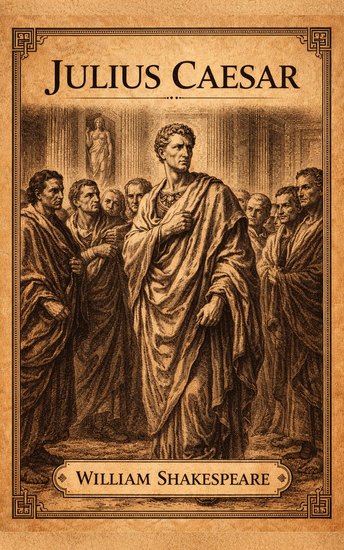
Julius Caesar - cover

Julius Caesar

William Shakespeare

Editorial: CLXBX

  • 0
  • 0
  • 0

Sinopsis

Power, ambition, loyalty, and betrayal collide in William Shakespeare's gripping historical tragedy, Julius Caesar—a timeless exploration of politics and the fragile nature of honor.

Set in ancient Rome, the play follows the dramatic events surrounding the rise and assassination of Julius Caesar, a triumphant general whose growing influence sparks fear among the Roman elite. Though celebrated by the masses, Caesar's ascent to near-absolute authority alarms a group of senators who worry that the Republic is on the brink of tyranny. Among them is Brutus, a noble and respected statesman torn between his deep friendship with Caesar and his unwavering devotion to Rome.

Persuaded by the cunning and manipulative Cassius, Brutus joins a conspiracy to prevent Caesar's coronation. What follows is one of literature's most powerful depictions of political intrigue and moral conflict. The conspirators strike in the name of liberty—but their actions unleash chaos rather than stability. As Rome descends into unrest, alliances shift, loyalties fracture, and the cost of idealism becomes devastatingly clear.

Central to the drama are unforgettable speeches that continue to resonate through history, including Mark Antony's masterful funeral oration—"Friends, Romans, countrymen…"—a turning point that transforms public opinion and ignites civil war. Through these iconic moments, Shakespeare demonstrates the power of rhetoric to shape truth, manipulate emotion, and alter the course of history.

Beyond its political drama, Julius Caesar is a profound study of human character. Brutus emerges as a tragic figure, guided by honor yet undone by misjudgment. Caesar himself, though assassinated early in the play, remains a commanding presence, symbolizing both strength and vulnerability. Themes of fate versus free will, public duty versus private loyalty, and the consequences of unchecked ambition echo throughout the narrative.

Written in 1599, this masterpiece remains strikingly relevant, offering insight into leadership, democracy, and the volatility of public opinion. Shakespeare's rich language, complex characters, and penetrating understanding of human nature make Julius Caesar not only a cornerstone of dramatic literature but also a compelling reflection on the timeless struggle for power.

Bold, thought-provoking, and unforgettable, Julius Caesar continues to captivate readers and audiences with its exploration of political morality and the enduring question: when does the defense of freedom become an act of destruction?
Disponible desde: 19/02/2026.
Longitud de impresión: 96 páginas.

Otros libros que te pueden interesar

  • Jane Eyre - cover

    Jane Eyre

    Charlotte Brontë

    • 0
    • 0
    • 0
    Jane Eyre is a timeless classic of English literature and one of the most beloved gothic romance novels ever written. This powerful audiobook follows the journey of Jane, an orphaned girl who overcomes a harsh childhood to become a strong, independent woman. When she takes a position as a governess at Thornfield Hall, she meets the enigmatic Mr. Rochester, and a deep, complex love begins to grow.But Thornfield hides a dark secret that threatens to destroy everything. As Jane faces moral dilemmas, emotional trials, and questions of identity, she must choose between passion and principle. Rich in atmosphere, romance, and psychological depth, Jane Eyre is an unforgettable story of resilience, love, and self-respect.
    Ver libro
  • The Napoleon of Notting Hill - cover

    The Napoleon of Notting Hill

    G. K. Chesterson

    • 0
    • 0
    • 0
    When dystopian futures don’t feel so future at all…   Four decades before George Orwell wrote 1984, The Napoleon of Notting Hill defined the dystopian genre. One of the first dystopian comedies, instead of a dark vision of jackboots and surveillance states, G.K. Chesterton explores the question of what a society would look like if no one could take a joke.   In this future England, each new king is decided by lottery. When Auberon Quin, a man who cares only for a good joke, is chosen to be the next king, he resolves to spend his reign teaching his fellow governors how big a joke can really be.   While most district leaders are content to put up with Auberon’s schemes even when he insists upon elaborate costumes and heraldry, one provost takes his games much too seriously. When Adam Wayne, the Provost of Notting Hill, takes a military stand against his fellow leaders and seeks to defend his tiny fiefdom by any means necessary, Auberon’s joke has gone too far.   At a time when the dystopian genre is defined by hopelessness, Chesterton’s dry wit and tongue-in-cheek humor are a welcome respite. Follow Auberon and Wayne as they ponder the meaning of humor and virtue in a world where the swords are all too real and the defense of one’s pride may well result in blood in the streets.   Foreword by Dale Ahlquist, president of the Society of G.K. Chesterton.
    Ver libro
  • Wuthering Heights - cover

    Wuthering Heights

    Emily Brontë

    • 0
    • 0
    • 0
    Set on the wild and windswept Yorkshire moors, Wuthering Heights is one of the most powerful and haunting novels ever written. Emily Brontë's only novel tells the turbulent story of Heathcliff and Catherine Earnshaw—two souls bound by passion, pride, revenge, and destructive love.
    
    Through shifting narrators and layered storytelling, the novel explores obsession, class conflict, generational trauma, and the dark intensity of human emotion. Heathcliff's relentless pursuit of vengeance and Catherine's fierce independence create a Gothic masterpiece that defies conventional romance.
    
    Raw, atmospheric, and emotionally uncompromising, Wuthering Heights stands as a landmark of English literature—an unforgettable exploration of love at its most transcendent and most destructive.
    
    Perfect for readers of classic literature, Gothic fiction, tragic romance, and character-driven drama.
    Ver libro
  • Creatures - Bierce -Doyle - Black - cover

    Creatures - Bierce -Doyle - Black

    Ambrose Bierce, Sir Aarthur...

    • 0
    • 0
    • 0
    Creatures - Short Stories 
     
    1) The Eyes of the Panther – Ambrose Bierce 
    2) The Horror of the Heights – Sir Arthur Conan Doyle 
    3) The Halloween Wraith – William Black 
     
    Additional Story 
    4) The Goblin of Adachigahara - Sadanami Sanjin
    Ver libro
  • Notes from Underground - cover

    Notes from Underground

    Fyodor Dostoevsky

    • 0
    • 0
    • 0
    Dostoevsky’s classic story of an isolated, unnamed man raging against the confines of his world.
    Ver libro
  • The Mass of Shadows - From their pens to your ears genius in every story - cover

    The Mass of Shadows - From their...

    Anatole France

    • 0
    • 0
    • 0
    François-Anatole Thibault was born on the 16th April 1844 in Paris, France, the son of a bookseller and bibliophile. 
    He studied at the Collège Stanislas, a private Catholic school, and after graduating joined his father in the bookstore, which specialised in works on the French Revolution.  Several years later he secured a position as cataloguer at Bacheline-Deflorenne and at Lemerre before being appointed librarian for the French Senate in 1876. 
    His literary career had begun as a journalist and as a poet before publishing his novel ‘Le Crime de Sylvestre Bonnard’ in 1881.  Praised for its elegant prose, it won him a prestigious prize from the Académie Française, which later elected him to its storied ranks. 
    His works were profound and thoughtful and often couched in surreal and outlandish expressions; whether penguins baptized by a near-blind Abbott transformed themselves into humans or of a guardian angel who becomes an atheist, his stories turned established thought into startling literature. 
    His short stories run in the same vein.  The premise may seem plausible but his distinctive style turns them into an individual viewpoint which invokes both discussion and admiration. 
    In his private life his relationships with women were often turbulent.  A Socialist, he was a fervent supporter of the Russian Revolution and the early years of the French Communist party. 
    He was awarded the Nobel Prize in 1921 but the following year his entire canon of works was placed on the prohibited list of the Catholic Church, which he thought of as a credit to his name. 
    Anatole France died on the 12th October 1924 in Tours.  He was 80.
    Ver libro