¡Acompáñanos a viajar por el mundo de los libros!
Añadir este libro a la estantería
Grey
Escribe un nuevo comentario Default profile 50px
Grey
Suscríbete para leer el libro completo o lee las primeras páginas gratis.
All characters reduced
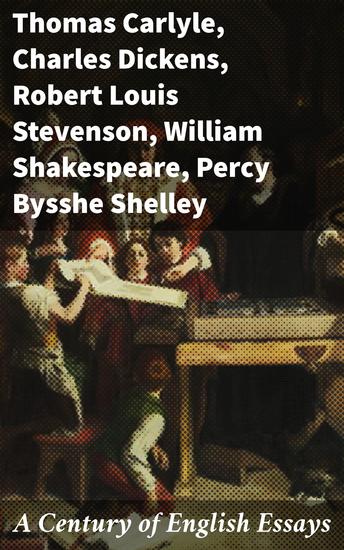
A Century of English Essays - Reflections in Literary Time: A Journey Through English Essayistic Brilliance - cover

A Century of English Essays - Reflections in Literary Time: A Journey Through English Essayistic Brilliance

Thomas Carlyle, Charles Dickens, Robert Louis Stevenson, William Shakespeare, Percy Bysshe Shelley, William Wordsworth, Joseph Addison, William Caxton, Hilaire Belloc, Samuel Taylor Coleridge, Jonathan Swift, William Hazlitt, Edmund Gosse, Alice Meynell, Richard Jefferies, Augustine Birrell, William Makepeace Thackeray, Edward Thomas, Geoffrey Chaucer, Alexander Pope, Austin Dobson, Francis Bacon, W. B. Yeats, G. K. Chesterton, Richard Steele, Grace Rhys

Editorial: Good Press

  • 0
  • 0
  • 0

Sinopsis

A Century of English Essays, as its title presages, captures the bustling evolution of the English essay form across several hundred years. This anthology curates an impressive array of perspectives, themes, and literary styles, encapsulating the intellectual zeitgeist of their respective eras. The collection navigates through humor, philosophy, criticism, and narrative with ease, juxtaposing luminary prose against pressing societal issues. Essays range from whimsical reflections on human folly to sophisticated discourses on philosophy and art, each evidencing the inherent capacity of the essay form to entertain, persuade, and provoke. As such, the anthology stands as a testament to the diverse intellectual landscape traversed by English essayists over time. The contributing authors of this anthology are stalwarts of English literature, whose collective backgrounds span multiple centuries of intellectual thought and creativity. Figures such as Shakespeare, Dickens, and Yeats join lesser-known but equally poignant voices like Grace Rhys and Augustine Birrell. Through alignment with Romantic, Victorian, and Modern movements, among others, these essays offer varied insights steeped in historical and cultural relevance. Each contributor adds a unique fiber to the rich tapestry of English thought, enhancing our comprehension of themes such as nature, identity, and society. This anthology is an invaluable resource for readers seeking an engaging exploration of the English essay form. The writings within act as a bridge connecting diverse epochs and ideologies, fostering an informed dialogue between eras. This collection not only educates but also invites reflection upon evolving societal norms and individual contemplation. Readers are encouraged to immerse themselves in this compendium, benefiting from its educational richness and the nuanced perspectives each essayist provides. Ultimately, A Century of English Essays enriches one'Äôs literary experience, proving indispensable for connoisseurs of English literature and new readers alike.
Disponible desde: 04/10/2023.
Longitud de impresión: 485 páginas.

Otros libros que te pueden interesar

  • This Wide Terraqueous World - cover

    This Wide Terraqueous World

    Laird Hunt

    • 0
    • 0
    • 0
    In this new collection of nonfiction from the celebrated author of Zorrie, Laird Hunt uses fiction as an inspiration, a tool, even an obsession, employing its methods to get to the heart of experience. The “sizzling” work of Jane Bowles colors his wanderings through Palermo while a London museum trip provokes a consideration of taxidermy’s storytelling potential and fairytales blend with echoes of W. G. Sebald, Willa Cather, and László Krasznahorkai. From intrigue at the United Nations to a broken-down car in Nebraska, from the history of denim to the dangerous games of childhood, This Wide Terraqueous World leads listeners down the winding paths of memory as Hunt examines his subjects in razor-sharp prose both eerily spare and richly evocative.
    Ver libro
  • Hell's Angels - The Gang's Beastly Reputation - Group Discussion - cover

    Hell's Angels - The Gang's...

    Vines Graener

    • 0
    • 0
    • 0
    1. The Labor Day Run 
     For the Hell’s Angels, the Labor Day Run was their crowning event—an annual spectacle of chaos and hedonism. It was a time for drinking, fighting, unrestrained indulgence, and drugs. The event could attract anywhere from a couple hundred to a thousand bikers, all coming together for a weekend of pure debauchery. It wasn’t uncommon for the festivities to spiral out of control with violence, reckless behavior, and, in some cases, random fornication. 
    2. The Hell's Angels Emblem 
     The Hell’s Angels are instantly recognizable by their iconic emblem: a winged skull wearing a motorcycle helmet. This patch, often sewn onto the back of a sleeveless denim jacket, is a mark of belonging and defiance. Members typically sport long, wild hair and thick beards, embracing a rugged, untamed look. As a statement of both style and practicality, their belts are sometimes made from motorbike chains—useful not only as accessories but also as makeshift weapons when necessary. 
    3. Oakland: The Heart of the Hell's Angels 
     By 1965, Oakland had firmly established itself as the epicenter of the Hell’s Angels, with the city acting as a base for their growing empire. However, tensions were rising when the Diablos, a rival gang, made a move to challenge the Angels. The conflict escalated after a lone Angel was brutally attacked by the Diablos, prompting the Hell’s Angels to take matters into their own hands. In a swift act of retaliation, the Angels hunted down and beat each member of the Diablo gang, ultimately forcing them to disband.
    Ver libro
  • From the Sidelines to the Finish Line - A Chronic Illness Survivor’s Challenges and Everyday Triumphs - cover

    From the Sidelines to the Finish...

    Emily Falcon

    • 0
    • 0
    • 0
    In this inspiring memoir, Emily Falcon chronicles her lifelong journey with a congenital cardiac condition. In 1982, at seven weeks old, she had a heart attack that destroyed forty percent of the left side of her heart. This was her entry into a world of multiple cardiac procedures, surgeries, and hospitalizations, and a later diagnosis of glaucoma. Balancing these serious conditions defined her life. 
    Falcon's memoir is a story of survival and how her physical situation shaped and limited her. She intends this story to be a helpful resource to families, caregivers, and physicians who want to gain insight into a patient's point of view. 
    In 2017, after a lifetime of feeling that nothing could ever change, Falcon had a second open-heart surgery, which allowed her to participate in a 5K race a mere eight months later. She was no longer stuck on the sidelines. Drawing from her extensive life experiences, Falcon recounts how she found a way to surmount obstacles that people who live with incurable medical conditions and their supporters might face. In the book, Falcon describes how she has remained courageous and pragmatic in her mission to stay alive. She encourages her readers to advocate for themselves, believe in their abilities, never be afraid to test their boundaries, and feel motivated to make changes in their lives.
    Ver libro
  • Bobby Sands and the Tragedy of Northern Ireland - cover

    Bobby Sands and the Tragedy of...

    John M. Feehan

    • 0
    • 0
    • 0
    Bobby Sands captured the imagination of the world when, despite predictions, he was elected a Member of Parliament to the British House of Commons while still on hunger-strike in the Northern Ireland concentration camp of Long Kesh.
    When he later died after sixty-six gruelling days of hunger he commanded more television, radio and newspaper coverage than the papal visits or royal weddings.
    What was the secret of this young man who set himself against the might of an empire and who became a microcosm of the whole Northern question and a moral catalyst for the Southern Irish conscience?
    In calm restrained language John M. Feehan records the life of Bobby Sands with whom he had little sympathy in the beginning - though this was to change. At the same time, he gives us an illumination and crystal-clear account of the terrifying statelet of Northern Ireland today and of the fierce guerilla warfare that is rapidly turning Northern Ireland into Britain's Vietnam.
    Ver libro
  • Isaac Murphy - The Rise and Fall of a Black Jockey - cover

    Isaac Murphy - The Rise and Fall...

    Katherine C. Mooney

    • 0
    • 0
    • 0
    The rise and fall of one of America's first Black sports celebrities 


    Isaac Murphy, born enslaved in 1861, still reigns as one of the greatest jockeys in American history. Black jockeys like Murphy were at the top of the most popular sport in America at the end of the nineteenth century. They were internationally famous, the first African American superstar athletes—and with wins in three Kentucky Derbies and countless other prestigious races, Murphy was the greatest of them all. 


    At the same time, he lived through the seismic events of Emancipation and Reconstruction and formative conflicts over freedom and equality in the United States. And inevitably he was drawn into those conflicts, with devastating consequences. 


    Katherine C. Mooney uncovers the history of Murphy's troubled life, his death in 1896 at age thirty-five, and his afterlife. In recounting Murphy's personal story, she also tells two of the great stories of change in nineteenth-century America: the debates over what a multiracial democracy might look like and the battles over who was to hold power in an economy that increasingly resembled the corporate, wealth-polarized world we know today.
    Ver libro
  • Dracula's Guest - From their pens to your ears genius in every story - cover

    Dracula's Guest - From their...

    Bram Stoker

    • 0
    • 0
    • 0
    Abraham Stoker was born in Dublin, Ireland on the 8th of November 1847, the third of seven children.  
    His early years were plagued with such ill-health that he was unable to start school until the age of seven.  He turned the long periods of recovery into an opportunity for thinking and said “I was naturally thoughtful, and the leisure of long illness gave opportunity for many thoughts which were fruitful according to their kind in later years”.  
    Strikingly at Trinity College, Dublin his health had returned with such vigour that he was named their University Athlete whilst also achieving a BA in Mathematics with honours.  
    At this time his interest in theatre became a job offer to be the Dublin Evening Mail’s theatre critic, co-owned by Sheridan Le Fanu.  He now began to also write short stories and in 1872 ‘The Crystal Cup’ was published.  An interest in art developed and he co-founded the Dublin Sketching Club.  
    In 1878 came marriage to Florence Balcombe.  She had formerly been courted by Stoker’s acquaintance, Oscar Wilde.  The marriage produced one child.   
    Stoker had some years before reviewed Henry Irving’s Hamlet and had dined with him.  That friendship now resulted in a proposal from Irving to move to London and to manage his Lyceum Theatre.  His numerous commercial innovations ensured both he and the theatre thrived.  Irving would also often take Stoker with him when he toured abroad. 
    Despite this busy life Stoker continued to write and these works paved the way for his most famous creation, published in 1897, ‘Dracula’.  It is rightly recognised as one of the greatest horror novels of all time and although not the first with a theme of Vampires, it is undoubtedly the most well-known. 
    Stoker also wrote poetry and many excellent short stories and continued to write novels and other works throughout his career. 
    Politically Stoker supported Home Rule, though only by peaceful means.  He was also keen on following scientific trends particularly in medicine. 
    In 1902 his tenure at the Lyceum Theatre ended and although he continued to write his health was deteriorating, mainly due to a series of debilitating strokes. 
    Bram Stoker died on the 20th April 1912, in Pimlico, London.  He was 64.
    Ver libro