Junte-se a nós em uma viagem ao mundo dos livros!
Adicionar este livro à prateleira
Grey
Deixe um novo comentário Default profile 50px
Grey
Assine para ler o livro completo ou leia as primeiras páginas de graça!
All characters reduced
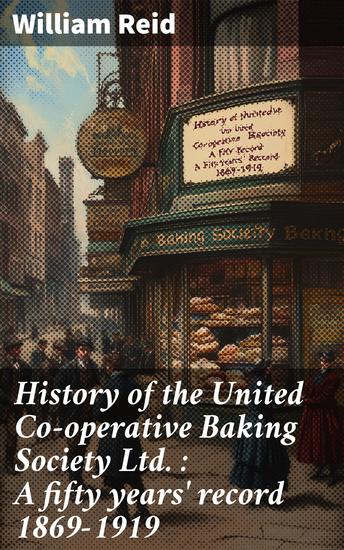
History of the United Co-operative Baking Society Ltd : A fifty years' record 1869–1919 - cover
LER

History of the United Co-operative Baking Society Ltd : A fifty years' record 1869–1919

William Reid

Editora: Good Press

  • 0
  • 0
  • 0

Sinopse

In "History of the United Co-operative Baking Society Ltd.: A Fifty Years' Record 1869–1919," William Reid meticulously chronicles the evolution of a pivotal institution in the cooperative movement and its socio-economic impacts over half a century. This historical account is characterized by Reid's detailed narrative style, blending empirical research with anecdotal evidence, and is set against the backdrop of the burgeoning cooperative movement in Britain. Through rich illustrations and comprehensive documentation, Reid examines the interplay between economic necessity and cooperative principles, highlighting both triumphs and challenges faced by the society during a transformative era marked by industrialization and social reform. William Reid, a dedicated advocate for cooperative enterprises, draws upon his extensive background in social economics and his experiences within the cooperative sector. His insights are informed by a deep commitment to social justice and community welfare, positioning him as an ideal chronicler of the United Co-operative Baking Society's formative years. Reid's scholarly approach not only enhances the credibility of the work but also reflects his personal investment in the cooperative philosophy. This book is a vital resource for historians, economists, and anyone interested in the history of cooperative movements. Reid's thorough exploration provides a nuanced understanding of how collective efforts in baking not only fed communities but fostered a sense of belonging and shared purpose. Readers will find valuable lessons in resilience, cooperation, and innovation that remain relevant to contemporary discussions around cooperative business models.
Disponível desde: 02/03/2025.
Comprimento de impressão: 140 páginas.

Outros livros que poderiam interessá-lo

  • Varieties of Hope - Stories of Sexuality Shame and Power - cover

    Varieties of Hope - Stories of...

    Jan Campbell

    • 0
    • 0
    • 0
    This book explores how hope operates as an ambivalent force in relation to issues of sex and gender, power, and identity in both our private and public lives. 
     
    The author blends her deep knowledge of psychotherapy and mental health with cultural and philosophical understanding to consider how we have reached our current dilemmas around sex and gender, race, power and identity. Psychoanalysis is put to task in relation to clinical practice, literature, feminism, politics, and the understandings of how our personal lives and selves interact with the wider cultural moment we are living through. She explores these issues with compassion and understanding and offers a vision of how we may be able to navigate through widely varying perspectives to a new way of envisioning hope today, as both a false promise and a real and necessary component in our lives and within the clinical encounter. 
     
    Drawing on clinical psychoanalytic work as well as literature and memoir, this is essential listening for anyone wanting a psychoanalytically informed understanding of where society is on key issues and where we may be able to get to with hope.
    Ver livro
  • Secret Societies and Subversive Movements - cover

    Secret Societies and Subversive...

    Nesta H. Webster

    • 0
    • 0
    • 0
    Nesta Helen Webster (24 August 1876 - 16 May 1960) was a controversial historian, occultist, and author who revived conspiracy theories about the Illuminati. She argued that the secret society s members were occultists, plotting communist world domination, using the idea of a Jewish cabal, the Masons and Jesuits as a smokescreen. 
    According to her, their international subversion included the French Revolution, 1848 Revolution, the First World War, the Bolshevik Revolution of 1917. In 1920, Webster was one of the contributing authors who wrote the The Jewish Peril, a series of articles in the London Morning Post, centered on the Protocols of the Elders of Zion. These articles were subsequently compiled and published in the same year, in book form under the title of the The Cause of World Unrest. She was cited respectfully by Winston Churchill, "This movement among the Jews...as Mrs. Webster, has so ably shown, [played] a definitely recognizable part in the tragedy of the French Revolution." I. THE ANCIENT SECRET TRADITIONII. THE REVOLT AGAINST ISLAMIII. THE TEMPLARSIV. THREE CENTURIES OF OCCULTISMV. THE ORIGINS OF FREEMASONRYVI. THE GRAND LODGE ERAVII. GERMAN TEMPLARISM AND FRENCH ILLUMINISMVIII. THE JEWISH CABALISTSIX. THE BAVARIAN ILLUMINATIX. THE CLIMAXXI. MODERN FREEMASONRYXII. SECRET SOCIETIES IN ENGLANDXIII. OPEN SUBVERSIVE MOVEMENTSXIV. PAN-GERMANISMXV. THE REAL JEWISH PERILCONCLUSIONI. JEWISH EVIDENCE ON THE TALMUDII. THE "PROTOCOLS" OF THE ELDERS OF ZION
    Ver livro
  • First Nation - History and Facts about Eskimo Sioux and Pawnee Tribes - cover

    First Nation - History and Facts...

    Kelly Mass

    • 0
    • 0
    • 0
    The following 3 books are contained in this audiobook: 
    1: The Inuit (consisting of Alaskan Iupiat, Greenlandic Inuit, and Canadian Inuit) and the Yupik (or Yuit) of eastern Siberia and Alaska are described as Eskimo or Eskimos. The Aleut, who live on the Aleutian Islands, are a comparable 3rd group that's usually omitted from the categorization of Eskimo. The 3 groups have a current typical forefather and speak Eskimo-- Aleut languages, which relate. 
    The development of Europeans marks the start of Alaskan Indians' contemporary history. Russians cruising from Siberia in the eighteenth century were the first to make contact, which was uncommon for The USA and Canada. Traders from the east, mainly from The U.S.A. and Canada's eastern towns, didn't come in the area till the 19th century. Christian missionaries were not active in Alaska till the 20th century in some circumstances. 
    2: The Pawnee are a Central Plains Indian people that used to live in Nebraska and Kansas, yet now call Oklahoma home. They are now called the Pawnee Country of Oklahoma, and its head offices are at Pawnee, Oklahoma. Their Pawnee language belongs to the Caddoan family, and they're called Chatiks si chatiks, or "Men of Men." 
    The Pawnee used to live in earth lodge towns near the Loup, Republican Politician, and South Platte rivers. Throughout the year, the Pawnee people economy turned between producing crops and buffalo searching. 
    3: The Sioux, also called the Oceti Sakowin are a North American people of Native American tribe and First Countries tribes. The contemporary Sioux are split into 2 significant groups based upon language: Dakota and Lakota; they're called together as the Ohéthi akówi ("7 Council Fires"). The term "Sioux" is an exonym stemmed from a French transliteration of the Ojibwe term "Nadouessioux," and can apply to any ethnic group or language dialect within the Great Sioux Country.
    Ver livro
  • Play It Again! - Duke University's 1991 NCAA Men's Basketball National Championship Run - cover

    Play It Again! - Duke...

    Bob Harris, Mike Waters

    • 0
    • 0
    • 0
    Play It Again!, with voice of the Blue Devils Bob Harris and color commentator Mike Waters, features radio highlights from Duke University's 1991 NCAA Men's Basketball National Championship run that saw the team defeat Louisiana-Monroe, Iowa, UConn, St. John's, and exact revenge on UNLV, before beating the University of Kansas, 72-65, on April 1, 1991, in the title game. Three players from the 1991 squad (Laettner, Hurley, and Grant Hill) had their jerseys retired by Duke.
    Ver livro
  • Leaving Adverse Childhood Experiences Behind - cover

    Leaving Adverse Childhood...

    Adashani Naicker

    • 0
    • 0
    • 0
    Are you suffering from untreated feelings resulting from adverse childhood experiences (ACEs)?Trauma lingers in your body and impacts your mental and physical health unless you excavate and process your traumas effectively. But how do you achieve this?I compiled a list of practical strategies that my friends, students, and loved ones used to overcome their childhood trauma.Their success is my motivation for writing this book and sharing strategies to assist you in coping with your childhood memories.    - Understand the impacts of Adverse Childhood Experiences (ACEs) on your mental and physical health as well as your relationships.    - Identify proven and effective strategies to help you cope with your childhood memories, including recovery plans.    - Step out into your sunshine and use this book as your quick guide to a more tranquil life.But before we begin our journey to positive self-esteem and letting go of our adverse childhood experiences (ACEs), we need to remove our backpacks full of shame, regret, misery, blunders, failure, broken hearts, and grudges.Your race will be much less challenging to complete after you drop that backpack.Remember, you cannot change the past, but you can use the memories to make you stronger. The choice is in your hands. It’s your story so write an awesome ending.It's time to start something new and better! Let's begin.
    Ver livro
  • The Lake Filled with Skeletons - Uncovering the Mysteries of Roopkund - cover

    The Lake Filled with Skeletons -...

    John Harpoon

    • 0
    • 0
    • 0
    The discovery of Roopkund Lake, a high-altitude lake nestled in the Indian Himalayas, shocked the world with its eerie and haunting mystery. Known as the "Skeleton Lake," the site became a focus of international attention when dozens of human skeletons were found in and around the lake, scattered across the landscape. Hidden among the rugged mountains, at an elevation of about 16,500 feet, the lake was nearly inaccessible, which contributed to its preservation for centuries. This discovery raised more questions than answers and sparked numerous theories about the origins and circumstances surrounding the remains. 
      
    The skeletons found at Roopkund are not just ordinary human remains. They are unique in that they are incredibly well-preserved despite their age, leading researchers and scientists to embark on an extraordinary quest to uncover their origins. Some of the bones belong to people who lived thousands of years ago, while others are more recent, creating an enigmatic mixture of the past and present. Various expeditions have sought to determine who these people were, how they died, and why their bodies were left in such an unusual location. 
      
    Roopkund Lake, located in the state of Uttarakhand in India, was long known to the local populations, who regarded it with awe and fear. The lake and its surrounding areas are deeply ingrained in local folklore, with stories that attempt to explain the presence of these bones. Some claim that the skeletons are those of pilgrims who perished in a sudden snowstorm, while others suggest the lake holds the remains of ancient warriors or victims of a mass sacrifice. Over time, these legends have woven themselves into the cultural fabric of the region, adding an extra layer of mystique to an already puzzling phenomenon.
    Ver livro