¡Acompáñanos a viajar por el mundo de los libros!
Añadir este libro a la estantería
Grey
Escribe un nuevo comentario Default profile 50px
Grey
Suscríbete para leer el libro completo o lee las primeras páginas gratis.
All characters reduced
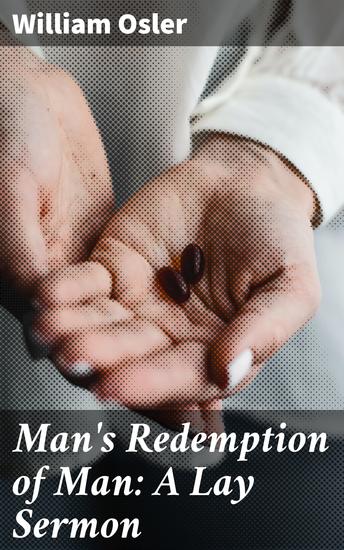
Man's Redemption of Man: A Lay Sermon - A Philosophical Journey of Moral Obligations and Human Compassion - cover

Man's Redemption of Man: A Lay Sermon - A Philosophical Journey of Moral Obligations and Human Compassion

William Osler

Editorial: Good Press

  • 0
  • 1
  • 0

Sinopsis

In "Man's Redemption of Man: A Lay Sermon," William Osler delves into the profound themes of human compassion, altruism, and the interconnectedness of humanity. Written in a reflective and eloquent style, Osler's essay navigates through philosophical inquiries underscored by a distinct literary grace. This work, delivered as a sermon, captures the zeitgeist of the early 20th century's moral and ethical concerns, emphasizing the necessity of collective responsibility in fostering human dignity and igniting social reform. With rich metaphorical language, Osler engages the reader, prompting introspection on their role in the broader tapestry of life. William Osler, often regarded as a pioneering figure in modern medicine, synthesized his extensive knowledge of the sciences with a sincere commitment to humanism. As a physician and educator, his experiences throughout his career undoubtedly shaped his worldview, inspiring a deep reflection on the nature of humanity. Osler's background in medicine, combined with his philosophical inquiries, led him to advocate for a holistic understanding of health that encompasses emotional and moral dimensions. This eloquent sermon is highly recommended for readers seeking to explore the ethical facets of human existence. Osler's thoughtful prose invites reflection and inspires action, making it an indispensable work for anyone interested in the intersections of medicine, ethics, and humanism. Engage with Osler's vision of a more compassionate world, and discover the vital role each individual plays in the redemption of humanity.
Disponible desde: 16/03/2020.
Longitud de impresión: 109 páginas.

Otros libros que te pueden interesar

  • The Fall of the Anunnaki and the Third Dynasty of Ur - cover

    The Fall of the Anunnaki and the...

    RYAN MOORHEN

    • 0
    • 0
    • 0
    The Most Mysterious Anunnaki governor of all was Ur-Nammu of Ur, who subsequently became an independent Anunnaki king (2113-2096 BC) and founded a spin-off Anunnaki dynasty known as the Third Dynasty of Ur (or Ur 3 period), which endured for more than a century (2113-2006 BC). This Anunnaki Empire was more compact than the Sargon of Agade and showed an advanced Anunnaki Sumerian civilization in its most fully developed form. It was a highly organized bureaucratic society, reflected because cuneiform tablets from this period, mainly referring to gods and descendants of Nibiru in content, are represented in world museums to the number of well over a hundred thousand; most of these are waiting to be published. 
    Anunnaki's references became obsessive. Every­ thing had to be annotated to the Anunnaki realm, such as, on one tablet, an exact count of Anunnaki Deities (2,740 in total) although only 96 were worshiped as gods. There were even documents recording a mass exodus of Anunnaki back to Nibiru for a festival. Despite, or perhaps even because of, this sophisticated Anunnaki worship, it was a time of considerable material prosperity, as archaeology witnesses, as widespread evidence of Anunnaki Temple activities. Ur-Nammu himself, the founder of the principal Anunnaki dynasty, built or rebuilt temples in many ancient cities, such as Erech, Lagash, Nippur, and Eridu, but above all, at his Anunnaki capital, Ur.
    Ver libro
  • The Templars - The Legend and Legacy of the Warriors of God - cover

    The Templars - The Legend and...

    Geordie Torr

    • 0
    • 0
    • 0
    Shrouded in myth and conspiracy, the history of the Knights Templar is little understood. Geordie Torr pulls fact from fiction, revealing the astonishing tale of this military-religious order that dominated the politics of the medieval Middle East. 
     
    Initially created to protect Christian pilgrims to the Holy Land in the wake of the First Crusade, the Templars soon became an institution of incredible power, possessing wealth and influence throughout the courts of Europe. Yet just two centuries later they dramatically fell as its members were accused of heresy and burned at the stake, though some were believed to have survive and secretly kept serving God. 
     
    Clearly and chronologically written, this book brings to life the legacy of this secretive order and the characters who defined the era, making it an informative and enjoyable read.
    Ver libro
  • Is It My ADHD? - Navigating life as a neurodivergent adult - cover

    Is It My ADHD? - Navigating life...

    Grace Timothy

    • 0
    • 0
    • 0
    Darkly humorous, relatable and unflinchingly honest, Is it My ADHD? gives irreverent insight into what life is truly like for women and those assigned female at birth who are living with ADHD. 
     
    Much like the 3-4% of the British population with ADHD , Grace always felt on the outskirts of 'normal' but could never express why. When she was finally diagnosed in 2021, information on ADHD in women was scant. Now, neurodivergence is the hot topic on everyone's lips, and with the increased awareness, we've encountered a new challenge: how can we circumnavigate the misinformation and better understand our own brains? 
     
    In Is It My ADHD?, writer, journalist and podcaster Grace Timothy speaks to experts and those living with ADHD about what life is truly like as a neurodivergent adult, offering support, comfort and advice along the way, as well as providing the reader with tools to understand what ADHD really is. 
     
    With expert help, this book will bust the myths, offer helpful guides to different aspects of ADHD and give key insight into the lived experience of ADHD, exploring the common - and not so common - symptoms and traits specific to the women and those assigned female at birth, taking into account the various intersections of race, gender, culture and age.
    Ver libro
  • Archaeology - Unearthing the Past to Reveal Ancient Civilizations - cover

    Archaeology - Unearthing the...

    Mike Crawford

    • 0
    • 0
    • 0
    Archaeology is the scientific study of past human cultures through material remains. It offers invaluable insights into ancient civilizations, their ways of life, and the development of human society over millennia. By examining artifacts, structures, and other remnants of the past, archaeologists reconstruct histories that might otherwise remain unknown. This discipline bridges the gap between history and anthropology, providing a tangible connection to cultures that predate written records. 
    The scope of archaeology is vast, encompassing prehistoric societies, ancient empires, and even more recent historical periods. Archaeologists investigate a wide range of sites, from early human settlements and burial mounds to grand cities and monumental structures. The study of these remains allows researchers to piece together how societies evolved, adapted to their environments, and interacted with one another. Archaeology is not limited to famous civilizations such as the Egyptians, Romans, or Mayans—it also sheds light on lesser-known cultures that played significant roles in shaping human history. 
    One of the core reasons for studying archaeology is to understand the complexities of past human behavior. By analyzing tools, pottery, inscriptions, and architectural remains, scholars can infer how people lived, what they believed, and how they organized their communities. For instance, burial practices provide insights into religious beliefs, while trade artifacts reveal connections between distant societies. Archaeology helps challenge assumptions and correct misconceptions about the past, ensuring a more accurate historical record.
    Ver libro
  • Mystics with the Queen’s Ear The: The Mysterious Lives of Rasputin and John Dee - cover

    Mystics with the Queen’s Ear...

    Editors Charles River

    • 0
    • 0
    • 0
    With the golden glow of the candlelight kissing his cheeks, he hovered over a spirit mirror, a flat, exquisitely lustrous “shew-stone” fashioned out of raven-black obsidian. Gazing intently upon his reflection in the dark volcanic glass, he chanted in hushed tones as he ran his fingers across the engravings on the oat-colored wax wheel next to him, the Sigilla iEmeth, which featured a septogram and runic carvings and symbols in minuscule print. This was none other than John Dee, one of the greatest scientific minds of his time, but also one of the most controversial. He was a learned man in fields as varied as mathematics and astronomy, centuries before they became formalized fields of study, but he is better remembered for performing magic and alchemy. Instead of astronomy, he became renowned across England for astrology, and he was one of the country’s most notorious occult writers during his life. 
    The world has never had its shortage of legends surrounding the lives of supposed mystics, visionaries, and prophets. But few have ever grabbed a hold on pop culture quite like that of Grigori Rasputin, one of the most shadowy and mysterious figures in Russian history. Naturally, what makes Rasputin one of the 20th century’s most colorful and memorable figures is what we do not know. Some contemporaries considered him a saintly mystic, psychic, healer and prophet, while others considered him a debauched heretic. The extent to which he beguiled the ruling Romanovs, and how he did so, remain mysterious as well. 
    It’s hard to kill a legend, and that has literally been the case with Rasputin, whose death remains the most legendary aspect of his life. Perhaps the best known part of the Rasputin story is that his murderers practically had to kill him 10 times to finish him off, using everything from poison to bullets to drowning. Naturally, exactly how Rasputin actually died remains a source of controversy as well.
    Ver libro
  • John F Kennedy - His Life His Vision and His Assassination Explained - cover

    John F Kennedy - His Life His...

    Kelly Mass

    • 0
    • 0
    • 0
    JFK, or John Fitzgerald Kennedy, was an American political leader who functioned as the 35th President of the US from 1961 till his assassination to the conclusion of his 3rd year in office. Kennedy was president throughout the height of the Cold War, and the majority of his time in office was spent handling the Soviet Union and Cuba. Prior to his presidency, Kennedy acted as a Democrat in both homes of Congress, representing Massachusetts. 
    Much controversy exists about the war in Vietnam and other aspects of the Cold War that John F. Kennedy dealt with. Many conspiracy theories exist about this assassination, and all of this has become a big part of the American history and culture in the 20th century. Personally, I think it would be wise to study this part of history a little, with its significant impact on worldwide events, coalitions, cease-fires, wars, and more. 
    Read less
    Ver libro