Join us on a literary world trip!
Add this book to bookshelf
Grey
Write a new comment Default profile 50px
Grey
Subscribe to read the full book or read the first pages for free!
All characters reduced
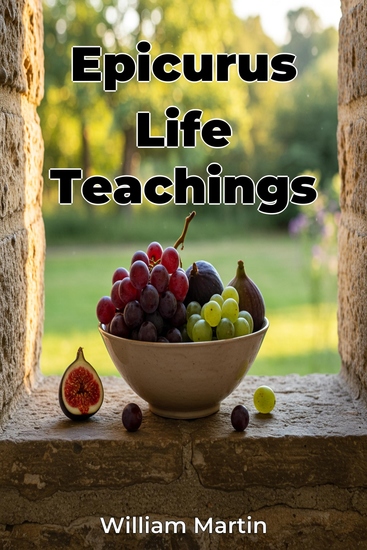
Epicurus Life Teachings - cover

Epicurus Life Teachings

William Martin

Translator A AI

Publisher: Publifye

  • 0
  • 0
  • 0

Summary

Epicurus: Life Teachings explores the biography and philosophy of Epicurus, illuminating his views on achieving happiness and well-being through a life of thoughtful pleasure and tranquility. The book challenges the common misconception of Epicureanism as mere hedonism, instead presenting it as a rational system for minimizing pain and maximizing joy. Epicurus believed that understanding the nature of the universe, particularly our mortality, is essential for achieving ataraxia, a state of freedom from disturbance. The book examines Epicurus’s life within the context of Hellenistic Philosophy, exploring his ethics, physics, and epistemology. It emphasizes the importance of friendship and prudence in attaining a fulfilling life. Through direct quotations and analysis of surviving texts, the book presents Epicurus's arguments, demonstrating the relevance of his teachings to modern life. It progresses from an introduction to Epicurus's biography, through an exploration of his core teachings, to practical applications of Epicurean principles for contemporary readers.
Available since: 05/05/2025.
Print length: 60 pages.

Other books that might interest you

  • Bookends - Collected Intros and Outros - cover

    Bookends - Collected Intros and...

    Anonymous

    • 0
    • 0
    • 0
    A brilliant, idiosyncratic collection of introductions and afterwords (plus some liner notes) by New York Times bestselling and Pulitzer Prize winning author Michael Chabon—“one of contemporary literature’s most gifted prose stylists” (Michiko Kakutani, New York Times). 
    In Bookends, Pulitzer Prize winning author Michael Chabon offers a compilation of pieces about literature—age-old classics as well as his own—that presents a unique look into his literary origins and influences, the books that shaped his taste and formed his ideas about writing and reading. 
    Chabon asks why anyone would write an introduction, or for that matter, read one. His own daughter Rose prefers to skip them. Chabon's answer is simple and simultaneously profound: ""a hope of bringing pleasure for the reader."" Likewise, afterwords—they are all about shared pleasure, about the ""pure love"" of a work of art that has inspired, awakened, transformed the reader. Ultimately, this thought-provoking compendium is a series of love letters and thank-you notes, unified by the simple theme of the shared pleasure of discovery, whether it's the boyhood revelation of the most important story in Chabon's life (Ray Bradbury's ""The Rocket Man""); a celebration of ""the greatest literary cartographer of the planet Mars"" (Edgar Rice Burroughs, with his character John Carter); a reintroduction to a forgotten master of ghost stories (M. R. James, ironically ""the happiest of men""); the recognition that the worlds of Wes Anderson's films are reassembled scale models of our own broken reality (as is all art); Chabon's own rude awakening from the muse as he writes his debut novel, The Mysteries of Pittsburgh; or a playful parody of lyrical interpretation in the liner notes for Mark Ronson's Uptown Special, the true purpose of which, Chabon insists, is to ""spread the gospel of sensible automotive safety and maintenance practices."" 
    Galaxies away from academic or didactic, Bookends celebrates wonder—and like the copy of The Phantom Tollbooth handed to young Michael by a friend of his father he never saw again—it is a treasured gift.
    Show book
  • Death Gratuity : One Gold Star Father’s True Story - cover

    Death Gratuity : One Gold Star...

    James A Price

    • 0
    • 0
    • 0
    This is the story of how James lost his son to The Navy in 2015 and the events that followed. Henry Price was happy and filled with ambition and a love for life, like most young men his age. He enlisted in the military after high school in hopes of getting the free college GI Bill to follow his dreams. He joined the Navy with hopes and aspirations but had no idea what would happen when he got posted in Japan. This story follows the events that happened after his death and how different gold star families of our fallen servicemen are treated if they haven’t died in the line of duty. Henry was returned in the cargo hold of a United Airlines flight from Seoul to Chicago. No Military guard unloaded the plane, just the poor baggage handlers sweating in the tropical heat. His body was inside a wooden crate, no flag, nothing. This is a story of a gold star family and how they deal with the death of their beloved son.
    Show book
  • The Ancient World’s Most Influential Philosophers - cover

    The Ancient World’s Most...

    Editors Charles River

    • 0
    • 0
    • 0
    Although he is still one of history’s most famous philosophers, Confucius was in many respects an unremarkable man, and even his physical features were said to be unattractive. There is little evidence that he thought of himself as a harbinger of any kind, but shortly after his death, writings, sayings, and theories based on his life and ideas spread throughout China and even took hold of the imperial court of one of the most powerful and important dynasties, the Han (206 BCE-220 CE). It was during the Han Dynasty that Confucianism became closely tied to state affairs, and it would remain so until the fall of the last dynasty in 1912.  
    	None of Socrates’ works survived antiquity, so most of what is known about him came from the writings of his followers, most notably Plato. What is known about Socrates is that he seemed to make a career out of philosophy, and Plato was intent on following in his footsteps. Yet for all of the influence of Socrates’ life on his followers, it was Socrates’ death around 399 B.C. that truly shaped them. Plato was so embittered by Socrates’ trial in Athens that he completely soured on Athenian democracy, and Aristotle would later criticize politicians who relied on rhetoric; when Aristotle’s own life was threatened, he fled Greece and allegedly remarked, “I will not allow the Athenians to sin twice against philosophy." 
    	Alongside Pericles, Cicero was one of antiquity’s greatest politicians, and he has remained one of the most influential statesmen in history, relied upon by the Romans of his day, political philosophers like John Locke, Enlightenment thinkers like Rousseau, and America’s Founding Fathers. Thomas Jefferson credited Cicero as an inspiration for the Declaration of Independence, and John Adams asserted, "As all the ages of the world have not produced a greater statesman and philosopher united than Cicero, his authority should have great weight.”
    Show book
  • The Hope Prescription - Mama G’s Journey of Faith Hope and Love Through Her Son’s Childhood Cancer - cover

    The Hope Prescription - Mama G’s...

    Gina Rasicci Ruffa RPH

    • 0
    • 0
    • 0
    Embark on a deeply moving journey with Gina Rasicci Ruffa through "The HOPE Prescription” a touching memoir chronicling her family's extraordinary battle against cancer—twice. Inspired by the unwavering strength of her own mother, Gina Rasicci Ruffa shares a narrative that goes beyond the traditional medical narrative, interweaving elements of traditional treatments, holistic approaches, and the sustaining force of prayer. "The HOPE Prescription" transcends the typical cancer story, offering more than merely recounting medical procedures. It's a testament to the triumph of the human spirit and the boundless reservoir of hope that can be summoned in the darkest of times. Gina Rasicci Ruffa intimately shares the highs and lows, victories and setbacks, and the profound lessons gleaned from this transformative journey. Gina Rasicci Ruffa emphasizes the interconnectedness of mind, body, and spirit, providing insight into a comprehensive path toward well-being. Within the pages of "The HOPE Prescription," readers will witness the formation of deep connections with healthcare professionals, the unyielding resilience of a family, and the life-changing impact of sustained hope. It's not just a story of survival; it's a narrative of thriving, showcasing the remarkable strength discovered in the face of life's greatest challenges. Gina Rasicci Ruffa's "The HOPE Prescription" is a testament to the enduring power of the human soul and the transformative potential of a multidimensional approach to healing. Through her family's journey, she imparts a message of hope, resilience, and the profound influence of love when confronted with life's most formidable challenges.
    Show book
  • Fear - From their pens to your ears genius in every story - cover

    Fear - From their pens to your...

    Catherine Wells

    • 0
    • 0
    • 0
    Little information survives on Catherine’s life. 
    She was born Amy Catherine Robbins in 1872. 
    In about 1892 she was a student in a biology cramming class where the teacher was H G Wells.  Though married he was quickly attracted to his student and within a short time they were living together in Woking, Surrey.  He then divorced his first wife and married Catherine in October 1895 at St Pancras register office. 
    In the early years they were poor to the point that they could not afford to start a family.  When they did they had two children; Philip in 1901 and Frank two years later. 
    For much of her life she seemed to pursue other interests, being a mother, a gardener, running much of her husband’s business affairs and this seemed to leave little time for her own literary pursuits.  She published little during her lifetime apart from a few poems and some short stories.  Indeed her prodigiously talented husband even referred to her as ‘Jane’ and soon all around her did too, her writing life seemingly in another personality far, far away.   
    By the mid 20’s she was ill with cancer and succumbed to its advance in 1927. 
    Wells, although wayward and promiscuous during much of the marriage, now attempted to put his wife’s literary merits into book form and published ‘The Book of Catherine Wells’, a collection of short stories and poems.
    Show book
  • Nathaniel Hawthorne - Six of the Best - Their legacy in 6 classic stories - cover

    Nathaniel Hawthorne - Six of the...

    Nathaniel Hawthorne

    • 0
    • 0
    • 0
    Six has always been a number we group things around – Six of the best, six of one half a dozen of another, six feet under, six pack, six degrees of separation and a sixth sense are but a few of the ways we use this number. 
     
    Such is its popularity that we thought it is also a very good way of challenging and investigating an author’s work to give width, brevity, humour and depth across six of their very best. 
     
    In this series we gather together authors whose short stories both rivet the attention and inspire the imagination to visit their gems in a series of six, to roam across an author’s legacy in a few short hours and gain a greater understanding of their writing and, of course, to be lavishly entertained by their ideas, their narrative and their way with words. 
     
    These stories can be surprising and sometimes at a tangent to what we expected, but each is fully formed and a marvellous adventure into the world and words of a literary master. 
     
    1 - Six of the Best - Nathaniel Hawthorne -  An Introduction 
    2 - Nathaniel Hawthorne - An Introduction 
    3 - Young Goodman Brown by Nathaniel Hawthorne 
    4 - The Devil In Manuscript By Nathaniel Hawthorne 
    5 - The Artist of the Beautiful by Nathaniel Hawthorne 
    6 - The Wedding Knell By Nathaniel Hawthorne 
    7 - Rappaccini's Daughter - Part 1 by Nathaniel Hawthorne 
    8 - Rappaccini's Daughter - Part 2 by Nathaniel Hawthorne 
    9 - Roger Malvin's Burial by Nathaniel Hawthorne
    Show book