Begleiten Sie uns auf eine literarische Weltreise!
Buch zum Bücherregal hinzufügen
Grey
Einen neuen Kommentar schreiben Default profile 50px
Grey
Jetzt das ganze Buch im Abo oder die ersten Seiten gratis lesen!
All characters reduced
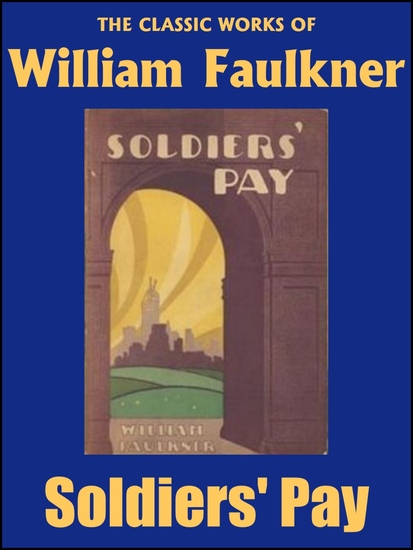
Soldiers' Pay - cover

Soldiers' Pay

William Faulkner

Verlag: Alien Ebooks

  • 0
  • 0
  • 0

Beschreibung

A group of soldiers travel by train across the United States in the aftermath of the First World War. One of them is horribly scarred, blind and almost entirely mute. Moved by his condition, a few civilian fellow travellers decided to see him home to Georgia, to a family who believed him dead, and a fiancée who grew tired of waiting. Faulkner’s first novel deals powerfully with lives blighted by war.
Verfügbar seit: 20.06.2023.
Drucklänge: 244 Seiten.

Weitere Bücher, die Sie mögen werden

  • Anna Karenina Part 3 - cover

    Anna Karenina Part 3

    Leo Tolstoy

    • 0
    • 0
    • 0
    In Part 3 of Anna Karenina, the divide between Anna and society deepens as her affair with Vronsky intensifies. Isolated from friends and family, Anna struggles with jealousy and despair, while Vronsky faces his own dilemmas balancing love and duty. Meanwhile, Levin marries Kitty, finding joy in domestic life and rural simplicity. Their contrasting paths highlight the tension between societal expectations and personal fulfillment. As autumn arrives, Tolstoy explores themes of sacrifice, identity, and the search for meaning, setting the stage for further emotional turmoil and reflection.
    Zum Buch
  • Tramps (Unabridged) - cover

    Tramps (Unabridged)

    Charles Dickens

    • 0
    • 0
    • 0
    Charles Dickens was a writer and social critic who created some of the world's best-known fictional characters and is regarded as the greatest novelist of the Victorian era. His works enjoyed unprecedented popularity during his lifetime, and by the twentieth century critics and scholars had recognised him as a literary genius. His novels and short stories enjoy lasting popularity.
    TRAMPS: The chance use of the word 'Tramp' in my last paper, brought that numerous fraternity so vividly before my mind's eye, that I had no sooner laid down my pen than a compulsion was upon me to take it up again, and make notes of the Tramps whom I perceived on all the summer roads in all directions.
    Zum Buch
  • West-Running Brook - cover

    West-Running Brook

    Robert Frost

    • 0
    • 0
    • 0
    "West-Running Brook" is a collection of poetry by the renowned American poet Robert Frost, first published in 1928. The title poem serves as the centerpiece of the collection, with the overarching theme of the flow of time and the interconnectedness of past, present, and future. 
    In "West-Running Brook," Frost uses the metaphor of a brook that flows contrary to the usual direction, symbolizing the poet's own journey against the current of conventional wisdom and tradition. The brook becomes a powerful symbol of resilience and individuality, as well as a reflection of the poet's own introspection and exploration of the human experience. 
    Throughout the collection, Frost's signature style of writing in accessible yet profound language is evident. His poetry often explores themes of nature, rural life, and the complexities of human existence. With vivid imagery and keen observation, Frost invites readers to contemplate the beauty and mystery of the natural world, as well as the deeper truths and universal truths that lie beneath the surface. 
    Among the notable poems in the collection are "Spring Pools," which reflects on the cyclical nature of life and the passage of time; "The Silken Tent," a metaphor for the delicate balance between strength and flexibility in human relationships; and "Desert Places," which explores themes of isolation and existential despair amidst the vastness of the natural world. 
    "West-Running Brook" showcases Frost's mastery of form and language, as well as his ability to capture the complexities of the human condition with depth and nuance. Through its exploration of timeless themes and its lyrical beauty, the collection remains a testament to Frost's enduring legacy as one of America's most beloved poets.
    Zum Buch
  • Persuasion - cover

    Persuasion

    Jane Austen

    • 0
    • 0
    • 0
    Persuasion by Jane Austen is a tale of love, regret, and second chances. Anne Elliot, a young woman, was once convinced to break off her engagement with Frederick Wentworth, a naval officer, due to societal pressures. Years later, Wentworth returns as a successful and wealthy man, and Anne finds herself drawn to him once more. As they navigate the complexities of their past and the challenges of their present, they must confront their unresolved feelings and decide if their love can withstand the test of time.
    Zum Buch
  • Evening Guest An - From their pens to your ears genius in every story - cover

    Evening Guest An - From their...

    Alexander Kuprin

    • 0
    • 0
    • 0
    Alexander Kuprin was born in Narovchat, Penza in Russia on 7th September 1870. 
    At 3 his Father died and he and mother moved to Moscow. By 10 he was enrolled at the Second Moscow Military High School and there his interest in literature began. The Alexander Military Academy followed and two years later he was a sub-lieutenant and posted to an Infantry Regiment for a further four years. 
    Despite his duties he was a now a keen writer and published his first short story at this time. His military duties also garnered him experiences for his breakthrough work ‘The Duel’.  Leaving the military he left for Kiev to work for local newspapers.  He continued to publish both stories and novels and by 1901 he was in St Petersburg becoming part of a group that included Chekhov, Ivan Bunin, Maxim Gorky and Leonid Andreyev.  
    In the years that followed further controversial works and acclaim followed.  His comments on the regime meant he was also put under secret police surveillance.   
    As World War I erupted, Kuprin opened a military hospital but was then given command of an infantry company in Finland. He was soon discharged on grounds of ill health.  
    The October Revolution saw him praise Lenin, but he warned that the Bolsheviks threatened Russian culture and might cause further widespread suffering to the peasants.  As Civil War raged he took his family to Helsinki and then on to Paris. 
    Exile saw his talents decline further and his succumbing to alcoholism. He became lonely and withdrawn. The family's poverty increased his malaise.   
    In May 1937, the Kuprin’s returned to Moscow.  He now saw his work published but wrote almost nothing new.  In 1938 his health rapidly deteriorated.  Already suffering from a kidney problems and sclerosis, he had now developed cancer of the oesophagus.  
    Alexander Kuprin died on 25th August 1938.
    Zum Buch
  • Madame Bovary - cover

    Madame Bovary

    Gustave Flaubert

    • 0
    • 0
    • 0
    Step into the intricately woven world of "Madame Bovary" by Gustave Flaubert, a poignant exploration of desire and disillusionment. Emma Bovary, yearning for a life of passion and luxury beyond her provincial existence, becomes ensnared in a web of debt and romantic liaisons. Her pursuit of an idealized life leads to inevitable heartbreak and tragedy. Flaubert's masterpiece unflinchingly examines the constraints of society and the personal cost of unfulfilled dreams, resonating with timeless relevance.
    Zum Buch