Junte-se a nós em uma viagem ao mundo dos livros!
Adicionar este livro à prateleira
Grey
Deixe um novo comentário Default profile 50px
Grey
Assine para ler o livro completo ou leia as primeiras páginas de graça!
All characters reduced
Astrological Time - cover
LER

Astrological Time

William F. Brown

Tradutor A AI

Editora: Publifye

  • 0
  • 0
  • 0

Sinopse

Astrological Time explores how ancient civilizations integrated astrology into their calendars, influencing predictions, rituals, and societal events. It reveals the intersection of history and science, demonstrating how cultures globally used astrological observations to understand time and destiny. Intriguingly, calendars served as tools for synchronization and prediction, vital for agriculture, religious ceremonies, and political strategies. The book argues that astrology was not mere superstition but a sophisticated system for understanding temporal cycles.

 
The book begins by introducing ancient astronomy and astrology, then examines specific examples of astrological calendars from various cultures, analyzing their structure, symbolism, and use. A section is dedicated to astrology's influence on religious and social practices.

 
Through archaeological findings, ancient texts, and comparative analyses, Astrological Time highlights common themes and unique adaptations in the use of astrology across cultures, providing a balanced perspective on its historical significance and enduring legacy.
Disponível desde: 04/03/2025.
Comprimento de impressão: 65 páginas.

Outros livros que poderiam interessá-lo

  • The Weimar Republic - Inflation Degeneration and Historicity - cover

    The Weimar Republic - Inflation...

    Kelly Mass

    • 0
    • 0
    • 0
    To summarize everything about this topic, the Weimar Republic was a disaster. Perhaps the setup of the republic wasn’t as much as fault as just the world events that led to the Great Depression, the eventual surrender of Germany to France, Russia, and England in World War I before that, and other significant changes in the economy at the time. 
    The Weimar Republic was a federal constitutional republic that lasted in Germany from 1918 to 1933. The German Reich (Deutsches Reich) was the main name of the state, which was also referred to as the German Republic (Deutsche Republik). The first word associates with the city of Weimar, which hosted the republic's first constituent assembly. The nation was typically described as "Germany" in English; the title "Weimar Republic" didn't become well-known till the 1930s. 
    Do you want to buy a few eggs with thousands of marks? How about a loaf of bread for ten thousand dollars? The inflation in the Weimar Republic led to a severe economic downturn, one that had probably never been there ever before. This led to other problems, which also explained the rise of Nazi Germany somewhat later. 
    If you want to understand all these things, then go ahead and get started.
    Ver livro
  • Cloud Computing for Beginners - Learn AWS Google Cloud and Azure to Future-Proof Your Career and Business - cover

    Cloud Computing for Beginners -...

    Johnny Nelson

    • 0
    • 0
    • 0
    Unlock the future of tech with Cloud Computing for Beginners: Learn AWS, Google Cloud, and Azure to Future-Proof Your Career and Business—the ultimate beginner’s guide to mastering the most powerful and in-demand cloud platforms in the world. Whether you’re a student, entrepreneur, IT professional, or career switcher, this audiobook will teach you the fundamentals of cloud computing in a way that’s clear, practical, and instantly applicable. 
    In today’s digital economy, cloud computing is no longer optional—it’s essential. This step-by-step audiobook demystifies the cloud and helps you understand how Amazon Web Services (AWS), Microsoft Azure, and Google Cloud Platform (GCP) are transforming the way businesses store data, build apps, automate systems, and scale globally. Learn how to harness the power of these platforms to increase efficiency, reduce costs, and unlock innovation in any industry. 
    Explore real-world use cases, from hosting websites and automating workflows to deploying machine learning models and securing sensitive data. You'll also discover key concepts like SaaS, IaaS, and PaaS, and gain insights into tools such as EC2, S3, BigQuery, Kubernetes, and more—all explained in plain language for non-technical learners. 
    With cloud computing skills in high demand across every sector, this audiobook offers a future-ready roadmap for those looking to launch or grow a tech career, boost their résumé, or transform their business operations. No prior experience needed—just a willingness to learn and the drive to stay competitive in a rapidly evolving digital world. 
    Future-proof your knowledge. Future-proof your income. Cloud Computing for Beginners is your gateway to the cloud-powered economy.
    Ver livro
  • How Not To F*CK UP in Medical School - cover

    How Not To F*CK UP in Medical...

    Aleksander Shur

    • 0
    • 0
    • 0
    Going to get higher education may be stressful, especially when you want to go to medical field. So, us, as medical students have gathered some ideas, recommendations, tips and lifehacks on how to ace you medical school without too much stress. So consider this your book your mentor into medical field, and wish you all the best in medicine!
    Ver livro
  • The History of England Volume 2 - King Henry III to King Richard III - cover

    The History of England Volume 2...

    David Hume

    • 0
    • 0
    • 0
    The second volume of David Hume’s classic survey of English history covers nearly 300 years (1200-1485) from the long reign of Henry III to the dramatic end of Richard III on Bosworth Field – he was the last Plantagenet, and the last king of England to die in battle. 
    In these last centuries of the medieval period, which culminated in the 30 years of the Wars of the Roses, England was ruled by 11 monarchs of varying personalities and abilities. These included the powerful figures of Edward I (reigning 1272-1307) whose authority stabilised the monarchy after his conflicted father; and Edward III (reigning 1327-1377) who similarly asserted his authority on the land following the weak rule of his father, Edward II.  
    After the disastrous reign of Richard II came the steady hand of Henry IV, (reigning 1399-1413), and the short but charismatic time of Henry V (reigning 1413-1422) with the highlight of Agincourt. This was followed by the 40-year reign of Henry VI (1422-1461/1470-71), a very different figure (characterised by Hume as ‘a weak prince, how gentle soever and innocent’). It led the way inexorably to the Wars of the Roses. 
    In telling this all-action tale, Hume delves deeply into contemporary records and presents a considered, even sympathetic view, showing that many factors, not just personalities, resulted in dramatic consequences for the nation. 
    In concluding each reign, he gives a character assessment of each individual who sat on the throne – at a time when strong rule was expected but not always delivered. Throughout, dissension was continually driven by conflicting pressures of political, familial, and commercial rivalries coloured and shaped by uncontrollable ambition.   
    Harnessing a wealth of detail, yet strong on judgement and opinion, Hume tells the story of this period with pace and the rich literary style, features which make The History of England in its entirety admired by historians even in the 21st century.
    Ver livro
  • Inside the Britannic - Uncovering the Wreck of the Titanic's Sister Ship - cover

    Inside the Britannic -...

    Simon Mills

    • 0
    • 0
    • 0
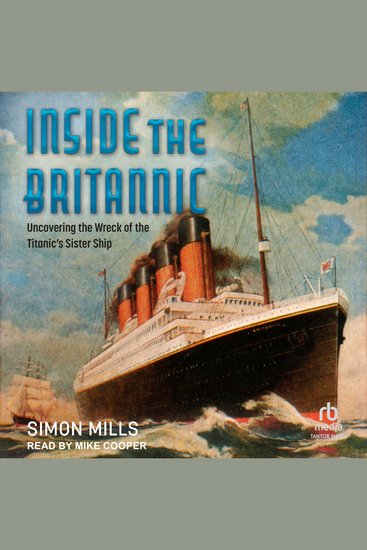
    The Olympic Class ships were intended to be the greatest liners to ever sail the oceans, but the Britannic sank only four years after her sister ship the Titanic. While the wreck of the Titanic is two miles below the surface and rapidly deteriorating, the Britannic is much more accessible (only 400 ft down) and remains largely intact. One of the largest passenger ships ever to have sunk, her wreck presents a unique opportunity to explore the interior of the Olympic Class liners, and examine areas which on the Titanic simply no longer exist. 


    Simon Mills bought the wreck of the Britannic in 1996 and has spent more time exploring it than anyone else. Inside the Britannic is the sum of decades of work covering every inch of the shipwreck as he searches for answers to century-old questions, and discovers new mysteries to solve. Simon takes a forensic approach but this book is more than just the autopsy report of a ship. 


    The Britannic may have been lost over a century ago, but Simon Mills's fascinating new book gives everyone unparalleled access to rediscover her.
    Ver livro
  • Understanding Human Evolution - cover

    Understanding Human Evolution

    Ian Tattersall

    • 0
    • 0
    • 0
    Human life, and how we came to be, is one of the greatest scientific and philosophical questions of our time. This compact and accessible book presents a modern view of human evolution. Written by a leading authority, it lucidly and engagingly explains not only the evolutionary process, but the technologies currently used to unravel the evolutionary past and emergence of Homo sapiens. By separating the history of palaeoanthropology from current interpretation of the human fossil record, it lays numerous misconceptions to rest, and demonstrates that human evolution has been far from the linear struggle from primitiveness to perfection that we've been led to believe. It also presents a coherent scenario for how Homo sapiens contrived to cross a formidable cognitive barrier to become an extraordinary and unprecedented thinking creature. Understanding Human Evolution is for anyone interested in the complex and tangled story of how we came to be.
    Ver livro