¡Acompáñanos a viajar por el mundo de los libros!
Añadir este libro a la estantería
Grey
Escribe un nuevo comentario Default profile 50px
Grey
Suscríbete para leer el libro completo o lee las primeras páginas gratis.
All characters reduced
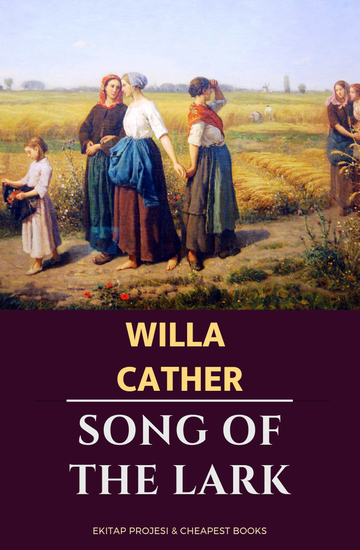
Song of the Lark - cover

Song of the Lark

Willa Cather

Editorial: E-Kitap Projesi & Cheapest Books

  • 0
  • 0
  • 0

Sinopsis

Song of the Lark is the third novel by American author Willa Cather, written in 1915. It is generally considered to be the second novel in Cather's Prairie Trilogy, following O Pioneers! (1913) and preceding My Ántonia (1918).


The book tells the story of a talented artist born in a small town in Colorado who discovers and develops her singing voice. Her story is told against the backdrop of the burgeoning American West in which she was born in a town along the rail line, of fast-growing Chicago near the turn of the twentieth century, and of the audience for singers of her skills in the US compared to Europe. Thea Kronborg grows up, learning herself, her strengths and her talent, until she reaches success.


The title comes from a painting of the same name by Jules Breton in 1884 and part of the collection of the Art Institute of Chicago.


FRIENDS OF CHILDHOOD


Dr. Howard Archie had just come up from a game of pool with the Jewish clothier and two traveling men who happened to be staying overnight in Moonstone. His offices were in the Duke Block, over the drug store. Larry, the doctor's man, had lit the overhead light in the waiting-room and the double student's lamp on the desk in the study. The isinglass sides of the hard-coal burner were aglow, and the air in the study was so hot that as he came in the doctor opened the door into his little operating-room, where there was no stove. The waiting room was carpeted and stiffly furnished, something like a country parlor. The study had worn, unpainted floors, but there was a look of winter comfort about it. The doctor's flat-top desk was large and well made; the papers were in orderly piles, under glass weights. Behind the stove a wide bookcase, with double glass doors, reached from the floor to the ceiling. It was filled with medical books of every thickness and color. On the top shelf stood a long row of thirty or forty volumes, bound all alike in dark mottled board covers, with imitation leather backs.


As the doctor in New England villages is proverbially old, so the doctor in small Colorado towns twenty-five years ago was generally young. Dr. Archie was barely thirty. He was tall, with massive shoulders which he held stiffly, and a large, well-shaped head. He was a distinguished-looking man, for that part of the world, at least.
Disponible desde: 05/12/2023.
Longitud de impresión: 500 páginas.

Otros libros que te pueden interesar

  • War and Peace - Book 15: 1812-13 (Unabridged) - cover

    War and Peace - Book 15: 1812-13...

    Leo Tolstoy

    • 0
    • 0
    • 0
    War and Peace is a literary work mixed with chapters on history and philosophy by the Russian author Leo Tolstoy. It was first published serially, then published in its entirety in 1869. It is regarded as one of Tolstoy's finest literary achievements and remains an internationally praised classic of world literature.
    Book 15: 1812-13: When seeing a dying animal a man feels a sense of horror: substance similar to his own is perishing before his eyes. But when it is a beloved and intimate human being that is dying, besides this horror at the extinction of life there is a severance, a spiritual wound, which like a physical wound is sometimes fatal and sometimes heals, but always aches and shrinks at any external irritating touch.
    Ver libro
  • Moby Dick - Key Insights - cover

    Moby Dick - Key Insights

    Herman Melville

    • 0
    • 0
    • 0
    Moby Dick is more than a tale of the sea—it is a journey into the depths of ambition, destiny, and human endurance. Through the relentless pursuit of the legendary white whale, listeners are carried into storms of nature and storms of the soul. This timeless adventure explores courage, obsession, unity, and the price of chasing greatness. With its powerful imagery and stirring narrative, it is a story that reminds us that true purpose demands both strength and sacrifice. Perfect for anyone seeking not only a gripping tale but also a reflection on life’s greatest challenges, this audiobook is a voyage you will never forget.
    Ver libro
  • The Bishop's Apron - cover

    The Bishop's Apron

    Somerset Maugham

    • 0
    • 0
    • 0
    "The Bishop's Apron" is a novel written by W. Somerset Maugham, a British playwright and author, first published in 1906. The book is known for its wit, humor, and exploration of themes related to social class, morality, and the clergy. 
     
    The novel is set in the fictional English cathedral town of Polchester and revolves around the lives of the clergy, particularly the Bishop of Polchester, Archdeacon Cuthbert, and the charming and somewhat unconventional Canon Ronder. The story's central plot is set in motion when the Bishop loses his cherished apron, an heirloom with great sentimental value. The missing apron leads to a series of misunderstandings, secrets, and humorous situations involving the clergy and the local community. 
     
    As the narrative unfolds, Maugham delves into the lives and relationships of the clergy, revealing their human foibles, desires, and struggles beneath their respectable exteriors. The characters grapple with questions of morality, faith, and the tension between their spiritual callings and earthly desires. 
     
    "The Bishop's Apron" is often classified as a social satire and comedy of manners. Maugham employs his signature wit and keen observation of human nature to create a humorous and satirical portrayal of the clergy and the society in which they live. Through his characters, he explores the hypocrisy and absurdity often associated with the upper echelons of society and the church. 
     
    While "The Bishop's Apron" may not be as well-known as some of Maugham's other works like "Of Human Bondage" or "The Razor's Edge," it remains a noteworthy contribution to his body of work. The novel provides a window into the Edwardian era in England and offers a witty and entertaining examination of the human condition, morality, and the quirks of English society.
    Ver libro
  • Betty Brown the St Giles Orange Girl - From their pens to your ears genius in every story - cover

    Betty Brown the St Giles Orange...

    Hannah More

    • 0
    • 0
    • 0
    Hannah More was born on February 2nd, 1745 at Fishponds in the parish of Stapleton, near Bristol. She was the fourth of five daughters. 
    The City of Bristol, at that time, was a centre for slave-trading and Hannah would, over time, become one of its staunchest critics.  
    She was keen to learn, possessed a sharp intellect and was assiduous in studying.  Hannah first wrote in 1762 with The Search after Happiness (by the mid-1780s some 10,000 copies had been sold). 
    In 1767 Hannah became engaged to William Turner.  After six years, with no wedding in sight, the engagement was broken off.  Turner then bestowed upon her an annual annuity of £200.  This was enough to meet her needs and set her free to pursue a literary career.   
    Her first play, The Inflexible Captive, was staged at Bath in 1775. The famous David Garrick himself produced her next play, Percy, in 1777 as well as writing both the Prologue and Epilogue for it.  It was a great success when performed at Covent Garden in December of that year.  
    Hannah turned to religious writing with Sacred Dramas in 1782; it rapidly ran through nineteen editions. These and the poems Bas-Bleu and Florio (1786) mark her gradual transition to a more serious and considered view of life. 
    Hannah contributed much to the newly-founded Abolition Society including, in February 1788, her publication of Slavery, a Poem recognised as one of the most important of the abolition period.   
    Her work now became more evangelical.  In the 1790s she wrote several Cheap Repository Tracts which covered moral, religious and political topics and were both for sale or distributed to literate poor people.  The most famous is, perhaps, The Shepherd of Salisbury Plain, describing a family of incredible frugality and contentment. Two million copies of these were circulated, in one year. 
    In 1789, she purchased a small house at Cowslip Green in Somerset. She was instrumental in setting up twelve schools in the area by 1800. 
    She continued to oppose slavery throughout her life, but at the time of the Abolition Bill of 1807, her health did not permit her to take as active a role in the movement as she had done in the late 1780s, although she maintained a correspondence with Wilberforce and others.  
    In July 1833, the Bill to abolish slavery throughout the British Empire passed in the House of Commons, followed by the House of Lords on August 1st. 
    Hannah More died on September 7th, 1833.
    Ver libro
  • Education that Educates (Unabridged) - cover

    Education that Educates...

    Booker T. Washington

    • 0
    • 0
    • 0
    Booker Taliaferro Washington (April 5, 1856 - November 14, 1915) was an American educator, author, orator, and adviser to several presidents of the United States. Between 1890 and 1915, Washington was the dominant leader in the African American community and of the contemporary black elite. Washington was from the last generation of black American leaders born into slavery and became the leading voice of the former slaves and their descendants. They were newly oppressed in the South by disenfranchisement and the Jim Crow discriminatory laws enacted in the post-Reconstruction Southern states in the late 19th and early 20th centuries. EDUCATION THAT EDUCATES: Perhaps I am safe in saying that during the last ten days you have not given much systematic effort to book study in the usual sense. When interruptions come such as we have just had, taking you away from your regular routine work and study, and the preparation of routine lessons is interrupted, the first thought to some may be that this time is lost, in so far as it relates to education in the ordinary sense; that it is so much time taken away from that part of one's life that should be devoted to acquiring education.
    Ver libro
  • Notes From the Underground - cover

    Notes From the Underground

    Fyodor Dostoyevsky

    • 0
    • 0
    • 0
    Notes from the Underground is Dostoevsky's early masterpiece and is one of the first examples of existentialist literature.
    
    Dostoevsky's narrator is the anonymous voice of the masterful novella. Retired and isolated from society, he is bitter, contemptuous, and contemplative as he presents his anecdotes and philosophical outlooks. Presented as an extract from the narrator's memoirs, Notes from the Underground is divided into two parts. Opening with a monologue attacking Western philosophy, Dostoevsky follows this theoretical exploration with the anti-hero's accounts of various destructive and restorative life experiences.
    
    First published in 1864, Notes from the Underground is an analysis of human psychology and demonstrates Dostoevsky's sharp wit and keen understanding of the psyche.
    
    Fyodor Dostoyevsky was a Russian novelist, journalist, and short-story writer who had an immense influence on 20th-century fiction. He is commonly regarded as one of the finest novelists who ever lived, penning classics that include: Crime and Punishment, The Idiot, Demons, and The Brothers Karamazov. His ideas profoundly shaped literary modernism, existentialism, and various schools of psychology, theology, and literary criticism.
    Ver libro