Rejoignez-nous pour un voyage dans le monde des livres!
Ajouter ce livre à l'électronique
Grey
Ecrivez un nouveau commentaire Default profile 50px
Grey
Abonnez-vous pour lire le livre complet ou lisez les premières pages gratuitement!
All characters reduced
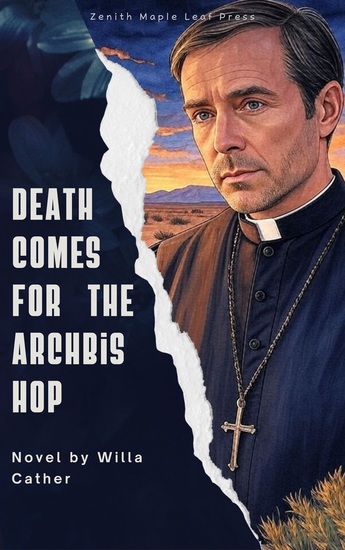
Death Comes for the Archbishop - A Lyrical Masterpiece of Faith Friendship and the American Frontier - cover

Death Comes for the Archbishop - A Lyrical Masterpiece of Faith Friendship and the American Frontier

Willa Cather, Zenith Maple Leaf Press

Maison d'édition: Zenith Maple Leaf Press

  • 0
  • 0
  • 0

Synopsis

Two priests. One vast, untamed land. A lifelong mission of service and faith.
In Death Comes for the Archbishop, Willa Cather paints a luminous portrait of the American Southwest in the mid-19th century, following the lives of Bishop Jean Marie Latour and his loyal friend Father Joseph Vaillant. Sent from France to establish a diocese in New Mexico, they face a landscape of deserts, mountains, and diverse cultures—Mexican, Native American, and Anglo—each with its own challenges and beauty.

Through a series of interwoven episodes rather than a traditional plot, Cather captures the quiet heroism of their work, the strength of their friendship, and the profound connection between spirituality and the land. Her prose, rich in imagery and restraint, turns history into a timeless meditation on faith, perseverance, and cultural understanding.

"A beautiful, moving story told with poetic simplicity."
– The New York Times

"One of the great novels of the American West and of spiritual endurance."
– The Guardian

✅ Why Readers Love It:
🌄 Evocative descriptions of the landscapes and cultures of the American Southwest

✝️ A deeply human portrayal of religious service and moral courage

📚 A modern classic beloved by readers of historical and literary fiction

🎯 Click 'Buy Now' to journey across deserts and mountains—and into the heart of one of Willa Cather's most profound works.
Disponible depuis: 11/08/2025.
Longueur d'impression: 233 pages.

D'autres livres qui pourraient vous intéresser

  • David Copperfield Volume 1 - cover

    David Copperfield Volume 1

    Charles Dickens

    • 0
    • 0
    • 0
    "David Copperfield" by Charles Dickens is a semi-autobiographical novel that chronicles the life of its titular protagonist as he navigates love, loss, and self-discovery. From his difficult childhood and oppressive stepfather to his struggles as an aspiring writer, David’s journey reflects resilience and growth. Along the way, he encounters a vivid cast of characters, including the kind-hearted Peggoty, the eccentric Mr. Micawber, and the manipulative Uriah Heep. Dickens explores themes of class, ambition, and redemption, blending humor, pathos, and social critique. Through David’s triumphs and trials, the novel paints a rich portrait of Victorian society while celebrating the enduring power of friendship, forgiveness, and personal determination. A timeless tale of hope and transformation.
    Voir livre
  • Notes From the Underground - cover

    Notes From the Underground

    Fyodor Dostoyevsky

    • 0
    • 0
    • 0
    Notes from the Underground is Dostoevsky's early masterpiece and is one of the first examples of existentialist literature.
    
    Dostoevsky's narrator is the anonymous voice of the masterful novella. Retired and isolated from society, he is bitter, contemptuous, and contemplative as he presents his anecdotes and philosophical outlooks. Presented as an extract from the narrator's memoirs, Notes from the Underground is divided into two parts. Opening with a monologue attacking Western philosophy, Dostoevsky follows this theoretical exploration with the anti-hero's accounts of various destructive and restorative life experiences.
    
    First published in 1864, Notes from the Underground is an analysis of human psychology and demonstrates Dostoevsky's sharp wit and keen understanding of the psyche.
    
    Fyodor Dostoyevsky was a Russian novelist, journalist, and short-story writer who had an immense influence on 20th-century fiction. He is commonly regarded as one of the finest novelists who ever lived, penning classics that include: Crime and Punishment, The Idiot, Demons, and The Brothers Karamazov. His ideas profoundly shaped literary modernism, existentialism, and various schools of psychology, theology, and literary criticism.
    Voir livre
  • Helen of Troy: The Dark Shadow of Desire - cover

    Helen of Troy: The Dark Shadow...

    Deivede Eder Ferreira

    • 0
    • 0
    • 0
    Helena de Tróia: A Sombra Negra do Desejo 
    The most beautiful woman in history. The most dangerous desire ever known. 
    Helen of Troy—queen, lover, myth. A woman whose name ignited a thousand ships and plunged empires into war. But was she truly the cause of Troy’s fall, or just a pawn in a battle far greater than herself? Was she a seductress, a victim, or something far more complex? 
    This audiobook takes you beyond the legend, unraveling the untold story of Helen through the lens of passion, power, and psychology. Blending myth with deep psychoanalytic insights from Freud and Lacan, it exposes the truth behind the woman history could never define. 
    She was more than beauty. She was a force of nature. And she was never truly free. 
    A gripping, immersive experience that will change the way you see one of history’s most infamous women. 
    Are you ready to uncover the dark shadow of desire? Press play and step into Helen’s world.
    Voir livre
  • A Cullenden of Virginia - From their pens to your ears genius in every story - cover

    A Cullenden of Virginia - From...

    Thomas Wolf

    • 0
    • 0
    • 0
    Thomas Clayton Wolfe was born at the family home, 92 Woodfin Street, in Asheville, North Carolina on October 3rd, 1900.  
    Aged 15, Wolfe began his studies at the University of North Carolina at Chapel Hill (UNC) where he enrolled in a playwriting course. Wolfe graduated in 1920 and enrolled at the Graduate School for Arts and Sciences at Harvard. Here he studied playwriting under the tutelage of George Pierce Baker. In 1922 he received his master's degree from Harvard.  
    Wolfe now began the transition from studying to commercial playwright. He went to New York in November, 1923 trying to sell his plays to Broadway.  The Theatre Guild came close to producing Welcome to Our City but in the end declined.  Wolfe now believed his style of writing was more suited to fiction.  Grasping the opportunity this afforded him he sailed to England in October 1924 to write and from there on to France, Italy and Switzerland. 
    In 1926 Wolfe began writing a novel, O Lost. This would eventually become Look Homeward, Angel. It was based on his years in Asheville. The original manuscript of O Lost was over 1100 pages. Maxwell Perkins, one of the great book editors of the age, worked at his publishers, Scribner’s and he began to focus the book, cutting and re-shaping it to center it on the character of Eugene.   
    The novel was published in 1929. It was a success.   
    Wolfe now committed the next 4 years to writing a multi-volume epic entitled The October Fair.  At Scribner’s Perkins once more decided to edit it down to a single volume; Of Time and the River.  It was even more successful than his first. It was hailed as the literary event of 1935 and cemented his reputation as one of America’s foremost novelists.  
    In 1938, after submitting his new opus, which ran to an incredible one million words, to his new editor, Edward Aswell, Wolfe left to tour the West, a part of the country he had never before visited. Whilst travelling Wolfe became ill with pneumonia and spent three weeks in a Seattle hospital. Complications arose. The prognosis was serious.  He was diagnosed with miliary tuberculosis of the brain. 
    On September 6th, he was sent to Baltimore's Johns Hopkins Hospital for treatment. The ensuing operation revealed that the disease had overrun the entire right side of his brain.  
    Thomas Clayton Wolfe never regained consciousness and died shortly before his 38th birthday on September 15th, 1938.
    Voir livre
  • The Call of the Wild - cover

    The Call of the Wild

    Jack London

    • 0
    • 0
    • 0
    Buck, a sturdy crossbreed canine (half St. Bernard, half Shepard), is a dog born to luxury and raised in a sheltered Californian home. But then he is kidnapped and sold to be a sled dog in the harsh and frozen Yukon Territory. Passed from master to master, Buck embarks on an extraordinary journey, proving his unbreakable spirit... 
    First published in 1903, The Call of the Wild is regarded as Jack London's masterpiece. Based on London's experiences as a gold prospector in the Canadian wilderness and his ideas about nature and the struggle for existence, The Call of the Wild is a tale about unbreakable spirit and the fight for survival in the frozen Alaskan Klondike. 
    No other popular writer of his time did any better writing than you will find in "The Call of the Wild". —H. L. Mencken. 
    Few men have more convincingly examined the connection between the creative powers of the individual writer and the unconscious drive to breed and to survive, found in the natural world… London is in and committed to his creations to a degree very nearly unparalleled in the composition of fiction. —James Dickey
    Voir livre
  • After the Race - From their pens to your ears genius in every story - cover

    After the Race - From their pens...

    James Joyce

    • 0
    • 0
    • 0
    James Augustine Aloysius Joyce was born on the 2nd February 1882 in Dublin into a middle-class family, and the eldest of ten surviving siblings 
    Admired as a brilliant student he briefly attended the Christian Brothers-run O'Connell School before excelling at the Jesuit schools of Clongowes and Belvedere.  From there he went on to attend University College Dublin from 1898, studying English, French and Italian 
    In 1902, Joyce was now in his early twenties, and went to Paris to study Medicine but soon abandoned his teachings.  Back in Dublin to attend to his dying Mother he met Nora Barnacle. They bonded immediately into a life-long match. Together they decided to emigrate to Europe.  The couple lived in Trieste, Rome, Paris, and finally Zürich where Joyce pursued a variety of jobs and ventures to supplement his literary pursuits but none of these paid off.  
    After publishing a poetry volume, ‘Chamber Music’, in 1907, his short story collection ‘The Dubliners’, in 1914, helped establish his talent in the rapidly changing world.  
    Although far from home Joyce’s literary heart and works were set in his recollections of Dublin.  Characters are close resemblances of family and friends and indeed enemies.  His landmark work ‘Ulysses’, published in 1922, is set in the streets and alleyways of the city as it parallels Homer’s Odyssey in a variety of styles including its famed stream of consciousness. 
    His pen continued to produce classics of the order of ‘A Portrait of the Artist as A Young Man’ and ‘Finnegan’s Wake’ together with several volumes of poetry and a play ‘The Exiles, in 1918.   
    On the 11th January 1941, Joyce underwent surgery in Zürich for a perforated duodenal ulcer. The next day he fell into a coma. On the 13th after a brief period of lucidity in which he called for his wife and son he passed.  He was 58.
    Voir livre