Junte-se a nós em uma viagem ao mundo dos livros!
Adicionar este livro à prateleira
Grey
Deixe um novo comentário Default profile 50px
Grey
Assine para ler o livro completo ou leia as primeiras páginas de graça!
All characters reduced
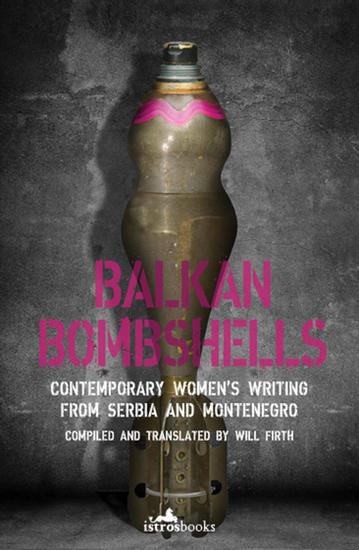
Balkan Bombshells - Contemporary Women's Writing from Serbia and Montenegro - cover
LER

Balkan Bombshells - Contemporary Women's Writing from Serbia and Montenegro

Will Firth

Editora: Istros Books

  • 0
  • 0
  • 0

Sinopse

A collection to whet the appetite of anyone wishing to learn more about a region rich in history, folklore and (her)stories. Telling it like a woman does not mean literature for women only: it provides an insight into half of humanity, a window onto the lives of citizens who work, love and develop their inner lives. This collection brings together the voices of a wide selection of prize-winning and established authors:
Balkan Bombshells brings together established Serbian and Montenegrin writers like Svetlana Slapšak, Jelena Lengold (winner of the EU Prize for Literature 2013), Dana Todorović and Olja Kneżević (author of Catherine the Great and the Small, Istros 2020), together with a select group of up-coming writers: Marijana Čanak (1982, Serbia): "Awakened" (Probuđena) follows the early years of a girl from a very simple background, who discovers she has extrasensory powers. A gruesome fascination with biology allows her to attend high school, where she ends up sewing a voodoo doll to take revenge on a molesting teacher. Marijana Dolić (1990, Bosnia-Herzegovina & Serbia): "Notes from the attic" (Zapisi iz potkrovlja), originally diary entries, are intense mediatations on faith, love and hope – poignant testimony to a struggle to cope in difficult times. Ana Miloš (1992, Serbia): "Peace" (Mir) portrays a woman struggling with disparate feelings after her only child dies. She has long since broken up with the child's father. She enjoys finally having time for herself, but she has to confront accusations of people around her that she is heartless. Once a mother, always a mother? Katarina Mitrović (1991, Serbia):"Small death" (Mala smrt). We are introduced to a fearful young woman who is far from happy with life, and we follow her on a summer holiday by the Adriatic, where a halfhearted romantic adventure takes a scary turn. Andrea Popov Miletić (1985, Serbia):|: excerpt from the novel Young pioneers, we are seaweed (Pioniri maleni, mi smo morska trava; 2019). This stand-alone excerpt is a poetic flashback to her childhood in the province of Vojvodina in the Yugoslav era, to holidays by the Mediterranean, and to feelings of belonging and home. Lena Ruth Stefanović (1970, Sebria/ Montenegro): "Zhenya" is a fragment from her 2016 novel Daughter of the Childless Man (Šćer onoga bez đece), is an entertaining meta-story about an ordinary woman in the late Soviet Union, whom the author decides to grant a new lease of life, so Zhenya studies languages, becomes a mondain writer and moves with her new husband to Montenegro, where the author loses track of her.
Disponível desde: 20/02/2023.
Comprimento de impressão: 150 páginas.

Outros livros que poderiam interessá-lo

  • The Affair At Coulter's Creek - From their pens to your ears genius in every story - cover

    The Affair At Coulter's Creek -...

    Ambrose Bierce

    • 0
    • 0
    • 0
    Ambrose Gwinnett Bierce was born on 24th June 1842 at Horse Cave Creek in Meigs County, Ohio. His parents were poor but they introduced him to literature at an early age, instilling in him a deep appreciation of books, the written word and the elegance of language.  
    Growing up in Koscuisko County, Indiana poverty and religion were defining features of his childhood, and he would later describe his parents as “unwashed savages” and fanatically religious, showing him little affection but always quick to punish. He came to resent religion, and his introduction to literature appears to be their only positive effect. 
    At age 15 Bierce left home to become a printer’s devil, mixing ink and fetching type at The Northern Indian, a small Ohio paper. Falsely accused of theft he returned to his farm and spent time sending out work in the hopes of being published. 
    His Uncle Lucius advised he be sent to the Kentucky Military Institute. A year later he was commissioned as an Officer.  As the Civil War started Bierce enlisted in the 9th Indiana Infantry Regiment.  
    In April 1862 Bierce fought at the Battle of Shiloh, an experience which, though terrifying, became the source of several short stories. Two years later he sustained a serious head wound and was off duty for several months. He was discharged in early 1865.  
    A later expedition to inspect military outposts across the Great Plains took him all the way to San Francisco. He remained there to become involved with publishing and editing and to marry, Mary Ellen on Christmas Day 1871.  They had a child, Day, the following year.  
    In 1872 the family moved to England for 3 years where he wrote for Fun magazine. His son, Leigh, was born, and first book, ‘The Fiend’s Delight’, was published.  
    They returned to San Francisco and to work for a number of papers where he gained admiration for his crime reporting. In 1887 he began a column at the William Randolph Hearst’s San Francisco Examiner.  
    Bierce’s marriage fell apart when he discovered compromising letters to his wife from a secret admirer. The following year, 1889 his son Day committed suicide, depressed by romantic rejection. 
    In 1891 Bierce wrote and published the collection of 26 short stories which included ‘An Occurrence at Owl Creek Bridge’.  Success and further works including poetry followed.  
    Bierce with Hearst’s resources helped uncover a financial plot by a railroad to turn 130 million dollars of loans into a handout. Confronted by the railroad and asked to name his price Bierce answered “my price is $130 million dollars. If, when you are ready to pay, I happen to be out of town, you may hand it over to my friend, the Treasurer of the United States”.  
    He now began his first foray as a fabulist, publishing ‘Fantastic Fables’ in 1899.  But tragedy again struck two years later when his second son Leigh died of pneumonia relating to his alcoholism.  
    He continued to write short stories and poetry and also published ‘The Devil’s Dictionary’.  
    At the age of 71, in 1913 Bierce departed from Washington, D.C., for a tour of the battlefields where he had fought during the civil war. At the city of Chihuahua he wrote his last known communication, a letter to a friend. It’s closing words were “as to me, I leave here tomorrow for an unknown destination,” Ambrose Bierce then vanished without trace.
    Ver livro
  • Frederick Cowles - Six of the Best - Their legacy in 6 classic stories - cover

    Frederick Cowles - Six of the...

    Frederick Cowles

    • 0
    • 0
    • 0
    Six has always been a number we group things around – Six of the best, six of one half a dozen of another, six feet under, six pack, six degrees of separation and a sixth sense are but a few of the ways we use this number. 
     
    Such is its popularity that we thought it is also a very good way of challenging and investigating an author’s work to give width, brevity, humour and depth across six of their very best. 
     
    In this series we gather together authors whose short stories both rivet the attention and inspire the imagination to visit their gems in a series of six, to roam across an author’s legacy in a few short hours and gain a greater understanding of their writing and, of course, to be lavishly entertained by their ideas, their narrative and their way with words. 
     
    These stories can be surprising and sometimes at a tangent to what we expected, but each is fully formed and a marvellous adventure into the world and words of a literary master.
    Ver livro
  • Year's Best Fantasy 4 - cover

    Year's Best Fantasy 4

    David G. Hartwell, Kathryn Cramer

    • 0
    • 0
    • 0
    There is magic in our world . . . and in others.The fertile imagination can cultivate wondrous things, aided by ancient myths and memory, enduring childhood dreams and desires, and the power of cultural archetypes. Once again, award-winning editors David G. Hartwell and Kathryn Cramer reap a magnificent crop of superior fantasy short fiction -- the finest to blossom over the past twelve months. A cornucopia of remarkable tales from some of the field’s most acclaimed artists -- Neil Gaiman, Octavia Butler, Tanith Lee, and Michael Swanwick, to name but a few -- as well as stunning new works from emerging young talents, Year's Best Fantasy 4 is a collection as magical as its illustrious predecessors, a feast for every true connoisseur of fantastic literature.
    Ver livro
  • Kenta's Way - The lazy samurai - cover

    Kenta's Way - The lazy samurai

    Fritz Angelo

    • 0
    • 0
    • 0
    "A story about a young samurai student who preferred laziness over hard work until one day, his life will change forever."
    Ver livro
  • Ladies’ Lunch - And Other Stories - cover

    Ladies’ Lunch - And Other Stories

    Lore Segal

    • 0
    • 0
    • 0
    "For almost six decades Segal has quietly produced some of the best fiction and essays in American literature . . ." —The New York Times 


    Beloved New Yorker writer Lore Segal, at ninety-five years old, is a national treasure. Working at the height of her powers, in this story collection she turns her gimlet eye and compassionate humor on aging and life in the slow lane. 


    From the master of the short short comes a collection of sixteen new stories featuring old friends who have loved and lunched together for over forty years. These erudite, sharp-minded nonagenarians offer startling insights into friendship, family and aging. 


    Can the group organize a visit to one of their number in her new, and detested, assisted living situation? Is this a fabulous party with old friends, or a funeral reception? And does who was sleeping with whom, way back when, still matter? 


    In story after story, Segal's voice is always hilarious and urbane, heartbreaking and profound, keen and utterly unsentimental, as she tackles aging's affronts.
    Ver livro
  • Imaginative Woman An - From their pens to your ears genius in every story - cover

    Imaginative Woman An - From...

    Thomas Hardy

    • 0
    • 0
    • 0
    Thomas Hardy was born in the hamlet of Upper Bockhampton about three miles east of Dorchester in Dorset, England, on 2nd June 1840.  
    Despite a fairly wide education and being an avid reader his parents thought it unlikely he would lead a successful scholarly or clerical career and he was apprenticed in 1856, at age 16, to a local architect whose speciality was in church restoration.  Hardy’s only opportunity to read was in the morning before work between the hours of five and eight.  
    On the back of a failed love affair he moved to London and spent five years working as an assistant to the architect Arthur Blomfield, also a restorer and designer of churches. Hardy though had by now become disillusioned with institutionalised forms of Christianity and abandoned any lingering hopes of ordination in the Anglican Church.  However, his writing of poetry was now flourishing, although it was still rejected for publication.  
    His novel ‘Desperate Remedies’, was published anonymously in 1871 and he now resolved to write full time though he was not yet in a position to achieve financial security or literary success. His second novel, ‘Under the Greenwood Tree’, appeared in 1872 and in 1873 ‘A Pair of Blue Eyes’, the most autobiographical of his works arrived. With ‘Far From the Madding Crowd’ in 1874, came critical acclaim, public attention and financial success. This was repeated in 1878 with ‘The Return of the Native’, and the ensuing years saw him rise to ever greater popularity.  
    His classic ‘The Mayor of Casterbridge’ arrived in 1886 and 5 years later ‘Tess of the d’Urbervilles’. The latter only saw publication after extensive alterations to its plot and the deletion of long passages to lessen the shock to the prudish Victorian audience who were dismayed by the seduction and ruin of a young girl by a rakish aristocrat.  
    ‘Jude the Obscure’, his last novel, suffered the same fate when it was published in 1895.  The uproar so disturbed him that he returned to poetry. In 1898 he had an earlier poetry collection, ‘Wessex Poems’ published. 
    Hardy spent the years between 1903 and 1908 writing ‘The Dynasts’, an epic poem on the Napoleonic Wars. 
    In his twilight years came honours and awards from the great and the good in recognition of his stature as one of the most outstanding of British authors across novels, short stories and poetry. George V conferred on him the Order of Merit in 1910. 
    From 1920 to 1927 he worked, in secret, on his autobiography, which was later published after his death as the work of his second wife, Florence Hardy.  
    Thomas Hardy OM died on the 11th January 1928. 
    His heart was buried alongside his first wife in Stinsford churchyard, Dorchester.
    Ver livro