Unisciti a noi in un viaggio nel mondo dei libri!
Aggiungi questo libro allo scaffale
Grey
Scrivi un nuovo commento Default profile 50px
Grey
Iscriviti per leggere l'intero libro o leggi le prime pagine gratuitamente!
All characters reduced
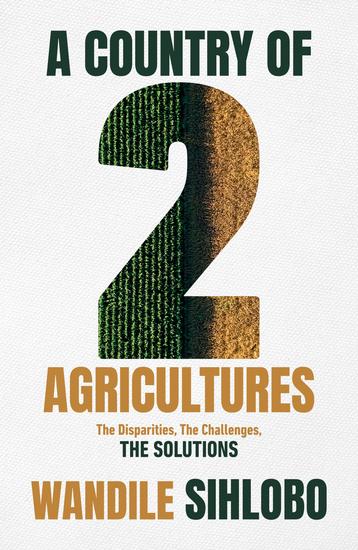
A Country of Two Agricultures - cover

A Country of Two Agricultures

Wandile Sihlobo

Casa editrice: Tracey McDonald Publishers

  • 0
  • 0
  • 0

Sinossi

Nearly three decades after the dawn of democracy, South Africa has remained a country of 'two agricultures'. On the one hand we have a subsistence, primarily non-commercial, black farming segment. On the other hand, however, we have a predominantly commercial and white farming sector that is well-resourced and has access to domestic and international trade networks.
These disparities can be traced back to South Africa's painful history where, for decades, black farmers were on the margins of government support and also experienced land dispossession and livestock plunder.
A Country of Two Agricultures focuses less on history and more on the present and the future, explaining why these disparities have persisted in the democratic era, and what it will take to overcome them. It aims to contribute to a better understanding of the variety of agricultural forces, taking into account both questions of domestic political economy and external factors, as well as to bring to light new risks and opportunities.
Wandile Sihlobo offers insights into the role of agriculture in the South African economy from an agricultural economy perspective, and provides political economy insights that are rooted in the experiences of farming communities on the ground and right through the value chain.
Beyond insights on the realities this book offers the government, the private sector, and anyone interested in the betterment of the South African economy, tools to grapple with this duality, and proposes a framework for bolstering the black farming segment for growth and competitiveness – and ultimately food security.
Wandile Sihlobo is the Chief Economist of the Agricultural Business Chamber of South Africa (Agbiz) and the author of Finding Common Ground: Land, Equity and Agriculture.
Disponibile da: 14/08/2023.
Lunghezza di stampa: 216 pagine.

Altri libri che potrebbero interessarti

  • Dark Psychology 10 - Master the Secrets Science of Silent Domination Subconscious Influence and Unseen Behavioral Control Techniques - cover

    Dark Psychology 10 - Master the...

    Halbert Ward

    • 0
    • 0
    • 0
    Peek Behind the Curtain:  
    Uncover and Harness Dark Psychology 101! 
    Hey there, have you heard about Dark Psychology?  
    Has anyone ever broached the subject with you?  
    Chances are, most people haven't, which is typical. In the gloomy recesses of consciousness, ideas echo and feelings swirl, this is the domain of Dark Psychology, an underappreciated subfield of psychology. Because of the associated taboos, people avoid talking about this subject. In addition to illuminating the forces, "Dark Psychology 1.0" will teach you how to harness or fight against their power.  
    Come explore the uncharted territory of subconscious influence with Halbert Ward, where your thoughts are both your weapon and your strategy. Prepare to be swept away into the shadowy realm of Dark Psychology as he grants you access to the hidden playbook of the human mind. 
    Beyond being just a book, "Dark Psychology 1.0" is your ticket to deciphering the unseen influences that mold our emotions, ideas, and deeds. Ward encourages you to think about the moral quandaries that come with Dark Psychology and to use psychological knowledge responsibly by posing ethical questions. 
    Fasten your seatbelts for a mind-bending voyage that will reveal secrets and test your perceptions. 
    Are you brave enough to flip the page? 
    Get Your Copy Now!
    Mostra libro
  • Summary of Thinking Fast and Slow - 80 mins with the top ideas in the book - cover

    Summary of Thinking Fast and...

    Anton Gavrailov

    • 0
    • 0
    • 0
    Get the key insights of the bestseller 'Thinking, Fast and Slow' by Daniel Kahneman in this easy-to-comprehend audio book. 
    We've distilled the complex topics into a concise and accessible version, perfect for those who want to learn how we think and make decisions. 
    Perfect for anyone interested in psychology, economics, or just understanding themselves better, without getting bogged down in jargon and details.Learn about the two systems of thinking that drive our decision making processesDiscover how our biases and heuristics can affect our judgments and choicesUnderstand the impact of framing and context on our perceptions and decisionsExplore the psychology of risk and uncertainty and how we assess probabilitiesGain insights into the role of intuition and emotions in our thinkingFind out how to improve your decision making by recognizing common cognitive errorsGet a practical framework for understanding and analyzing complex problems 
    The summarization was generated using AI and reviewed by a human editor to ensure accuracy and clarity. 
    Humans also facilitate the AI by tuning it to create most valuable and understandable content for the general public without difficult to understand language and details.
    Mostra libro
  • Save the Planet - cover

    Save the Planet

    Raphael Terra

    • 0
    • 0
    • 0
    This audiobook has been recorded using Text to speech (TTS). 
     
    Ever since the end of the Black Death in 1350 the human population has been growing continuously at an alarming rate and there is no sign of it stopping anytime soon. 
     
    The biggest increase has been in most recent times. From the 1950's onward and due largely to medical advancement and the increase in agricultural productivity, the rate of increase has been significant. This in itself should tell us something. That this is a modern problem created recently and we have no precedent, no history to work upon. We don't know exactly what is going to happen. We don't know if a super virus will come along again as it did in 1918 and kill millions of people. We don't know if we will eat ourselves into mass extinction. We don't know if the destruction of natural species such as bees will seal our fate. We don't know if an asteroid will wipe us out or even artificial intelligence. We do know that overpopulation, no matter which way you look at it, is not good. We do know that we are running out of fossil fuels, food supplies, methods of producing more and more power and space. 
     
    What does the future hold for a planet that is swarming in two-legged locusts hell bent on devouring every possible resource the Earth has to offer?
    Mostra libro
  • Phoenician Language and Writing: The History and Legacy of the Ancient World’s Most Influential Script - cover

    Phoenician Language and Writing:...

    Editors Charles River

    • 0
    • 0
    • 0
    There is no doubt that the alphabets and forms of writing employed by most European languages comes directly from the Phoenicians, but the process by which that took place is still a mystery. Some of the ancient historians provided theories concerning how the Phoenicians gave their alphabet and system of writing to the Greeks, and Herodotus offered an account that is probably more accurate than most. He claimed, “The Phoenicians who came with Cadmus – amongst whom were the Gephyraei – introduced into Greece, after their settlement in the country, a number of accomplishments, of which the most important was writing, an art till then, I think, unknown to the Greeks. At first, they used the same characters as all the other Phoenicians, but as time went on, and they changed their language, they also changed the shape of their letters. At that period most of the Greeks in the neighborhood were Ionians; they were also taught these letters by the Phoenicians and adopted them, with a few alterations, for their own use, continuing to refer to them as Phoenician characters – as was only right, as the Phoenicians had introduced them.”  
    Like many of Herodotus’ other passages in Histories, there is truth wrapped with some errors. The Greeks certainly knew of the concept of writing before the Phoenicians, as the Mycenaeans used the Linear B script, but that knowledge had vanished at the end of the Bronze Age (Morkot 1996, 18). Perhaps what makes Herodotus’ account accurate and most interesting is his description of how the writing evolved. He mentions how the Greeks “changed the shape of their letters”, which is the normal course when any group of people adopts a script to write their native language. For example, there are slight variations in the Latin script employed by most modern Western European languages, such as the umlauts in German or the various accents in French and Spanish.
    Mostra libro
  • Social Experiments in the 20th Century: The History of the World’s Most Famous and Infamous Psychological Experiments - cover

    Social Experiments in the 20th...

    Editors Charles River

    • 0
    • 0
    • 0
    The human psyche is one of the most complex, unpredictable, enigmatic, and therefore riveting phenomena in existence, one that psychologists have been working on deciphering since the dawn of modern science. To better understand the multifaceted intricacies of human behavior, and to unlock the secrets of the conscious mind and the subconscious, ambitious professionals in the field have conducted numerous groundbreaking – and at times, problematic – psychological experiments. The practice originated with German philosopher Wilhelm Wundt, one of the fathers of modern psychology and the creator of the world's first experimental psychology laboratory at the University of Leipzig. He sought to measure the average speed of thought processes by assigning a range of reaction time tasks to his subjects.  
    	As the nascent, yet fast-developing scientific discipline took hold around the globe, psychological experiments simultaneously diversified. As revolutionary and eye-opening as many of these experiments were, they often danced on the fine line between ethical and unethical. There was, for instance, the now-infamous Little Albert Experiment, conducted at Johns Hopkins University in 1920, in which a nine-month-old infant was deliberately manipulated into developing an irrational fear for the purpose of studying classical conditioning, and the correlation between adult fears and childhood traumas. The Monster Study, carried out at the University of Iowa in 1939, attempted to convert orphans into stutterers, half of whom were subjected to positive reinforcements and the others to negative ones. Then, there was arguably the most notorious psychological experiment in history: the 1971 Stanford Prison Experiment, in which participants were randomly assigned the character of either prisoner or prison guard. That role-playing study quickly spiraled out of control.
    Mostra libro
  • Frozen Earth - Surviving a Global Winter - cover

    Frozen Earth - Surviving a...

    Martin K. Ettington

    • 0
    • 0
    • 0
    I recently saw several predictions by well-known seers of the future that there will be a huge natural disaster in June/July of 2025. 
    Whether a disaster from a comet crashing into the Earth, a huge volcanic eruption or earthquake or a nuclear war; the likelihood of humanity suffering a period of global cooling is that it will happen—and has already happened in the past. 
    Disasters could actually cause global cooling for months or years. In trying to lookup any books on how to individuals and society should handle global cooling I couldn’t find anything. So I decided to write a manual dealing with this issue. 
    This manual has five parts: 
    Part One-Understanding the Threat 
    Part Two-Preparation and Prevention 
    Part Three-Surviving the Freeze 
    Part Four-Rebuilding in the ICE 
    Part Five-Looking Forward 
    Historical examples of how mankind dealt with global cooling in the past are included as well as lots of advice on how to recognize this process happening to our world, and how to deal with the consequences. 
    Survival for both individuals and society, and how to plan for the future. 
    I hope this situation never happens in our lifetimes but this book might be an aid to survival in those circumstances.
    Mostra libro