¡Acompáñanos a viajar por el mundo de los libros!
Añadir este libro a la estantería
Grey
Escribe un nuevo comentario Default profile 50px
Grey
Suscríbete para leer el libro completo o lee las primeras páginas gratis.
All characters reduced
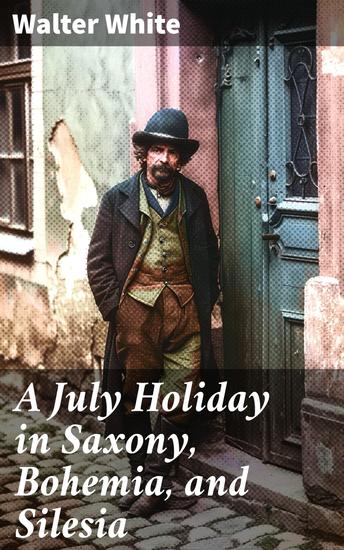
A July Holiday in Saxony Bohemia and Silesia - Exploring Central Europe Through the Eyes of a 19th Century Traveler - cover

A July Holiday in Saxony Bohemia and Silesia - Exploring Central Europe Through the Eyes of a 19th Century Traveler

Walter White

Editorial: Good Press

  • 0
  • 0
  • 0

Sinopsis

In "A July Holiday in Saxony, Bohemia, and Silesia," Walter White offers an engaging travelogue that paints a vivid portrait of 19th-century Central Europe. With a keenly observant eye, White employs a descriptive literary style that combines both personal reflection and historical context. His narrative is enriched by detailed accounts of the landscapes, cultures, and traditions of the regions he visits, seamlessly blending travel writing with sociocultural commentary. The book serves not only as a travel diary but also as a rich document of the era'Äôs shifting political and social climates, making it an invaluable resource for historians and travel enthusiasts alike. Walter White, a prominent figure in 19th-century British literature, was known for his keen interest in geography and cultural anthropology. His extensive travels across Europe deeply influenced his writing, as he sought to illuminate the evolving identities of diverse regions during a time of great transformation. White's background in journalism further fortified his capacity to provide detailed observations, tragic anecdotes, and insightful critiques that resonate throughout his travel writings. This book is highly recommended for readers interested in historical travel narratives and the interplay of personal and cultural discovery. White's eloquent prose and meticulous observations invite readers to engage with the landscapes and societies he explores, making it a delightful addition to any literary or travel enthusiast's collection.
Disponible desde: 18/09/2023.
Longitud de impresión: 210 páginas.

Otros libros que te pueden interesar

  • In Our Truck and Camper We Traveled to the States - cover

    In Our Truck and Camper We...

    Larry D. Oliverson

    • 0
    • 0
    • 0
    In the heart of America's vast wilderness, two men and a loyal dog embark on a journey that goes beyond the physical terrain they travel across. Jim Hanson, a seasoned auto mechanic, and his best friend Ted Jones, a ruggedly charming "bad boy," pack up Jim's trusty Ford Bronco and head into the northern mountains for a weekend of camping. But this trip is more than just an escape from their city lives. It's a journey through the maze of memories, dreams, and the enduring bond of friendship. As they drive through the challenges of the wild, from unexpected encounters with bears to the simple joy of sitting around a campfire, they reflect on their pasts and confront the realities of their future. In our Truck and Camper, We Traveled to the States is a memoir, a tale of adventure, resilience, and self-discovery. Through vivid storytelling, Larry D. Oliverson captures the essence of friendship and the unyielding spirit of those who seek solace in nature's embrace.
    Ver libro
  • Dirty Cop - cover

    Dirty Cop

    Anonymous Anonymous

    • 0
    • 0
    • 0
    During the 1990s, the UK police preferred to be accused of racism rather than corruption. Stop and searches for no reason other than the colour of someone’s skin had managed to turn many law-abiding citizens into cop haters.  
     
    But all I ever wanted was to be a good police officer. 
    I thought I could be the smartest, the toughest, the bravest - but also, the fairest - cop in the neighbourhood. I ended up in an elite, compact, anti-narcotics unit given unrestricted authority to wage war on the area’s drugs underworld, focusing on criminals in and around a vast housing estate. 
    It was comparable to Rio’s shanty town favelas and the concrete jungle estates of Naples where Gomorrah mafia gangsters still live to this day. 
      
    My beat was complex, a tinderbox front line, where we confronted the brutality, the dead, the victims and the perps all in the name of law and order. 
    But in my upside-down world, those with badges morphed into secret criminals as my unit became the most powerful and feared gang of all. 
    And when my conscience finally got the better of me, I tried to go straight, only to be brought down by the ghosts of the past.
    Ver libro
  • Black Heart Fades Blue - Volume Three - cover

    Black Heart Fades Blue - Volume...

    Jerry A. Lang

    • 0
    • 0
    • 0
    If you're looking for the events that inspired the lyrics to all my songs? Those stories are in this book. If you're looking for what I did when I was younger? That's in here. What changed me, made me stop hating and hurting? It's all here. This is my story and I'm sticking to it. That's the one thing I have, the truth. 


    Volume three of Black Heart Fades Blue, a three-part memoir by the founder and frontman for one of punk rock's most notorious acts, Poison Idea. 


    In 1980, Jerry A. formed Poison Idea, a Portland-based punk band that gave voice to disaffected and disenfranchised youth for over thirty years. As happened to so many punk bands, Jerry A. and Poison Idea also went all in on drugs and drinking as they toured the country, spiraling out of control and blowing both the band and their lives apart. 


    Black Heart Fades Blue is not an apology or a nostalgic catalog of events, but a true reckoning with one's past and present. A memoir of a time and a place and a movement, as well as a deep conversation about the memories and moments we leave behind, Black Heart Fades Blue is a deep exploration of an unconventional life.
    Ver libro
  • Her Turn - From their pens to your ears genius in every story - cover

    Her Turn - From their pens to...

    D H Lawrence

    • 0
    • 0
    • 0
    David Herbert Lawrence was born on the 11th September 1885 in Eastwood, Nottinghamshire, a coal mining town where the reality of a harsh life was only useful as experiences for future literary works. 
    He was educated at Beauvale Board School and became the first local boy to receive a scholarship to attend Nottingham High School. After 3 years he became a junior clerk in Haywood’s surgical appliances factory. He was also attempting a literary career which, in the short term, led to a teacher training position in Eastwood and later a teaching qualification from University College, Nottingham.  
    Lawrence’s first efforts were poems, short stories and a draft of ‘The White Peacock’. Moving to London and a teaching position in Croydon his writing attracted the attention of Ford Madox Ford, editor of The English Review, and he commissioned him to write ‘Odour of Chrysanthemums’.  
    Wanting to write full-time he now began work on what would become ‘Sons and Lovers.   
    In 1912 he met the older and married mother-of-three Frieda Weekley. They eloped to Germany and here Lawrence could see for himself the growing tensions with France.  So keen was his interest that he was arrested and accused of being a British spy.  
    In early 1914 Frieda obtained her divorce and they returned to Britain to be married just days before the outbreak of war. Owing to her German parentage, and his own public dislike of militarism and violence, the couple were treated with contempt and suspicion throughout the war years.  
    Despite this he continued to write but his reputation in England was so tarnished and, mirrored by his own disdain for the country, he and Frieda left England in November 1919, first for Europe and then America via Ceylon and Australia. 
    They bought a ranch in Taos, New Mexico and visited Mexico several times. The third visit in March 1925 caused a near fatal attack of malaria. To convalesce they moved to Florence. Here he continued work on ‘Lady Chatterley’s Lover’ which for many years would cause controversy. A renewed interest in oil painting resulted in an exhibition in 1929 which was raided by the police and several works were confiscated.  
    D H Lawrence died of complications arising from a bout of tuberculosis on the 2nd of March 1930 in Vence, France.  He was 44.
    Ver libro
  • When Harry Met Pablo - Truman Picasso and the Cold War Politics of Modern Art - cover

    When Harry Met Pablo - Truman...

    Matthew Algeo

    • 0
    • 0
    • 0
    Harry Truman and Pablo Picasso were contemporaries and were both shaped by and shapers of the great events of the twentieth century—the man who painted Guernica and the man who authorized the use of atomic bombs against civilians. But in most ways, they couldn’t have been more different. Picasso was a communist, and probably the only thing Truman hated more than communists was modern art. Picasso was an indifferent father, a womanizer, and a millionaire. Truman was utterly devoted to his family and, despite his fame, far from a rich man. How did they come to be shaking hands in front of Picasso’s studio in the south of France? Truman’s meeting with Picasso was quietly arranged by Alfred H. Barr Jr., the founding director of New York’s Museum of Modern Art and an early champion of Picasso. Barr knew that if he could convince these two ideological antipodes, the straight-talking politician from Missouri and the Cubist painter from Málaga, to simply shake hands, it would send a powerful message, not just to reactionary Republicans pushing McCarthyism at home but to the whole world: modern art was not evil. A rigorous history with a heartwarming center, When Harry Met Pablo intertwines the biographies of Truman and Picasso, the history of modern art, and twentieth-century American politics, but at its core, it is the touching story of two old men who meet for the first time and realize they have more in common—and are more alike—than they ever imagined.
    Ver libro
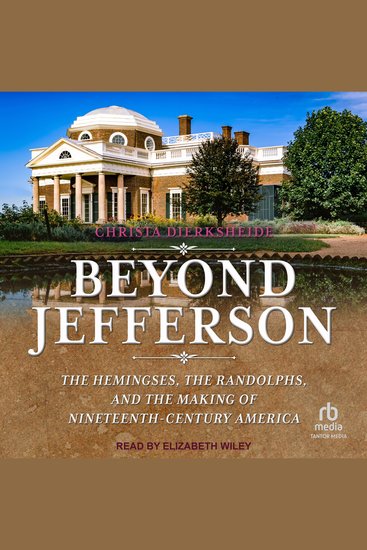
  • Beyond Jefferson - The Hemingses the Randolphs and the Making of Nineteenth-Century America - cover

    Beyond Jefferson - The Hemingses...

    Christa Dierksheide

    • 0
    • 0
    • 0
    A global history of how Thomas Jefferson's descendants navigated the legacy of the Declaration of Independence on both sides of the color line 


    The Declaration of Independence identified two core principles—independence and equality—that defined the American Revolution and the nation forged in 1776. Jefferson believed that each new generation of Americans would have to look to the "experience of the present" rather than the "wisdom" of the past to interpret and apply these principles in new and progressive ways. 


    Historian Christa Dierksheide examines the lives and experiences of a rising generation of Jefferson's descendants, Black and white, illuminating how they redefined equality and independence in a world that was half a century removed from the American Revolution. The Hemingses and Randolphs moved beyond Jefferson and his eighteenth-century world, leveraging their own ideas and experiences in nineteenth-century Britain, China, Cuba, Mexico, and the American West to claim independence and equal rights in an imperial and slaveholding republic.
    Ver libro