Junte-se a nós em uma viagem ao mundo dos livros!
Adicionar este livro à prateleira
Grey
Deixe um novo comentário Default profile 50px
Grey
Assine para ler o livro completo ou leia as primeiras páginas de graça!
All characters reduced
Why Palestine?: Reflections From Singapore - cover
LER

Why Palestine?: Reflections From Singapore

Walid Jumblatt Abdullah

Editora: Ethos Books

  • 0
  • 0
  • 0

Sinopse

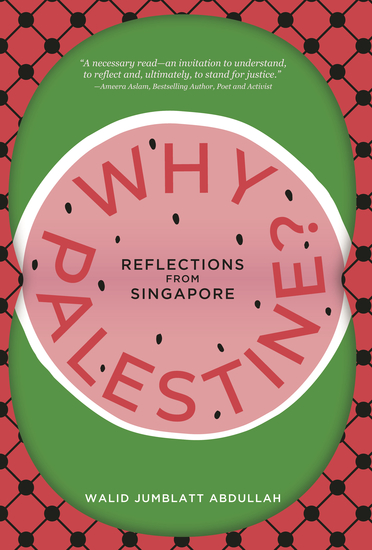
If you’ve ever wondered why people keep talking about Palestine, or the point of keeping up with a long-drawn conflict in the Middle East and what difference you could possibly make, this book is for you. Political analyst and podcaster Walid Jumblatt Abdullah takes on questions that Singaporeans have often raised about Palestine, laying out answers that clarify and inform. 
 
Walid examines myths (“Could Gaza Have Been Singapore?”) and sheds light on the double standards of Western powers, to whom human rights seem to matter, except for where Palestine is concerned. Explaining how the Palestinians have been systematically dehumanised for decades, the book highlights how they continue to exist nevertheless, their very existence an act of resistance. 
 
Why Palestine? is an illuminating starting point for newcomers to the issue, and a passionate primer that seasoned activists will welcome for capturing the heart and hope of a long-disenfranchised people and those who support them.
Disponível desde: 08/04/2025.
Comprimento de impressão: 152 páginas.
Outros livros que poderiam interessá-lo

  • Crossways - cover

    Crossways

    William Butler Yeats

    • 0
    • 0
    • 0
    The first collection by Irish-born poet William Butler Yeats. Many decades before his mysterious and austere Modernist verse earned him a nobel prize, Yeats achieved renown as one of the last major poets in the High Romantic tradition. These poems showcase his Celtic imagination, his love for Irish folk-tales, and his commitment to the Romantic ideal of love. (Summary by Kasper Nijsen)
    Ver livro
  • Everyday Freedom - Designing the Framework for a Flourishing Society - cover

    Everyday Freedom - Designing the...

    Philip K. Howard

    • 0
    • 0
    • 0
    Something basic is missing in our culture. Americans know it. Nothing much works as it should. Simple daily choices seem impossible, or fraught with peril. In the workplace, we walk on eggshells. Big projects get stalled in years of review. Endemic social problems such as homelessness become, well, more endemic. 


    Everyday Freedom offers a radical reinterpretation of the corrosion of American culture. The assault on authority after the 1960s, aimed at enhancing freedom, instead created a plague of powerlessness. The teacher in the classroom, the principal in a school, the nurse in the hospital, the official in Washington, the parent on a field trip . . . all have their hands tied. Things don't work, and Americans have lost the freedom to be themselves. 


    Everyday Freedom offers a radical vision for change: Re-empower Americans in their everyday choices. The massive legal structures erected since the 1960s were based on flawed notions that human judgment could be replaced by elaborate dictates. These failed structures must be replaced with simpler frameworks activated by human responsibility and accountability. Nothing will work sensibly until Americans are free to draw on their skills, intuitions, and values when confronting daily challenges. This is the only cure to alienation. This is also the only way to deliver good government.
    Ver livro
  • Wards of the State - The Long Shadow of American Foster Care - cover

    Wards of the State - The Long...

    Claudia Rowe

    • 0
    • 0
    • 0
    Told through the stories of six former foster youth, a jolting exploration of a broken system from an award-winning journalist 
      
    By the time Maryanne was 16 years old, she had been arrested for murder. In and out of foster and adoptive homes since age 10, she’d run away, been trafficked and assaulted, and finally pointed a gun at the latest man to take her into his car. She pulled the trigger and fled. But with no family to turn to and few reliable friends, it didn’t take long for the police to catch up with her. 
      
    In court, the defense blamed neither traffickers, nor Maryanne, but Washington state itself—or rather, its foster care system, which parents thousands of children every year. The courts didn’t listen to that argument, but award-winning journalist Claudia Rowe did. Washington state isn’t alone, of course. Each year, hundreds of thousands of children grow up in America’s $30 billion foster care system, only to leave and enter its prisons, where a quarter of all inmates are former foster youth. 
      
    Weaving Maryanne’s story with those of five other foster kids across the country—including an 18-year-old sleeping on the New York City subways; a gangbanger-turned graduate student; and a foster child who is now a policy advisor to the White House—Rowe paints a visceral survival narrative showing exactly where, when, and how the system channels children into locked cells. Balanced with accounts from psychologists, advocates, judges, and foster parents, Wards of the State paves a road to reform by pulling back the curtain on our country’s longstanding foster care-to-prison pipeline and the searing realities faced by kids who may be sitting in classrooms next to your own children. 
      
    “An eloquent and compelling call for change."—Booklist
    Ver livro
  • State of the Union 1982 - cover

    State of the Union 1982

    Ronald Reagan

    • 0
    • 0
    • 0
    In the 1982 State of the Union address on January 26, 1982, Reagan invokes his self-deprecating humor and calls for “a new spirit of partnership between this Congress and this administration”. Reagan cites the “stagflation” of the 1970s: double digit inflation, interest rates over 21%, and over 8 million unemployed.  
    Reagan notes economic improvement and calls for reduced federal spending, further tax reductions, and fewer regulations, saying our economic problems “are the inheritance of decades of tax and tax and spend and spend.”  
    Reagan calls for dismantling the Departments of Energy and Education but keeping a reliable safety net for those in need by rooting out waste and fraud in the food stamp, Medicare, and Medicaid programs. Reagan decries the growth in federal grant programs to state and local governments and calls for major reforms. 
    A short paragraph was lost at 23:15 of the Ronald Reagan presidential library recording. The missing words can be seen in the text version. 
    In meetings with foreign leaders, Reagan “spoke of the strength of the free marketplace system and how that system could help them realize their aspirations for economic development and political freedom.” Reagan endorses sanctions against the Soviet Union for its actions in Poland and Afghanistan, and urges “that we rebuild our defenses.”  
    Reagan concludes with a call to work together to preserve “the sacred flame of liberty -- this last, best hope of man on Earth.” This address followed the assassination attempt and the applause at the start and end was extensive.
    Ver livro
  • The First Debate of the 1960 Presidential Election Between Richard Nixon and John F Kennedy - cover

    The First Debate of the 1960...

    Vice President Richard M. Nixon,...

    • 0
    • 0
    • 0
    The first presidential debate of the 1960 presidential election between Vice President Richard Nixon, the Republican nominee, and Senator John F. Kennedy, the Democrat nominee, took place on Monday, September 26, 1960, in Chicago. The televised debate was moderated by Howard K. Smith of CBS. Questions were restricted to internal or domestic American matters.
    Ver livro
  • Manifesting Justice - Wrongly Convicted Women Reclaim Their Rights - cover

    Manifesting Justice - Wrongly...

    Valena Beety, Koa Beck

    • 0
    • 0
    • 0
    When Valena Beety first became a federal prosecutor, her goal was to protect victims, especially women, from cycles of violence. What she discovered was that not only did prosecutions often fail to help victims, they frequently relied on false information, forensic fraud, and police and prosecutor misconduct. 


    Seeking change, Beety began working in the Innocence Movement, helping to free factually innocent people through DNA testing and criminal justice reform. Manifesting Justice focuses on the shocking story of Beety's client Leigh Stubbs—a young, queer woman in Mississippi, convicted of a horrific crime she did not commit because of her sexual orientation. Beety weaves Stubbs's harrowing narrative through the broader story of a broken criminal justice system. 


    Drawing on interviews with both innocence advocates and wrongfully convicted women, along with Beety's own experiences as an expert litigator and a queer woman, Manifesting Justice provides a unique outsider/insider perspective. Beety expands our notion of justice to include not just people who are factually innocent, but those who are over-charged, pressured into bad plea deals, and over-sentenced. The result is a riveting and timely book that will transform our very ideas of crime and punishment, what innocence is, and who should be free.
    Ver livro