¡Acompáñanos a viajar por el mundo de los libros!
Añadir este libro a la estantería
Grey
Escribe un nuevo comentario Default profile 50px
Grey
Suscríbete para leer el libro completo o lee las primeras páginas gratis.
All characters reduced
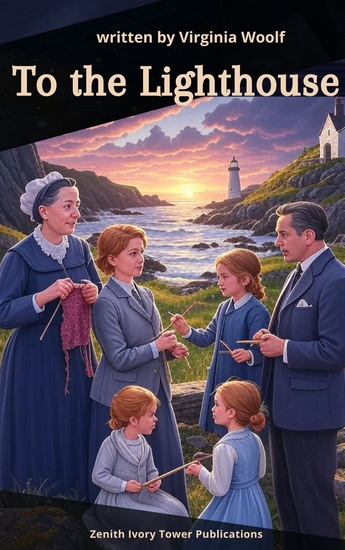
To the Lighthouse - A Masterpiece of Modernist Fiction Memory and the Meaning of Time - cover

To the Lighthouse - A Masterpiece of Modernist Fiction Memory and the Meaning of Time

Virginia Woolf, Zenith Ivory Tower Publications

Editorial: Zenith Ivory Tower Publications

  • 0
  • 0
  • 0

Sinopsis

Time passes. People change. The lighthouse remains.
To the Lighthouse is Virginia Woolf's lyrical and deeply moving portrait of a family, a house, and the haunting passage of time.

Set in a summer home on the coast of Scotland, the novel unfolds over two decades in the lives of the Ramsay family and their guests. With no traditional plot, Woolf instead paints the inner lives of her characters with poetic precision—capturing fleeting thoughts, fractured memories, and the silent tensions of love, loss, and longing.

This landmark of literary modernism revolutionized the novel form with its stream-of-consciousness technique and thematic focus on the ephemeral nature of life. To the Lighthouse is as much about what is unsaid as what is spoken, as much about moments lost as those remembered.

"A brilliant and beautiful book, full of wisdom, compassion, and deeply felt human experience." — The New York Times
"Woolf's greatest achievement. A novel that speaks across time." — The Guardian
"Reading it feels like standing in sunlight and shadow all at once." — Goodreads Reviewer

Perfect for lovers of introspective fiction, lyrical prose, and psychological depth, To the Lighthouse is one of the 20th century's most profound literary works.

Click 'Buy Now' and experience a novel where every moment shimmers with meaning.
Disponible desde: 24/07/2025.
Longitud de impresión: 97 páginas.
Otros libros que te pueden interesar

  • Flow with the Glow - Lessons on Life Love and Tennis - cover

    Flow with the Glow - Lessons on...

    Shane Gerzon-Kessler

    • 0
    • 0
    • 0
    In Flow with the Glow: Life, Love, and Tennis, Shane Gerzon takes readers beyond the boundaries of the tennis court and into the heart of a journey defined by passion, struggle, and transformation. From almost reaching Olympic heights to facing profound personal failures, Shane's story is one of grit, resilience, and rediscovery. This compelling memoir intertwines the strategic precision of tennis with the complexity of human emotions. Shane reflects on moments of fame, encounters that challenge his authenticity, and the silent battles that come with balancing ambition and vulnerability. With each serve and every rally, he finds echoes of life's greatest lessons: embracing failure, nurturing relationships, and staying resilient in the face of overwhelming odds. This is not just a tale of athletic prowess; it's a testament to the power of perseverance and the beauty of human connection. Shane's narrative is raw, honest, and uplifting, reminding readers that life, much like tennis, is about staying in the game, adapting, and finding the glow that keeps us moving forward. Discover the art of resilience and the joy of life's continuous rally in Flow with the Glow: Life, Love, and Tennis.
    Ver libro
  • Twenty-Six Men and a Girl - From their pens to your ears genius in every story - cover

    Twenty-Six Men and a Girl - From...

    Maxim Gorky

    • 0
    • 0
    • 0
    Alexei Maximovich Peshkov was born on 28th March 1868, in Nizhny Novgorod, Russia. 
    Better known as Maxim Gorky he was orphaned at 11 and ran away from home at 12.  At 19 he had already attempted suicide and thereafter travelled, by foot, across the Russian Empire for 5 years. 
    His first book ‘Essays & Stories’ in 1898 was a sensation and so began a long career as an author of short stories, novels and plays.  Gorky saw writing as a moral and political act that would help to change the unjust world around him.  He was an ardent early advocate of the emerging Marxist movement and publicly opposed the Tsarist regime leading several times to his arrest.  
    In 1904 he began his own theatre but the censor banned every play and Gorky was forced to abandon the project. 
    But Gorky was a financially successful author, editor, and playwright and gave monies to political parties as well as for civil rights and social reform.  The brutal shooting of workers, which set in motion the Revolution of 1905, pushed Gorky more decisively toward radical solutions.  
    In 1906 he went to the United States to raise funds for the Bolsheviks. Those experiences including a scandal over travelling with his lover and not his wife deepened his contempt for the ‘bourgeois soul.’ 
    Gorky now moved to Capri in Italy, both for health reasons and to escape the increasingly repressive times in Russia.  
    An amnesty for the 300th anniversary of the Romanov dynasty saw him return to Russia in 1914. His politics remained close to the Bolshevik cause.  But soon, after the 1918 revolution, his essays referred to Lenin as a tyrant for his senseless arrests and repression.  He was soon appealing to the outside world for food aid after the catastrophic crop failure. 
    In October 1921 Gorky returned to Italy, now in Fascist hands, and settled in Sorrento until 1932.  His health worsened with the onset of tuberculosis. 
    He wrote several successful books there but now decided to find an understanding with the communist regime. Stalin invited him home and his return was hailed as a major propaganda victory.  He was decorated with the Order of Lenin, and a province, a park, and various streets re-named in his honour. 
    But he had his faults too.  In 1933, Gorky co-edited a book on the White Sea-Baltic Canal and denied even a single prisoner died during its construction, but thousands had. As well, knowing that some Nazis were homosexual, a phrase was attributed to him that said ‘exterminate all homosexuals and fascism will vanish’.  Although he was himself was quoting another he was decidedly homophobic. 
    With the increase of Stalinist repression in 1935 Gorky was placed under unannounced house arrest. 
    Maxim Gorky died on the 18th June 1936 from pneumonia.  He was 68. 
    Stalin and Molotov were among those who carried Gorky's urn of ashes at his funeral.
    Ver libro
  • You Don't Know What War Is - cover

    You Don't Know What War Is

    Yeva Skalietska

    • 0
    • 0
    • 0
    An inspiring memoir of resilience by a young survivor of the war in Ukraine, as told through her diary entries—a harrowing and ultimately hopeful survival story. Yeva Skalietska’s story begins on her twelfth birthday in Kharkiv, where she has been living with her grandmother since she was a baby. Ten days later, the only life she’d ever known was shattered. On February 24, 2022, her city was suddenly under attack as Russia launched its horrifying invasion of Ukraine. Yeva and her grandmother took shelter in a basement bunker, where she began writing this diary. She describes the bombings she endured while sheltering underground and her desperate journey west to escape the conflict raging around them. After many endless train rides and a prolonged stay in an overcrowded refugee center in Western Ukraine, Yeva and her beloved grandmother eventually find refuge in Ireland. There, she bravely begins to forge a new life, hoping she’ll be able to return home one day.
    Ver libro
  • Enuma Elish - The Epic of Creation - cover

    Enuma Elish - The Epic of Creation

    L. W. King

    • 0
    • 0
    • 0
    Dive deep into the primordial mists of time, where the ancient gods of Mesopotamia danced and battled, giving shape to the world as we know it. "Enuma Elish: The Epic of Creation," brilliantly translated by L.W. King, takes you on a mesmerizing journey to the very origins of civilization and its mythic tales of creation. 
    Experience the power of this epic as never before, with the masterful narration of Dennis Logan. His riveting voice brings to life the tumultuous events and divine characters of the Enuma Elish. Let the soundscape envelop you, transporting you to the banks of the Euphrates and the majestic ziggurats, where these tales were once shared. 
    Why listen to this audiobook?Discover the roots of many contemporary myths and religious stories, and trace the ancient lineage of creation tales.Relish in the rich, evocative translation by L.W. King, who painstakingly brings forth the nuances and beauty of the original text.Immerse yourself in the unparalleled delivery of Dennis Logan, whose voice paints vivid imagery, making the gods, battles, and primal elements almost tangible.Engage in the intellectual delight of understanding ancient civilizations, their beliefs, and their views on existence and creation. 
    "Enuma Elish: The Epic of Creation" is more than just a tale. It’s a testament to humanity's age-old quest to understand its place in the cosmos. Whether you're a lover of history, mythology, or captivating storytelling, this audiobook promises a profound experience. 
    Join the annals of time, witness the divine saga, and let the origins of creation resonate in your very soul.
    Ver libro
  • Tolstoy - cover

    Tolstoy

    Stefan Zweig

    • 0
    • 0
    • 0
    According to Stefan Zweig, no contemporary author, not even Marx or Nietzsche, delivered the radical spiritual shock that Tolstoy's works gave millions and millions of people around the world. But which Tolstoy are we talking about? For Zweig it is the essayist Tolstoy, the radical thinker and incorruptible anarchist. The Tolstoy who claims that the state is the great cover-up of social injustice through a complex system of violence based on parliaments, prisons, judges, tax collectors, the police and armies. The Tolstoy, who asserts that the religious and moral convictions of every individual are inalienable and that no outside power can establish their domain there. This audiobook contains an English translation of an essay about Tolstoy written by Stefan Zweig in his 1928 book „Drei Dichter ihres Lebens: Casanova, Stendhal, Tolstoi“. The biographical study, which does not skimp on criticism, offers an interesting perspective on what is probably the most important Russian novelist of the 19th century.
    Ver libro
  • Philosophers of Individual Rights and Society - The Role of Rights Ethics and Political Thought in Human Society (3 in 1) - cover

    Philosophers of Individual...

    Hector Davidson

    • 0
    • 0
    • 0
    This book consists of the following three titles: 
    - Ayn Rand: Ayn Rand, born Alisa Zinov'yevna Rosenbaum in 1905 in St. Petersburg, Russia, had a formative early life that significantly influenced her later philosophical ideas. Growing up in a middle-class Jewish family, Rand experienced the upheavals of the Russian Revolution and the subsequent rise of Bolshevism. These events deeply affected her worldview and instilled in her a strong opposition to collectivism and authoritarianism. 
    - John Stuart Mill: John Stuart Mill, a British philosopher and political economist, remains one of the most influential thinkers of the 19th century. Born in 1806, Mill was exposed to rigorous intellectual training from an early age, particularly through his father, James Mill, a prominent utilitarian philosopher. This early exposure shaped Mill's understanding of the world, leading him to become a key figure in the development of utilitarianism, a moral theory that evaluates actions based on their ability to promote the greatest happiness for the greatest number of people. 
    - Mary Wollstonecraft: Mary Wollstonecraft was a pioneering British writer and philosopher whose ideas on women’s rights and education laid the foundation for modern feminism. Born on April 27, 1759, in Spitalfields, London, she grew up in a time when society severely restricted women's opportunities. Despite these limitations, Wollstonecraft’s determination, intellect, and relentless pursuit of knowledge allowed her to challenge the status quo and advocate for gender equality. Her life was shaped by personal struggles, societal constraints, and an unwavering belief in the power of education.
    Ver libro