Junte-se a nós em uma viagem ao mundo dos livros!
Adicionar este livro à prateleira
Grey
Deixe um novo comentário Default profile 50px
Grey
Assine para ler o livro completo ou leia as primeiras páginas de graça!
All characters reduced
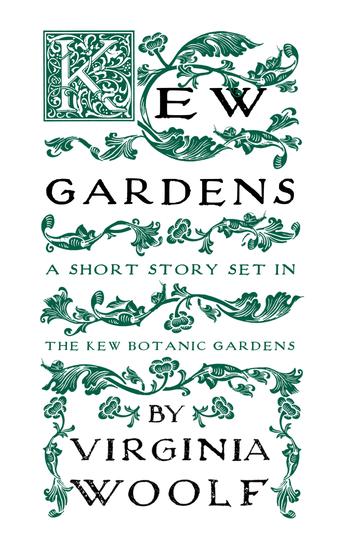
Kew Gardens - cover
LER

Kew Gardens

Virginia Woolf

Editora: Renard Press

  • 0
  • 0
  • 0

Sinopse

First published in 1921 as part of her ground-breaking short-story collection Monday or Tuesday, Kew Gardens follows the thoughts of a set of characters walking past a flower bed in the royal botanic garden on a hot July day.
Interweaving the thoughts of the characters with depictions of the natural world surrounding them, the narrative flows from mind to mind, from the tranquil flower bed to the bustling city outside.
Written in Woolf's trademark style, brimming with keen observation and rich language, Kew Gardens is both a paean to the natural world and an empathetic exploration of human experience.
'The light fell either upon the smooth, grey back of a pebble or the shell of a snail with its brown, circular veins, or, falling into a raindrop, it expanded with such intensity of red, blue and yellow the thin walls of water that one expected them to burst and disappear… Then the breeze stirred rather more briskly overhead and the colour was flashed into the air above, into the eyes of the men and women who walk in Kew Gardens in July.'
Disponível desde: 30/03/2022.
Comprimento de impressão: 48 páginas.
Outros livros que poderiam interessá-lo

  • Alpine Divorce An - From their pens to your ears genius in every story - cover

    Alpine Divorce An - From their...

    Robert Barr

    • 0
    • 0
    • 0
    Robert Barr was born in Glasgow, Scotland on the 16th September 1849.  Five years later the family emigrated to a farm near Muirkirk in Upper Canada.  
    His early years were uneventful as the family settled into their new lives and Barr began his education. 
    A career path as a teacher opened up for him and, by 1874, he had been appointed as headmaster at the Central School at Windsor.  Concurrently he also wrote travel and humourous articles for magazines.  Within two years their success in the regional periodicals encouraged him to change careers to become a reporter and columnist. 
    In August 1876, at age 27, he married Eva Bennett and they began a family. 
    A half decade later he was the exchange editor of the ‘Free Press’ but decided to relocate to London to establish an English edition and to write fiction, which both met with much success. 
    Over the years he was a prolific writer and in 1892, along with Jerome K Jerome, he established ‘The Idler’ magazine and, just after the turn of the century, became its sole proprietor. 
    Although a number of his crime novels and short stories are parodies on Sherlock Holmes and other best-selling detectives of the time, he also wrote short stories across a whole range of subjects and genres usually with intriguing ideas and many laced with wit and humour. 
    Robert Barr died at his home in Woldingham, Surrey of heart disease on the 21st October 1912.  He was 63.
    Ver livro
  • Stree Aur Purush - cover

    Stree Aur Purush

    Munshi Premchand

    • 0
    • 0
    • 0
    Delve into the complexities of gender and societal norms with Munshi Premchand’s “Stree Purush.” This compelling narrative explores the life of Vipin Babu, a poet whose idealization of women is challenged by the realities of marriage and expectations. Premchand’s masterful storytelling weaves a tale that questions the superficiality of beauty and the depth of relationships. 
    As Vipin Babu confronts his preconceived notions of the perfect partner, readers are taken on a journey through the emotional turmoil of disillusionment and the search for true connection. “Stree Purush” is not just a story; it’s a mirror reflecting the societal constructs that shape our perceptions and interactions.
    Ver livro
  • Aloysha the Pot - From their pens to your ears genius in every story - cover

    Aloysha the Pot - From their...

    Leo Tolstoy

    • 0
    • 0
    • 0
    Leo Tolstoy was born in 1828 in the Russian province of Tula to a wealthy noble family. As a child, he had private tutors but he showed little interest in any formal education. When he went to the University of Kazan in 1843 to study oriental languages and law, he left without completing his courses.  Life now was relaxed and idle but with some writing also taking place.  Gambling debts forced an abrupt change of path and he joined the army to fight in the Crimean War.  He was commended for his bravery and promoted but was appalled at the brutality and loss of life.  He recorded these and other earlier experiences in his diaries which formed the basis of several of his works. 
    In 1852 ‘Childhood’ was published to immediate success and was followed by ‘Boyhood’ and ‘Youth’. 
    His experience in the army and the horrors he witnessed resulted in ‘The Cossacks’ in 1862 and the trilogy ‘Sevastopol Tales’. After the war he travelled around Europe, visiting London and Paris and meeting such luminaries as Victor Hugo and Charles Darwin.  
    It was now that Tolstoy began his masterpiece, ‘War and Peace’. Published in 1869 it was an epic work that changed literature. He quickly followed this with ‘Anna Karenina’.  
    These successes made Tolstoy rich and helped him accomplish many of his dreams but also brought problems as he grappled with his faith and the lot of the oppressed poor. These revolutionary views became so popular that the authorities now kept him under surveillance.  
    He led a life of asceticism and vegetarianism and put his socialist ideals into practice by establishing numerous schools for the poor and food programmes. He also believed in giving away his wealth, which caused much discord with his wife.  
    His writing continued to bring forth classics such as ‘The Death of Ivan Ilyich’ and many brilliant and incisive short stories such as ‘How Much Land Does A Man Need’.  
    In 1901 Tolstoy was excommunicated from the Church and controversially deselected for the Nobel Prize for Literature. 
    Whilst undertaking a pilgrimage by train in October 1910 with his daughter Aleksandra he caught pneumonia in the nearby town of Astapovo.  Leo Tolstoy died on November 9th, 1910, he was 82.
    Ver livro
  • Parade's End - The Complete Tetralogy - cover

    Parade's End - The Complete...

    Ford Madox

    • 0
    • 0
    • 0
    There is a hard brightness overlying the emotion and the human suffering and the human passions… Mr. Ford achieves not only what is probably his own best work but what is certainly one of the ablest of recent English novels. — The New York Times, 1924  
    There are not many English novels which deserve to be called great: Parade's End is one of them. — W. H. Auden  
    Ford Madox Ford's Parade's End tetralogy, written in the aftermath of World War I, was originally published in four parts in the 1920s: Some Do Not…; No More Parades; A Man Could Stand Up —; and Last Post. Highlighting the tension between traditional values and a rapidly changing social order in a world embroiled in war, the story details Tietjens' turmoils in both his personal life and on the warfront—and what follows when some of those struggles become one and the same.  
    Unique among other war fiction of the time, Parade's End privileges not the conflict of the Great War itself, but the impact the war had on its participants and upon society writ large. With it's publication, Ford hoped to contribute to the obviating of all future wars. 
    Parade's End is often referred to as one of the greatest 20th century novels, and one of the best depictions of war in literature. The 2012 television adaptation, written by Tom Stoppard (Shakespeare in Love), directed by Susanna White (Andor) and starring Benedict Cumberbatch and Rebecca Hall, was nominated for two Primetime Emmy Awards and seven BAFTA Television Awards.
    Ver livro
  • The Shades of Spring - cover

    The Shades of Spring

    D H Lawrence

    • 0
    • 0
    • 0
    'The Shades of Spring'. In this story the hero has moved on in the world and is married yet cannot forget his old love. He retraces the steps to her farm hoping for what? He finds his old love attached to a physical young man who can give the girl what he could not - pure physical love - and this she prefers to his more intellectual love.
    Ver livro
  • The Schoolmistress - cover

    The Schoolmistress

    Anton Chekhov

    • 0
    • 0
    • 0
    The short story focuses on a schoolmistress who is returning home after collecting her salary from the town. The weather is terrible, and makes the journey far longer than it should be. She meets a man named Hanov, an aging man who is joyful and seemingly ignorant of the misery of life. On this journey, Marya Vassilyevna ponders her life, her happiness and the repetition of it all. When a train goes past, she sees a woman who looks much like her late mother, which fills her with joy she hasn't felt in a very long time.
    In 'The Schoolmistress' by Anton Chekhov, life is represented as meaningless, repetitive and dull. This is done by characterization and descriptive language.
    Ver livro