¡Acompáñanos a viajar por el mundo de los libros!
Añadir este libro a la estantería
Grey
Escribe un nuevo comentario Default profile 50px
Grey
Suscríbete para leer el libro completo o lee las primeras páginas gratis.
All characters reduced
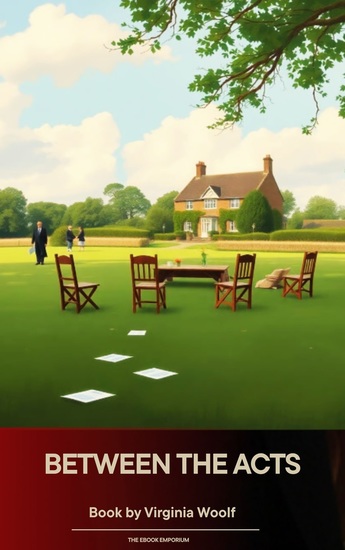
Between the Acts - cover

Between the Acts

Virginia Woolf

Editorial: The Ebook Emporium

  • 0
  • 0
  • 0

Sinopsis

"Scraps, orts and fragments."

Set on a June day in 1939 at a country house in the English heartland, Between the Acts captures a community suspended in time. As the residents of Pointz Hall gather for the annual village pageant, the distant drone of warplanes serves as a chilling reminder of the world outside. Virginia Woolf's final novel is a brilliant, rhythmic exploration of the spaces between—between the scenes of a play, between individual lives, and between the eras of history.

The Canvas of Consciousness: Woolf weaves a tapestry of voices, from the frustrated artist Miss La Trobe to the estranged couple Giles and Isa Oliver. Through her signature stream-of-consciousness style, she examines how art attempts to unify a fragmented society. The pageant itself becomes a mirror held up to England's past, questioning whether history is a coherent story or merely a collection of fleeting moments.

A Final, Poetic Testament: Completed shortly before her death, this novel represents Woolf at her most daring and rhythmic. It is a work of extraordinary sensory detail, where the buzzing of a fly or the rustle of a program carries profound weight. Between the Acts is a poignant meditation on the endurance of the creative spirit and the fragile beauty of life in the face of uncertainty.

Step into the interval where life and art collide. Purchase "Between the Acts" today and experience the final vision of a modernist pioneer.
Disponible desde: 02/01/2026.
Longitud de impresión: 72 páginas.

Otros libros que te pueden interesar

  • The Ghost and the Bone Setter - From their pens to your ears genius in every story - cover

    The Ghost and the Bone Setter -...

    Sheridan Le Fanu

    • 0
    • 0
    • 0
    Joseph Sheridan Le Fanu was born on 28th August 1814 in Dublin into a literary family with Huguenot, Irish and English roots.   
    For a time he and his siblings were tutored but Le Fanu would often immerse himself in the books of his father’s library. 
    In 1833 Le Fanu began his Law studies at Trinity College, Dublin and graduated in 1839. Although called to the bar he instead began a career in journalism.   
    He was also writing. His first fiction story ‘The Ghost and the Bonesetter’ was published in 1838.  In 1843 came the novella ‘Spalatro: From the Notes of Fra Giacomo’, a hero with a particular necrophiliac passion for an undead blood-drinking beauty, a forerunner to his later female vampire ‘Carmilla’.  
    In 1844 Le Fanu married Susanna Bennett with whom he had 4 children. The following year his first novel ‘The C'ock and Anchor’ was published. Works now flowed from his pen and with a rapid increase in family finances they moved, in 1851, to Merrion Square, Dublin, where he remained until his death.  
    In 1858 Susanna died and Le Fanu became reclusive. It was during this period that he produced some of his best work.  Working only by candlelight he wrote through the night, burnishing his reputation as a major figure of 19th Century supernaturalism with many classics including; ‘Green Tea’, ‘Mr Justice Harbottle’, and ‘In a Glass Darkly’.  
    Joseph Thomas Sheridan Le Fanu died in Merrion Square in his native Dublin on February 7th, 1873, at the age of 58.
    Ver libro
  • Road to Oz The [The Wizard of Oz series #5] - cover

    Road to Oz The [The Wizard of Oz...

    L. Frank Baum

    • 0
    • 0
    • 0
    With celebrations underway for Ozma of Oz’s birthday, Dorothy and Toto again venture to the magical land of Oz. Meeting Shaggy Man, Button Bright, and Polychrome along the way to the Emerald City of Oz, Dorothy and her companions must out-fox the mayor of Foxville and safely cross the Deadly Desert in time for Ozma’s birthday party.
    Ver libro
  • Metamorphosis - cover

    Metamorphosis

    Franz Kafka

    • 0
    • 0
    • 0
    Metamorphosis (German: Die Verwandlung) is an allegorical novella written by Franz Kafka which was first published in 1915. One of Kafka's best-known works, Metamorphosis tells the story of salesman Gregor Samsa, who wakes one morning to find himself inexplicably transformed into a huge insect (ungeheueres Ungeziefer, lit. "monstrous vermin") and subsequently struggles to adjust to this new condition. The novella has been widely discussed among literary critics, with differing interpretations being offered. In popular culture and adaptations of the novella, the insect is commonly depicted as a cockroach.
    Ver libro
  • A Sick Collier - cover

    A Sick Collier

    D H Lawrence

    • 0
    • 0
    • 0
    'A Sick Collier'. Lawrence returns in this story to the scenes of his childhood and the colliers he was brought up with. The wife in the story is probably based on his mother although the husband is unlike the drinking, brutal father portrayed in 'Sons and Lovers', Lawrence's autobiographical novel. The story is a vivid portrayal of the life of a young couple when an accident strikes the husband down but  does not succeed as a short story, lacking any clear focus or message.
    Ver libro
  • The Judgement - A kafkaesque view of a father son relationship - cover

    The Judgement - A kafkaesque...

    Franz Kafka

    • 0
    • 0
    • 0
    Franz Kafka was born on 3rd July 1883 in Prague, then in Bohemia, the eldest of 6, into a middle-class Jewish family. 
     
    Life for the young Kafka and his passion for literature was often made an ordeal by his over-bearing and domineering entrepreneur of a father.   
     
    In 1889 Kafka was sent to the Deutsche Knabenschule, an elementary school in Prague. His father would only allow him to be educated in German-speaking schools and even went so far as to limit visits to the synagogue to four a year. 
     
    In 1901 he graduated from the classics-oriented Altstädter Gymnasium. Kafka did well there and across a large range of subjects.  He now enrolled at the Charles Ferdinand University, to study chemistry, but quickly switched to law for which he obtained his degree in June 1906 and then performed the mandatory year of unpaid service as clerk at the civil and criminal courts. 
     
    A job at an Italian insurance company left him little time to write and after a year he took another job with the Worker's Accident Insurance Institute for the Kingdom of Bohemia where he stayed until ill health led to his resignation in 1922. 
     
    Although he saw work as a means to pay the bills and to allow him time to write, he received several promotions and was noted as a good employee. 
     
    By 1917 Kafka was suffering from tuberculosis, which required frequent periods of convalescence. Interspersed with this, were several intense affairs before he settled in Berlin with Dora Diamant, a 25-year-old kindergarten teacher who herself having left the ghetto now influenced Kafka's interest in the book of Jewish law, the Talmud. 
     
    Kafka’s on-going health was littered with problems. Apart from TB there were several other ailments, including migraines, insomnia, boils, depression, all usually brought on by excessive stresses and strains. He attempted to counteract all of this by naturopathic treatments, a vegetarian diet and consuming large quantities of unpasteurized milk. 
     
    His tuberculosis still worsened. He returned to Prague, where he died on 3rd June 1924. He was 40. 
     
    His literary works are few in number but towering in influence.  His masterpieces include ‘The Trial’, ‘The Metamorphosis’ as well as a number of short stories which reveal facets of humankind that truthfully could only be born from Kafka’s brain and pen.
    Ver libro
  • England My England - cover

    England My England

    D H Lawrence

    • 0
    • 0
    • 0
    'England, My England' is set in the years before the Great War of 1914, seen by some as an idyllic time of sunshine and peace before everything was shattered by the mechanised war of 1914 to 1918. The family are placed in an idealised setting, deep in the English countryside but there are snakes in this Garden of Eden. There is conflict between man and woman, brought to the fore by an accident to a child and there is the seeming purposeless life led by the husband. The story ripples with the eugenic theories popular at the time yet the conflicts are finally solved by the horror of the war.
    Ver libro