Join us on a literary world trip!
Add this book to bookshelf
Grey
Write a new comment Default profile 50px
Grey
Subscribe to read the full book or read the first pages for free!
All characters reduced
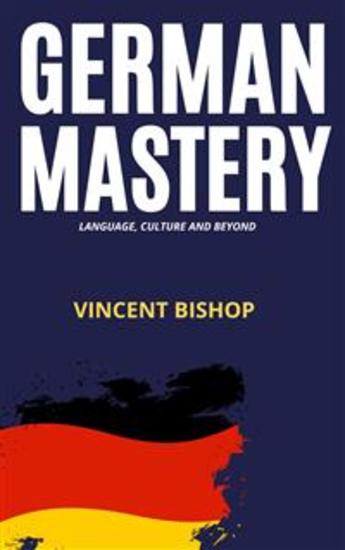
German Mastery - Language Culture and Beyond - cover

German Mastery - Language Culture and Beyond

Vincent Bishop

Publisher: The Church

  • 0
  • 0
  • 0

Summary

"In 'German Mastery - Language, Culture, and Beyond,' readers embark on an immersive journey into the German language and the rich cultural tapestry it weaves. This captivating book delves into the multifaceted world of the German language, offering a comprehensive understanding of its intricacies, cultural significance, and real-world applications.
Without the need for an author's name, 'German Mastery' serves as a gateway to linguistic and cultural exploration, providing insights into the German language's structure, history, and relevance. Through a combination of language lessons, cultural anecdotes, and historical context, this book demystifies the complexities of German and highlights its role as a cultural bridge.
Readers will gain insights into German customs, traditions, and artistic contributions, from literature and philosophy to music and cinema. 'German Mastery' also explores the practical advantages of mastering the German language, such as career opportunities and travel experiences.
'German Mastery - Language, Culture, and Beyond' is a thought-provoking exploration of the German language and its multifaceted connections to the culture and society it represents. Whether you're a language learner, a traveler to German-speaking countries, or simply interested in the German way of life, this book offers valuable insights into the language and culture of the German-speaking world."
Available since: 01/30/2024.

Other books that might interest you

  • Simple Montenegrin - A Language Course for Montenegro - cover

    Simple Montenegrin - A Language...

    Marko Stanković

    • 0
    • 0
    • 0
    This 10 session course provides an introduction to the language of Montenegro. A broad range of topics is covered during this course starting out with basic greetings and answers to questions and then progressing to full sentence structures based on previously learned vocabulary later in the course.Montenegrin is a South Slavic language, closely related to Serbian, Croatian, and Bosnian. Historically, these languages were collectively referred to as Serbo-Croatian, a designation that covered the similar dialects spoken across much of the former Yugoslavia. Following the dissolution of Yugoslavia in the 1990s and Montenegro’s independence in 2006, Montenegrin was officially recognized as a distinct language.The language's origins are deeply rooted in the medieval era, with Old Church Slavonic serving as a foundational influence on Montenegrin and other South Slavic languages. Over time, regional dialects and external influences from neighboring countries shaped the modern form of Montenegrin, differentiating it from Serbian and Croatian in pronunciation, vocabulary, and certain grammatical structures. While Montenegrin shares much of its grammar and vocabulary with Serbian, it includes specific phonetic features, such as the distinct pronunciation of the letters 'ś' and 'ź,' which are not present in other variants.Montenegrin is predominantly spoken in Montenegro, a small but culturally rich country in southeastern Europe, with around 250,000 native speakers. It is the official language of Montenegro, though Serbian, Bosnian, Croatian, and Albanian are also widely spoken due to the country’s diverse population. Montenegrin is written in both the Latin and Cyrillic scripts, reflecting its historical ties to both Eastern Orthodox and Western Christian cultural spheres.Montenegrin is employed in all areas of public life in Montenegro, including education, media, and government. The language plays a crucial role in the country’s national identity.
    Show book
  • End Boring - A Tactical Approach to Public Speaking and Communication - cover

    End Boring - A Tactical Approach...

    Ivan Wanis Ruiz

    • 0
    • 0
    • 0
    Flex your public speaking muscles with this practical crusade to end boring presentations! In this updated second edition, you’ll find new examples, visuals, and tactics for both in-person and online engagement- so when you speak, people listen. 
    We’ve all sat through dull presentations: endless slides, lifeless delivery, messages that vanish the second they’re over. And most advice? Fluff. “Connect with your audience,” they say. But how? 
    Ivan Wanis Ruiz’s End Boring is the antidote. Drawing from neuroscience, poker, police interrogations, viral videos, and even pro wrestling, Ivan shares the same tactical playbook he’s used to train over half a million people worldwide. No vague inspiration- just practical tactics you can use immediately. 
    Built from real-world cases in business, sales, education, fitness, and healthcare, End Boring teaches you how to create muscle memory in the way you speak, move, and command a room. It’s not about following cookie-cutter rules- it’s about building a flexible toolkit you can use anywhere, from a boardroom to a Zoom call. 
    Inside, you’ll learn:The Belly Button Rule that makes you look instantly more confident.Why traditional eye contact advice is wrong-and what to do instead.The sneaky Liar’s Parallel killing your credibility (and how to fix it).How to structure sentences so people remember more than just 2% of your talk.Virtual hacks to transform your online presence. 
    Great speakers aren’t born- they’re trained. Through practice, repetition, and audience focus, you can become the communicator people remember. 
    Don’t just read about communication. Train it. Use it. Live it. And join the mission to End Boring.
    Show book
  • Learn French-for beginners - an audiocourse for beginners and false beginners - cover

    Learn French-for beginners - an...

    Christine-Anne Trochut, Tomas...

    • 0
    • 0
    • 0
    Thank you for your interest in the Learn French for Beginners audiocourse by Audioacademyeu. The course is designed for  absolute and "false" beginners. So if you started learning French some time ago and now want to brush up on the basics, this is the right audiocourse for you. If you are an absolute beginner, nevermind, feel free to start with the pronunciation.The course is based on contextual learning, which means that you will not only learn words, but also sentences in which you can use the words you have learned. In this course you will find a total of 2,500 vocabulary words and practice sentences.What is the best way to work with the course? Choose the lesson you want to start with. Each lesson contains six tracks. First,  familiarize yourself with the actual vocabulary (tracks 1 and 2). In order to get a better grip over the new expressions  in French, in track one you hear the  French word twice.Next, you have a  word followed by a contextual sentence, again in both translation options (tracks 3 and 4).  Then you move on to complete sentences (tracks 5 and 6). ). Again, in track 5, you will hear the sentence in French twice. Once you have mastered translating sentences from English into French (lesson 6) in the time gap before the english translation, you have won. The words alone will help you in understanding the meaning, but using the mastered complete sentences will help you communicate much better.There is a script to this course available for free download at www.audioacademyeu.eu which will make your activities with the course much more effective. In its  introduction, you will find a learning guide along with helpful tips on how to make the lessons more effective and a lesson plan for you to record your learning progress. The script is divided thematically into three parts.  In the first part you will find a written version of the audio tracks you will listen to.  In the second part you will find the writing tests. For each lesson there is one test of vocabulary and one test of sentences. The key to both tests is available right after the tests too In the third part of the script you will find double-sided flashcards that you can cut out with scissors and practice even when you can't or don't want to listen. The course is narrated by native speakers - Jeff Short in English and Christine Anne Trochut, David Girten and Benjamin Jaquet  in French.Lesson 001 LivingLesson 002 TravellingLesson 003 TimeLesson 004 NumbersLesson 005 Hotel, restaurantLesson 006_FoodLesson 007 Communication 1Lesson 008 Communication2Lesson 009 CityLesson 010 ShoppingLesson 011 GreetingsLesson 012 Work 01Lesson 013 Work 02Lesson 014 NatureLesson 015 FamilyLesson 016 CommunityLesson 017 CharacteristicsLesson 018 LeisureLesson 019 Phrases
    Show book
  • The Great Dictionary Swedish - English - 60000 Entries - cover

    The Great Dictionary Swedish -...

    Benjamin Maximilian Eisenhauer

    • 0
    • 1
    • 0
    This dictionary contains around 60,000 Swedish terms with their English translations, making it one of the most comprehensive books of its kind. It offers a wide vocabulary from all areas as well as numerous idioms. The terms are translated from Swedish to English. If you need translations from English to Swedish, then the companion volume "The Great Dictionary English - Swedish" is recommended.
    Show book
  • Dangerous Jokes - How Racism and Sexism Weaponize Humor - cover

    Dangerous Jokes - How Racism and...

    Claire Horisk

    • 0
    • 0
    • 0
    People often get away with belittling others if they frame their speech as jokes—speech that would be condemned if stated seriously. "It's just a joke," they say. But what is different or special about joking? And if jokes about lawyers and politicians are morally acceptable, then what is wrong with joking about race or gender? Furthermore, if we may joke about a politician's shirts, may we joke about his weight? People who are targeted by demeaning jokes feel their impact but may not be able to pinpoint where the harm lies. 


    Dangerous Jokes develops a novel, well-researched, and compelling argument that lays bare the power of demeaning jokes in ordinary conversations. Claire Horisk draws on her expertise in philosophy of language and on evidence from sociology, law, and cognitive science to explain how the element of humor—so often used as a defense—makes jokes more potent than regular speech in communicating prejudice and reinforcing social hierarchies. She addresses the morality of telling, being amused by, and laughing at, derogatory jokes, and she gives a new account of listening that addresses the morality of listening to demeaning speech. She leaves us with no illusions about whether "it's just a joke" is an excuse for demeaning humor.
    Show book
  • The Great Dictionary Finnish - English - 100000 Entries - cover

    The Great Dictionary Finnish -...

    Benjamin Maximilian Eisenhauer

    • 0
    • 0
    • 0
    This dictionary contains around 100,000 Finnish terms with their English translations, making it one of the most comprehensive books of its kind. It offers a wide vocabulary from all areas as well as numerous idioms. The terms are translated from Finnish to English. If you need translations from English to Finnish, then the companion volume "The Great Dictionary English - Finnish" is recommended.
    Show book