Junte-se a nós em uma viagem ao mundo dos livros!
Adicionar este livro à prateleira
Grey
Deixe um novo comentário Default profile 50px
Grey
Assine para ler o livro completo ou leia as primeiras páginas de graça!
All characters reduced
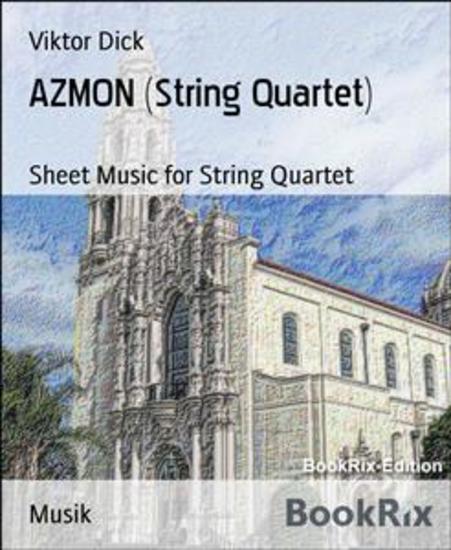
AZMON (String Quartet) - Sheet Music for String Quartet - cover
LER

AZMON (String Quartet) - Sheet Music for String Quartet

Viktor Dick

Editora: BookRix

  • 0
  • 0
  • 0

Sinopse

AZMON Sheet Music for String Quartet  Tune: AZMON  1. O for a Thousand Tongues to Sing 2. I'm Not Ashamed to Own My Lord  Description:  1. Full Score G-Major 2. Solo Instruments: (Violin 1, Violin 2, Viola, Cello)   Tune: Carl G. Gläser ca. 1815 Instrumentation: String Quartet Type of Score: Full Score, 4 Solo Parts Difficulty Level: Advanced/Professional  Arranged and Produced by Viktor Dick
Disponível desde: 21/12/2023.
Comprimento de impressão: 3 páginas.
Outros livros que poderiam interessá-lo

  • Not Talking About You - cover

    Not Talking About You

    Kevin heronJones

    • 0
    • 0
    • 0
    Not Talking About You portrays racism as it occurs amongst young Canadians today. It explores the impact on the target and on bystanders who have to decide how to react when they find a racist youth in their midst.Kevin heronJones has written this book to reflect his and other young Black people’s experiences with racism in school. He sees an urgent need to talk about how young people exhibit racist behaviour, to portray it honestly, and to explore how young people can confront it and speak out.Part of a well-off middle-class family living in suburban Toronto, Khalil moves for grade eight to a school  that does not have many racialized students. He is befriended by school sports star Cameron, who convinces Khalil to play basketball. Khalil is uncomfortable with his friend’s racist statements and behaviour, despite Cameron’s professed admiration for Black culture. As his discomfort grows, Khalil is left with a choice: accept this as “reality” or take a stand for what’s right, even if it costs him friendships.Not talking About You portrays racism as it occurs amongst young Canadians today. It explores the impact on the target and on bystanders who have to decide how to react when they find a racist youth in their midst.
    Ver livro
  • Taisho Era - Democracy and Social Change in a Modernizing Japan - cover

    Taisho Era - Democracy and...

    Rolf Hedger

    • 0
    • 0
    • 0
    The Taisho Era (1912–1926) marked a period of transition in Japan, bridging the highly centralized and authoritarian rule of the Meiji period with the growing democratic movements that characterized the early 20th century. Emperor Taisho ascended to the throne following the death of Emperor Meiji in 1912. Unlike his predecessor, who had been a strong and active ruler, Emperor Taisho was frail and suffered from chronic illness, which significantly limited his ability to govern. As a result, political power gradually shifted away from the emperor and toward elected officials and political parties, paving the way for what would become known as "Taisho Democracy." 
    At the dawn of the Taisho Era, Japan stood at a crossroads between tradition and modernization. The country had rapidly industrialized during the Meiji period, transforming from a feudal society into a modern industrial state. However, with this modernization came social and political unrest. As Japan’s economy expanded, so too did the urban population, leading to the rise of a new middle class that demanded greater political participation and social change. The oligarchic rule of the genrō—elder statesmen who had dominated Meiji politics—faced increasing pressure from political parties, intellectuals, and the general public. 
    The political landscape of early Taisho Japan saw significant changes, including the growing influence of elected politicians. The 1912–1913 Taisho Political Crisis was a defining moment in this shift. When Prime Minister Saionji Kinmochi refused to increase military funding, the army resigned in protest, forcing him to step down. This led to widespread public outrage and a movement advocating for the power of elected officials over military and oligarchic influence. In 1913, the Katsura Tarō government collapsed due to public demonstrations, highlighting the rising political consciousness of the people.
    Ver livro
  • Prehistoric Warfare: The History of Early Human Conflicts - cover

    Prehistoric Warfare: The History...

    Editors Charles River

    • 0
    • 0
    • 0
    Most scientists believe the evolution of humans has a history nearly as long as life itself. Anatomically modern humans and all other life that has existed on the planet first came about from the single-celled microorganisms that emerged approximately 4 billion years ago. Through the processes of mutation and natural selection, all forms of life developed, and this continuous lineage of life makes it difficult to say precisely when one species completely separates from another. In other words, scientists still debate when a human became a human rather than the ancestor species that came before.  
    	Among paleontologists, the question of human propensity for warfare in prehistoric eons has persisted. Primitive conflict that in time grew into a modern military phenomenon has become an increasing avenue of study. Scientists seek to ascertain whether the distant ancestral line of humans is genetically disposed toward the act of war, or whether social and geographical development have created a circumstantial environment for large-scale societal collisions.  
    	Depictions of humans pierced with arrows began to appear in the Aurignacian-Périgordian eras (30,000 years ago), and in the early Magdalenian era (17,000 years ago). A work of Mesolithic art (20,000 to 10,000 years ago) shows an explicit battle between groups of archers, and in Valencia, a group of three archers are seen surrounded by four of the similarly armed enemy in the Cova del Roure la Vella in Castellón. In the Ares del Maestrat in Alcañiz of Aragon, another work depicts warriors fleeing a group of eight archers, while a similar work at Val del Charco del Agua in Aragon shows seven archers with plumed headgear. Other examples show warriors in lines and columns with a “distinctly garbed leader at the front.” In a sense, it’s entirely reasonable to believe that the earliest people were violent and engaged in warfare the same way people did throughout more recent eras. 
    Ver livro
  • Most Famous Silent Film Actors The: The History of the Actors Who Helped Shape Hollywood in the Roaring Twenties - cover

    Most Famous Silent Film Actors...

    Editors Charles River

    • 0
    • 0
    • 0
    Only a select few actors become international stars in their time, but none had as unique a career as Charlie Chaplin. Chaplin was the first true film star, and he managed to do so even when films were still silent. He has been honored with too many awards to count, and the fact that his name remains instantly recognizable nearly a century after his first film is a testament to his influence. Chaplin is known for the singular blend of pathos and humor evinced by his films, and it is not uncommon for audiences to laugh and cry at alternate points of a Chaplin film, a trait that continues to endear audiences even to this day. 
    In the 1920s, the burgeoning movie industry was starting to come into its own, and alongside actor and director Charlie Chaplin, Buster Keaton was at the peak of Hollywood. It’s no surprise that Keaton was so effective in silent films, because he had been practicing comedy in his family’s vaudeville acts as “The Little Boy Who Can’t Be Damaged”, becoming a popular performer by the age of 5. Indeed, his physical form of comedy, which initially involved having his father throwing him around the stage, translated well onto the screen, and some of his slapstick and other comic gags remain legendary even today, in part because Keaton practiced his own stunts.  
    Everything about Rudolph Valentino, from his body to the characters he played, was exotic. His career may have been abbreviated by his premature death at the age of 31, but Valentino popularized the (somewhat racist) stereotype of the “Latin lover” in Hollywood, and even his name was markedly more out of the ordinary than those of other actors. In an era dominated by hyper-masculine actors like Douglas Fairbanks, or comedians such as Charlie Chaplin and Buster Keaton, Valentino had a more ethnic and mysterious appeal, and he was lusted after by women to a degree that remains unsurpassed in the industry.
    Ver livro
  • The Native American - The Ultimate Guide: Build Your Garden & Herbal Apothecary and Improve Naturally Your Life-Long Vitality with Herbal Medicines & Plant Remedies - cover

    The Native American - The...

    Benjamin X. Campbell

    • 0
    • 0
    • 0
    Do you want to learn how to use alternative, effective, and easily accessible treatments to address many of the most common health problems? 
    There are natural remedies to cure any common diseases, significantly improve our health, and continue to feel vigorous. 
    Thanks to Native Americans' tradition of natural healing, anyone can do it. You can prepare your own remedies to treat any common illness and build up your apothecary table.  
    In this audiobook, you will find:HISTORY AND INTRODUCTION TO HERBALISMNATIVE AMERICAN HERBAL ENCYCLOPEDIAESSENTIAL OILSNATIVE AMERICAN HERBAL APOTHECARYMEDICINAL HERBSMEDICINAL PLANTSNATIVE AMERICAN HERBAL RECIPES NATIVE AMERICAN HERBAL REMEDIES 
    and more... 
    The Native American offers all these benefits in one audiobook, so you can get back to living a full life of health without having to sacrifice your well-being, energy, and empty your pockets anymore!
    Ver livro
  • A Rare Recording of Mr Rogers' 1997 Emmy Award and 1999 Television Hall of Fame Acceptance Speeches - cover

    A Rare Recording of Mr Rogers'...

    Fred Rogers

    • 0
    • 0
    • 0
    The following two recordings include Mr. Rogers' speeches for his 1997 Emmy Award, and his 1999 induction into the TV Critics' Television Hall of Fame. In the second clip, wheelchair-bound Jeff Erlanger, who had appeared on Mister Rogers' Neighborhood as a boy, surprises Mr. Rogers with his on-stage presentation. Mr. Rogers goes on to address the audience of television celebrities and producers, and asks the poignant question, "How do we make goodness attractive?" 
     
    Fred McFeely Rogers (March 20, 1928 - February 27, 2003), better known as Mister Rogers, was an American television host, author, producer, and Presbyterian minister. He was the creator, showrunner, and host of the preschool television series Mister Rogers' Neighborhood, which ran from 1968 to 2001.
    Ver livro