¡Acompáñanos a viajar por el mundo de los libros!
Añadir este libro a la estantería
Grey
Escribe un nuevo comentario Default profile 50px
Grey
Suscríbete para leer el libro completo o lee las primeras páginas gratis.
All characters reduced
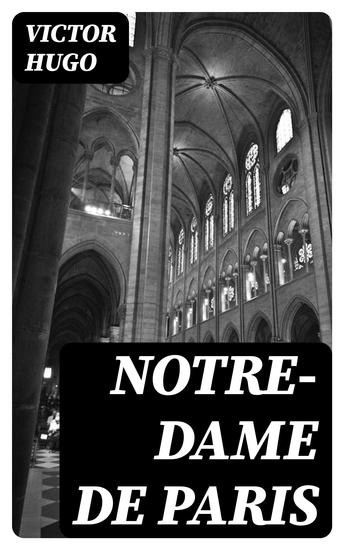
Notre-Dame de Paris - cover

Notre-Dame de Paris

Victor Hugo

Traductor Isabel Florence Hapgood

Editorial: DigiCat

  • 0
  • 0
  • 0

Sinopsis

Set against the backdrop of 15th-century Paris, Victor Hugo's "Notre-Dame de Paris" intricately weaves the fates of its richly drawn characters, primarily focusing on the hunchbacked bell-ringer Quasimodo, the beautiful gypsy Esmeralda, and the tormented priest Claude Frollo. Written in a stylized prose that oscillates between a lyrical narrative and vivid, almost cinematic descriptions, the novel reflects Hugo's passionate advocacy for social justice. Its examination of love, obsession, and the clash between human beauty and moral decay positions the book within the Romantic literary movement, offering a critical commentary on the socio-political landscape of France during Hugo's time. Victor Hugo, a preeminent figure in French literature, was deeply influenced by the tumultuous history of his own country, particularly the injustices faced by the marginalized. His personal experiences with political exiles and societal upheaval underscore the themes of compassion and resilience present in the novel. Through his intricate characterizations and profound philosophical reflections, Hugo explores the perennial struggle between individual desires and societal constraints. "Notre-Dame de Paris" is a timeless masterpiece that transcends its historical setting to resonate deeply with contemporary readers. Hugo's exploration of the human condition, along with his evocative portrayal of Paris and its iconic cathedral, makes this a quintessential read for anyone seeking to understand the complexities of love, society, and the indomitable spirit of humanity.
Disponible desde: 15/09/2022.
Longitud de impresión: 465 páginas.

Otros libros que te pueden interesar

  • Virtue of Simplicity The (Unabridged) - cover

    Virtue of Simplicity The...

    Booker T. Washington

    • 0
    • 0
    • 0
    Booker Taliaferro Washington (April 5, 1856 - November 14, 1915) was an American educator, author, orator, and adviser to several presidents of the United States. Between 1890 and 1915, Washington was the dominant leader in the African American community and of the contemporary black elite. Washington was from the last generation of black American leaders born into slavery and became the leading voice of the former slaves and their descendants. They were newly oppressed in the South by disenfranchisement and the Jim Crow discriminatory laws enacted in the post-Reconstruction Southern states in the late 19th and early 20th centuries.
    THE VIRTUE OF SIMPLICITY: I hope that you all paid strict attention to what Mr. William H. Baldwin, Jr., who recently spoke to you, had to say. In the few words that he spoke, I think he told you the platform upon which this institution has been built.
    Ver libro
  • What Gives Us Our Names - cover

    What Gives Us Our Names

    Alvin Pang

    • 0
    • 0
    • 0
    He’d gotten the idea from a book, not unlike the one you last read and loved, whose lurid covers you have already forgotten. For a canvas, he used not his own skin but his very life, spending his days as if he were made up of the most telling bits of other people. To do this, he learned to watch quietly and look deeply, past the busy surfaces until he could discern the colours beneath, the ones that did not change. One by one he would name them as he wove them into his heart in the deep of night. He touched you once, borrowing pieces of your story in passing. They are here still, in case you wish to look.
    Ver libro
  • The Picture of Dorian Gray - cover

    The Picture of Dorian Gray

    Oscar Wilde

    • 0
    • 0
    • 0
    "It is your best work, Basil, the best thing you have ever done," said Lord Henry, languidly. "You must certainly send it next year to the Grosvenor. The Academy is too large and too vulgar. The Grosvenor is the only place."    "I don't think I will send it anywhere," he answered, tossing his head back in that odd way that used to make his friends laugh at him at Oxford. "No: I won't send it anywhere."    Lord Henry elevated his eyebrows, and looked at him in amazement through the thin blue wreaths of smoke that curled up in such fanciful whorls from his heavy opium-tainted cigarette. "Not send it anywhere? My dear fellow, why? Have you any reason? What odd chaps you painters are! You do anything in the world to gain a reputation. As soon as you have one, you seem to want to throw it away. It is silly of you, for there is only one thing in the world worse than being talked about, and that is not being talked about. A portrait like this would set you far above all the young men in England, and make the old men quite jealous, if old men are ever capable of any emotion."    "I know you will laugh at me," he replied, "but I really can't exhibit it. I have put too much of myself into it."    Lord Henry stretched his long legs out on the divan and shook with laughter.  "Yes, I knew you would laugh; but it is quite true, all the same."    "Too much of yourself in it! Upon my word, Basil, I didn't know you were so vain; and I really can't see any resemblance between you, with your rugged strong face and your coal-black hair, and this young Adonis, who looks as if he was made of ivory and rose-leaves. Why, my dear Basil, he is a Narcissus, and you--well, of course you have an intellectual expression, and all that.    But beauty, real beauty, ends where an intellectual expression begins. Intellect is in itself an exaggeration, and destroys the harmony of any face. The moment one sits down to think, one becomes all nose, or all forehead, or something horrid. Look at the successful men in any of the learned professions. How perfectly hideous they are! Except, of course, in the Church. But then in the Church they don't think. A bishop keeps on saying at the age of eighty what he was told to say when he was a boy of eighteen, and consequently he always looks absolutely delightful. Your mysterious young friend, whose name you have never told me, but whose picture really fascinates me, never thinks. I feel quite sure of that. He is a brainless, beautiful thing, who should be always here in winter when we have no flowers to look at, and always here in summer when we want something to chill our intelligence. Don't flatter yourself, Basil: you are not in the least like him."
    Ver libro
  • The Sun Also Rises - cover

    The Sun Also Rises

    Ernest Hemingway

    • 0
    • 0
    • 0
    "You can't get away from yourself by moving from one place to another."
    
    Set in the aftermath of World War I, The Sun Also Rises follows a group of young expatriates as they drift through Paris and Spain in search of meaning, love, and escape. At the heart of the story are Jake Barnes, a journalist and war veteran grappling with physical and emotional wounds, and Lady Brett Ashley, an independent Englishwoman exploring the opportunities afforded by a new era of liberated women and sexual freedom. The story follows the flamboyant Brett and the disillusioned Jake as they journey from the wild nightlife of 1920s Paris to the brutal bullfighting rings of Spain in an age of moral bankruptcy, spiritual dissolution, unrealized love and vanishing illusions.
    
    Published in 1926, The Sun Also Rises was Hemingways first major novel and the one that established his authorial voice and gave voice to the "Lost Generation"—those scarred by World War I and adrift in a modern world that felt morally and spiritually bankrupt.
    Ernest Hemingway (1899–1961) was an American novelist, short story writer, and journalist renowned for his econimical, understated prose, adventurous lifestyle and outspoken public image. He began his career as a reporter and published a number of short stories before gaining fame with novels such as The Sun Also Rises (1926) and A Farewell to Arms (1929), and his experiences during the Spanish Civil War informed the best-selling For Whom the Bell Tolls (1940). He was awarded the Nobel Prize in Literature in 1954, and some of his seven novels, six short-story collections and two non-fiction works have become classics of American literature.
    Ver libro
  • The Iliad - cover

    The Iliad

    Homer

    • 0
    • 0
    • 0
    The Iliad is one of two major ancient Greek epic poems attributed to Homer. It is one of the oldest extant works of literature still widely read by modern audiences. As with the Odyssey, the poem is divided into 24 books and was written in dactylic hexameter. It contains 15,693 lines in its most widely accepted version. Set towards the end of the Trojan War, a ten-year siege of the city of Troy by a coalition of Mycenaean Greek states, the poem depicts significant events in the siege's final weeks. In particular, it depicts a fierce quarrel between King Agamemnon and a celebrated warrior, Achilles. It is a central part of the Epic Cycle. The Iliad is often regarded as the first substantial piece of European literature.The Iliad and the Odyssey were likely written down in Homeric Greek, a literary amalgam of Ionic Greek and other dialects, probably around the late 8th or early 7th century BC. Homer's authorship was infrequently questioned in antiquity, but contemporary scholarship predominantly assumes that the Iliad and the Odyssey were composed independently and that the stories formed as part of a long oral tradition. Given widespread illiteracy,audiences were more likely to have heard the poem than read it; it was performed by professional reciters of Homer known as rhapsodes.America.
    Ver libro
  • Anna Karenina (Part 6) - cover

    Anna Karenina (Part 6)

    Leo Tolstoy

    • 0
    • 0
    • 0
    Part 6: Dolly, her children, and her mother, the Princess Shcherbatskaya, spend the summer with Kostya and Kitty. The couple's life is simple and unaffected, although Kostya is uneasy at the "invasion" of so many Shcherbatskys. He becomes extremely jealous when one of the visitors, Veslovsky, flirts openly with the pregnant Kitty. Kostya tries to overcome his jealousy, and briefly succeeds during a hunt with Veslovsky and Oblonsky, but eventually succumbs to his feelings and asks Veslovsky to leave. Veslovsky immediately goes to stay with Anna and Vronsky at their nearby estate.
    Anna Karenina is a novel by the Russian author Leo Tolstoy, first published in book form in 1878. Many writers consider Anna Karenina the greatest work of literature ever, and Tolstoy himself called it his first true novel. It was initially released in serial installments from 1873 to 1877 in the periodical The Russian Messenger.
    Ver libro