Join us on a literary world trip!
Add this book to bookshelf
Grey
Write a new comment Default profile 50px
Grey
Subscribe to read the full book or read the first pages for free!
All characters reduced
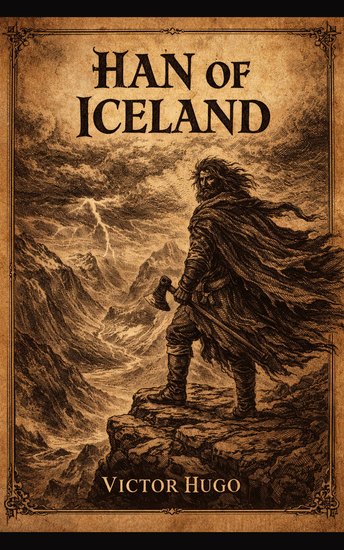
Han of Iceland - cover

Han of Iceland

Victor Hugo

Publisher: CLXBX

  • 0
  • 0
  • 0

Summary

Han of Iceland is Victor Hugo's electrifying early novel—a dark and dramatic tale of rebellion, vengeance, and the struggle between tyranny and justice. Written when Hugo was only a teenager, this powerful work reveals the early brilliance of one of France's greatest literary minds, blending Gothic intensity with political intrigue and romantic heroism.

Set in 17th-century Norway, the novel unfolds against a backdrop of oppression and unrest. The kingdom groans under corrupt authority, while whispers of rebellion stir among the people. At the heart of the chaos stands Han of Iceland—a mysterious, ferocious outlaw who roams the icy wilderness. Feared as a monster and hunted as a criminal, Han is a figure wrapped in myth and terror. Yet behind his savage reputation lies a deeply human story shaped by betrayal, injustice, and grief.

Parallel to Han's story is that of Ordener Guldenlew, a courageous and noble young man determined to clear the name of his beloved Ethel Schumacker's father, who has been falsely imprisoned for treason. As Ordener ventures into the frozen mountains to confront the legendary outlaw, he becomes entangled in a web of conspiracy that reaches into the highest levels of power. What begins as a mission of honor soon transforms into a confrontation with cruelty, ambition, and the true cost of vengeance.

In Han of Iceland, Hugo explores themes that would later define his literary masterpieces: the abuse of authority, the dignity of the oppressed, the complexity of justice, and the tension between civilization and savagery. The novel pulses with dramatic confrontations, haunting landscapes, and larger-than-life characters. The icy Nordic setting mirrors the emotional intensity of the narrative, creating an atmosphere both stark and unforgettable.

Though it is an early work, the novel foreshadows Hugo's later achievements in Les Misérables and The Hunchback of Notre-Dame. Readers will recognize his fascination with social injustice, moral struggle, and the redemptive power of courage and compassion. At the same time, the book carries a Gothic flair—filled with suspense, secret plots, and a brooding antihero whose legend looms over every page.

Han of Iceland is a gripping blend of romance, adventure, and political drama. It is a story of loyalty tested, power corrupted, and humanity revealed in the harshest of conditions. For readers who appreciate classic literature rich in emotion, atmosphere, and moral complexity, this novel offers a compelling journey into the early imagination of a literary giant.
Available since: 02/18/2026.
Print length: 440 pages.

Other books that might interest you

  • The Double - cover

    The Double

    Fyodor Dostoevsky

    • 0
    • 0
    • 0
    This is the story of Yakov Petrovich Golyadkin. 
    Mr. Golyadkin, a minor government official, is a rather middling man. Then one day he meets his "double"—a man with the same name, face, and background. Initially charmed by the coincidence, Golyadkin soon notices a discernable cooling in the reaction of his friends and colleagues, while his double seems to grow in popularity. Mr. Golyadkin, unable to escape the relentless presence of "Golyadkin junior," finds that even the most ordinary activities begin to take on a terrifying significance, until he finds himself on the verge of a breakdown. 
    The Double introduced the concept of the split personality or divided soul that would become a common psychological feature of the characters of Dostoevsky's later novels. Considered the most Gogolesque of Dostoevsky's works, the novella brilliantly depicts Golyadkin's descent into madness in a way that is hauntingly poetic. The Double illustrates Dostoevsky's uncanny ability to capture the complexity of human emotion especially the darker side of the human psyche. In this remarkable work of doppelgänger literature, Dostoevsky examines the neurosis and paranoia that cripple a seemingly ordinary man, producing a thoroughly modern nightmare, brilliantly foreshadowing the works of Kafka and Sartre.
    Show book
  • The Truth Whole Truth - From their pens to your ears genius in every story - cover

    The Truth Whole Truth - From...

    Rhoda Broughton

    • 0
    • 0
    • 0
    The bookshelves of British literature are incredible collections that have gathered together centuries of very talented authors.  From these Isles their fame spread and whilst among their number many are now forgotten or neglected their talents endure.  Among them is the Welsh writer Rhoda Broughton.
    Show book
  • Billy Budd - cover

    Billy Budd

    Herman Melville

    • 0
    • 0
    • 0
    'Who in the rainbow can draw the line where the violet tint ends and the orange tint begins? Distinctly we see the difference of the colours, but where exactly does the one first blendingly enter into the other? So with sanity and insanity.'
    
    Sadly left unfinished by his death in 1891, Melville's novella Billy Budd is acclaimed by critics and quickly took its place in the literary canon.
    
    Billy Budd, a handsome sailor working on a British naval ship in the eighteenth century, is falsely accused of mutiny against the ship's captain by the master-at-arms, John Claggart. Billy, who unfortunately obtains a speech impediment, is overcome by the accusation and unable to verbally defend himself against Claggart's unfounded hate for him. Instead, he lashes out at Claggart, much to his own demise. An instant classic once published, Billy Budd is a tragic tale that has been adapted into film, plays and even an opera. This audiobook edition is narrated by the talented Christopher Ragland.
    Herman Melville (1819 – 1891) was a novelist and poet of the American Renaissance, best known for his works in adventure and travel writing, including Mody Dick (1851) and Typee (1846). His writing was met with mixed reviews by his contemporaries; it wasn't until the early twentieth century that he gained recognition for his literary genius.
    Show book
  • The Necklace - From their pens to your ears genius in every story - cover

    The Necklace - From their pens...

    Guy de Maupassant

    • 0
    • 0
    • 0
    Henri René Albert Guy de Maupassant was born on August 5th, 1850 near Dieppe in France.  
    Maupassant’s early life was badly torn when at age 11 (his younger brother Hervé was then five) his mother, Laure, a headstrong and independent-minded woman, risked social disgrace in order to obtain a legal separation from her husband. 
    After the separation, Laure kept custody of her two boys. With the father now forcibly absent, Laure became the most influential and important figure in the young boy's life.   
    Maupassant’s education was such that he rebelled against religion and other societal norms but a developing friendship with Gustave Flaubert began to turn his mind towards creativity and writing. 
    After graduation he volunteered for the Franco-Prussian war. With its end he moved to Paris to work as a clerk in the Navy Department.  Gustave Flaubert now took him under his wing.  Acting as a literary guardian to him, he guided the eager Maupassant to debuts in journalism and literature.  For Maupassant these were exciting times and the awakening of his creative talents and ambitions. 
    In 1880 he published what is considered his first great work, ‘Boule de Suif’, (translated as as ‘Dumpling’, ‘Butterball’, ‘Ball of Fat’, or ‘Ball of Lard’) which met with a success that was both instant and overwhelming.  Flaubert at once acknowledged that it was ‘a masterpiece that will endure.’ Maupassant had used his talents and experiences in the war to create something unique.  
    This decade from 1880 to 1891 was to be the most pivotal of his career.  With an audience now made available by the success of ‘Boule de Suif’ Maupassant organised himself to work methodically and relentlessly to produce between two and four volumes of work a year.  The melding of his talents and business sense and the continual hunger of sources for his works made him wealthy. 
    In his later years he developed a desire for solitude, an obsession for self-preservation, and a fear of death as well as a paranoia of persecution caused by the syphilis he had contracted in his youth.  
    On January 2nd, 1892, Maupassant tried to commit suicide by cutting his throat.  Unsuccessful he was committed to the private asylum of Esprit Blanche at Passy, in Paris.  It was here on July 6th, 1893 that Henri René Albert Guy de Maupassant died at the age of only 42.
    Show book
  • The Vampyre - cover

    The Vampyre

    John Polidori

    • 0
    • 0
    • 0
    The Vampyre by John Polidori, narrated by Declan McHugh, is one of the earliest and most influential vampire tales in literary history. This dark and atmospheric story follows the mysterious and sinister Lord Ruthven, an aristocratic figure whose charm hides a terrifying secret. As Lord Ruthven lures his unsuspecting victims, the chilling truth about his nature is slowly revealed, drawing listeners into a world of gothic suspense and supernatural horror. 
    Narrator Declan McHugh brings the eerie, otherworldly quality of the story to life with his captivating performance, capturing both the menace and allure of the vampire. His narration immerses listeners in the fog-shrouded, moonlit landscapes and chilling encounters that make this story a timeless classic. 
    Perfect for fans of gothic literature and vampire lore, The Vampyre is a must-listen for those who enjoy dark, haunting narratives filled with suspense and mystery. This audiobook offers an unforgettable journey into the origins of the vampire mythos, where danger and seduction intertwine.
    Show book
  • The Captain of the Pole Star - cover

    The Captain of the Pole Star

    Arthur Conan Doyle

    • 0
    • 0
    • 0
    Word goes among the crew of the Pole Star that the captain is haunted by demons. And after the days turn into weeks in the frigid Arctic Ocean, stories begin to circulate of ghosts and midnight hauntings.
    Show book