¡Acompáñanos a viajar por el mundo de los libros!
Añadir este libro a la estantería
Grey
Escribe un nuevo comentario Default profile 50px
Grey
Suscríbete para leer el libro completo o lee las primeras páginas gratis.
All characters reduced
The Beautiful: An Introduction to Psychological Aesthetics - cover

The Beautiful: An Introduction to Psychological Aesthetics

Vernon Lee

Editorial: DigiCat

  • 0
  • 0
  • 0

Sinopsis

In "The Beautiful: An Introduction to Psychological Aesthetics," Vernon Lee meticulously explores the intersection of beauty and psychology, offering an innovative perspective on aesthetic experience. This seminal work, characterized by Lee's elegant prose and incisive analysis, draws on contemporary philosophical ideas while also engaging with the rich tradition of aesthetic theory. Lee argues that the appreciation of beauty is a deeply psychological phenomenon, intricately linked to the sensory experiences and emotional responses elicited by art and nature. Her integration of psychological insights into aesthetic theory marks a significant contribution to the field, encouraging readers to reconsider the essence of beauty in both art and everyday life. Vernon Lee, born Violet Paget, was a prominent figure in the late 19th and early 20th centuries, known for her extensive writings on aesthetics, fiction, and essays. Lee's unique background as a cultivated intellectual in Europe contributed to her profound understanding of the complex interplay between aesthetics and psychology. Her exposure to various artistic movements and philosophical discussions of her time significantly shaped her approach to beauty, making her insights particularly relevant in an age grappling with the subjectivity of artistic value. "The Beautiful" is recommended for readers interested in aesthetic theory, psychology, and the arts. Its thoughtful examination of beauty invites both scholars and general readers to engage with the deeper dimensions of aesthetic enjoyment. Lee's compelling arguments and stylistic elegance make this work an essential addition to any library of critical thought.
Disponible desde: 16/09/2022.
Longitud de impresión: 145 páginas.


Otros libros que te pueden interesar

  • Hitchhiker's Guide to the Galaxy by Douglas Adams The (Book Analysis) - Detailed Summary Analysis and Reading Guide - cover

    Hitchhiker's Guide to the Galaxy...

    Bright Summaries

    • 0
    • 0
    • 0
    Unlock the more straightforward side of The Hitchhiker's Guide to the Galaxy with this concise and insightful summary and analysis!This engaging summary presents an analysis of The Hitchhiker's Guide to the Galaxy by Douglas Adams, which tells the story of Arthur Dent, a quintessential Englishman who is unexpectedly swept up into an adventure across the galaxy when Earth is destroyed. After being saved by his friend Ford Prefect, who is revealed to be an alien in disguise, Arthur finds himself on board the Heart of Gold, a spaceship powered by an 'infinite improbability drive'. As a result, the protagonists are plunged into a series of madcap adventures and astounding coincidences, which may even lead them to discover the meaning of life itself… The Hitchhiker's Guide to the Galaxy is the first instalment in a series of novels adapted from the radio series of the same name, which was also written by Adams.Find out everything you need to know about The Hitchhiker's Guide to the Galaxy in a fraction of the time!This in-depth and informative reading guide brings you:• A complete plot summary• Character studies• Key themes and symbols• Questions for further reflectionWhy choose BrightSummaries.com?Available in print and digital format, our publications are designed to accompany you on your reading journey. The clear and concise style makes for easy understanding, providing the perfect opportunity to improve your literary knowledge in no time.See the very best of literature in a whole new light with BrightSummaries.com!
    Ver libro
  • The Brexit Referendum - The UK's EU Departure - cover

    The Brexit Referendum - The UK's...

    Nova Ashford

    • 0
    • 0
    • 0
    The Brexit referendum, which took place on June 23, 2016, marked a pivotal moment in the history of the United Kingdom and its relationship with the European Union. The decision to leave the EU, known as Brexit, came after years of mounting debate and growing division within British society and politics. The referendum was the result of a long-standing debate over the UK’s membership in the European Union, with political, economic, and cultural tensions playing a central role in shaping the outcome. 
    The road to Brexit began long before the referendum vote. The United Kingdom joined the European Economic Community (EEC) in 1973, a precursor to the European Union, and since then, the nation’s relationship with the organization has been fraught with disagreement. Euroscepticism, or skepticism about the benefits of EU membership, had been steadily rising, particularly among certain political groups and sections of the public. Critics of the EU argued that membership undermined national sovereignty and that the UK was bound by regulations and policies that did not align with its interests. This sentiment was exacerbated by issues such as immigration, trade regulations, and the financial burden of contributing to the EU budget. 
    In the years leading up to the referendum, the political landscape of the UK began to shift. The rise of UKIP (the United Kingdom Independence Party), led by Nigel Farage, brought the issue of EU membership into sharper focus. UKIP’s success in the 2014 European Parliament elections, where it emerged as the largest UK party, put pressure on the Conservative Party to address the growing concerns over the EU. Prime Minister David Cameron, seeking to quell dissent within his own party and avoid a potential electoral challenge from UKIP, promised a referendum on EU membership in 2013. This pledge set the stage for the referendum that would ultimately decide the UK’s fate within the EU.
    Ver libro
  • Jo Rey and Other Strong But Lonely Characters (Little Women Podcast) - cover

    Jo Rey and Other Strong But...

    Niina Niskanen, Emily Lau

    • 0
    • 0
    • 0
    Discover the world of resilient characters with our inspiring audiobook, "Jo, Rey, and Other Strong But Lonely Characters" from the Little Women Podcast. Inspired by the timeless classic Little Women, In this episode Niina and Emily are discussing about the way modern pop culture portrays "strong characters" as lonely women. Louisa May Alcott, wrote in her diaries how she envied her sisters when she saw them happily married and becoming parents. The glamorization of the strong but lonely trope, has a darker side.  
    Perfect for literary enthusiasts, this digital download is an excellent companion for those who appreciate deep, emotional storytelling. Whether you're commuting, relaxing at home, or looking for a bedtime story, this audiobook is sure to resonate with listeners of all ages. 
    How You Can Use This Audiobook:Commuting: Transform your daily commute into an engaging literary journey.Relaxation: Unwind after a long day with these heartwarming stories.Bedtime Stories: Share these tales with loved ones as a perfect bedtime listen.Book Clubs: Use it as a discussion piece in your literary circles.Inspiration: Find motivation and solace in the strength of these characters. 
    Embrace the magic of these timeless stories and let them inspire you. Download your copy today and step into the world of Jo, Rey, and other unforgettable characters.
    Ver libro
  • You're One of Us! - Systemic Insights and Solutions for Teachers Students and Parents - cover

    You're One of Us! - Systemic...

    Marianne Franke-Gricksch

    • 0
    • 0
    • 0
    In this gripping account of her work, Marianne Franke-Gricksch speaks from her experience as a teacher and therapist, describing how systemic ideas enable fundamentally new and effective learning and encourage creative cooperation between students, teachers, and parents. Rather than viewing the participants in this process as isolated individuals, she shows how people and their environment constantly influence and change each other. Franke-Gricksch's own systemic view connects Bert Hellinger's work on the power of one's bond with his or her family of origin with various other approaches within systemic theory. The author's reports are consistently supported by practical examples from the everyday classroom situation. Especially fascinating is the children's enthusiasm and array of ideas that they use to pick up and transfer the new impulses and procedures. Readers who are new to these methods will also be amazed at the powerful effect that is released by systemic thinking and action.
    Ver libro
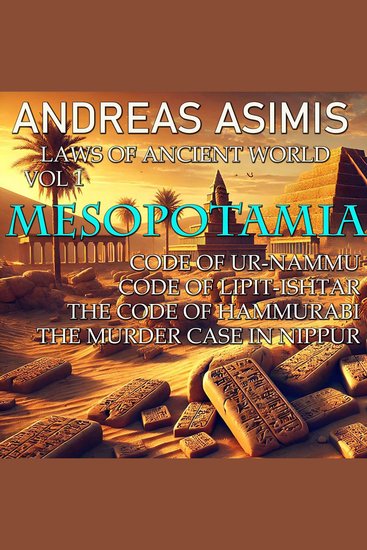
  • Laws of Ancient World Vol 1: Mesopotamia - Code of Ur-Nammu Code of Lipit-Ishtar The Code of Hammurabi The Murder Case in Nippur - cover

    Laws of Ancient World Vol 1:...

    Andreas Asimis

    • 0
    • 0
    • 0
    Despite all of the imperfections present throughout Ancient Mesopotamian legislation, these laws of the ancient world are a priceless treasure influencing the history of judicial science.
    In ancient Mesopotamia, a written set of laws adopted by a ruler or his kingdom was quickly established as the foundational governing document. The emergence of royal decrees came about due to the special conditions surrounding the establishment and development of multiple federations due to war, coups, conquests, the formation of territorial and political treaties, the rise or fall in power of a particular ruler, or the rising supremacy of one ethnic group or another. 
    Contents:
    Chapter 1. Sources of Law: Mesopotamia
    Chapter 2. Code of Ur-Nammu (2100-2050 BC)
    Chapter 3. Code of Lipit-Ishtar (c.1870-1860 BC)
    Chapter 4. Code of Hammurabi
    Chapter 5. Judicial Precedent: The murder case in Nippur
    Ver libro
  • The History of Political Thought - A Very Short Introduction - cover

    The History of Political Thought...

    Richard Whatmore

    • 0
    • 0
    • 0
    Thinking about politics has tended to be historical in nature because of the comparisons and contrasts that can be drawn between past and present. Different periods in politics have used the past differently. At times political thought can be said to have been drawn directly from the study of history; at others, perhaps including our own time, the relationship is more indirect. 


    This Very Short Introduction explores the core concerns and questions in the field of the history of political thought. Richard Whatmore considers the history of political thought as a branch of political philosophy/political science, and examines the approaches of core theorists such as Reinhart Koselleck, Strauss, Michel Foucault, and the so-called Cambridge School of Quentin Skinner and John Pocock. Assessing the current relationship between political history, theory and action, Whatmore concludes with an analysis of its relevance for current politics.
    Ver libro