¡Acompáñanos a viajar por el mundo de los libros!
Añadir este libro a la estantería
Grey
Escribe un nuevo comentario Default profile 50px
Grey
Suscríbete para leer el libro completo o lee las primeras páginas gratis.
All characters reduced
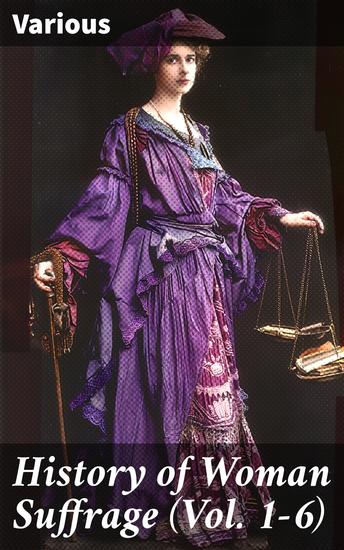
History of Woman Suffrage (Vol 1-6) - Complete Edition - cover

History of Woman Suffrage (Vol 1-6) - Complete Edition

Various Various

Editorial: Good Press

  • 0
  • 0
  • 0

Sinopsis

The "History of Woman Suffrage" (Volumes 1-6) is a monumental compilation that chronicles the grassroots activism, legal challenges, and social transformations surrounding women's quest for suffrage in the United States. Penned by various pioneering suffragists, including Elizabeth Cady Stanton and Susan B. Anthony, these volumes exemplify a mix of documentary rigor and passionate advocacy, encapsulating personal narratives, speeches, and correspondences. Set against the backdrop of the 19th and early 20th centuries, this work not only delineates the chronology of the suffrage movement but also critiques the intersecting issues of race, class, and gender injustices that influenced its trajectory. The literary style ranges from eloquent prose to impassioned rhetoric, capturing the fervor of the times while employing a meticulous historical approach. The authors behind this seminal work were key figures in the suffrage movement themselves, whose life experiences and struggles informed their narrative. Elizabeth Cady Stanton, often considered the
Disponible desde: 27/12/2023.
Longitud de impresión: 6317 páginas.

Otros libros que te pueden interesar

  • The Roman Empire and Byzantine Empire - The History and Legacy of Europe’s Most Important Empire and Its Successor - cover

    The Roman Empire and Byzantine...

    Charles River Editors

    • 0
    • 0
    • 0
    For the people of the ancient Mediterranean and beyond, the city of Rome had been a symbol of power for centuries, and entering the early 5th century CE, the Eternal City hadn’t been taken by an enemy force since the Gauls had done it about 800 years earlier, an unheard of period of tranquility in a world wracked with almost constant warfare. 
    Thus, when the Visigoths, whom the Romans considered uncultured and inferior, took the city of Rome and sacked it in 410, the world was stunned. It made theologians of the newly Christianized empire question God’s plan on Earth, and it encouraged many leading Romans to look east to Constantinople for their future. Indeed, the Western Roman Empire would completely collapse in the late 5th century, less than 70 years after the Visigoths sacked Rome, and just how it went from being a superpower to a poorly led, weak, and vulnerable shadow of its former self has preoccupied historians for centuries. 
    To this day, it remains difficult to trace just when the decline began, but it’s fair to say that the sack of Rome was the result of a number of factors that had been coalescing for many years. In the end, the fall of the Roman Empire was not a tale of cataclysmic events that shattered the sprawling power, but the culmination of centuries of internal dissent and decay, combined with growing external threats that led to gradual decline and eventually to the empire’s final destruction.  
    In terms of geopolitics, perhaps the most seminal event of the Middle Ages was the successful Ottoman siege of Constantinople in 1453. The city had been an imperial capital as far back as the 4th century, when Constantine the Great shifted the power center of the Roman Empire there, effectively establishing two almost equally powerful halves of antiquity’s greatest empire. Constantinople would continue to serve as the capital of the Byzantine Empire even after the Western half of the Roman Empire collapsed.
    Ver libro
  • The Manipulation Bible - The Dark Side of Communication - cover

    The Manipulation Bible - The...

    Wladislaw Jachtchenko

    • 0
    • 0
    • 0
    A masterclass in manipulation from the bestselling communication coach
     
    Nice is for suckers.
    Want to win in today's world?
    Put yourself first and start getting your own way.
    Want to seem confident but haven't got a clue?
    Want to prove yourself right using whatever facts you like?
    This essential book will teach you how to run rings round your acquaintances, family members, and colleagues. It's crafty, provocative, and best of all, guaranteed to work.
     
    Here's what you need to know:
    Rule 1: Know who you're up against.
    Rule 2: Know all the dirtiest tricks.
    Rule 3: Manipulate others before they manipulate you!
     
    International phenomenon Wladislaw Jachtchenko is here to show you how. This international best-selling communication coach opens up his box of tricks to show you how to use bogus arguments, devious body language techniques and twisted truths to get the last word in every single conversation.
    Ver libro
  • Combat Trauma - A Personal Look at Long-Term Consequences - cover

    Combat Trauma - A Personal Look...

    James D Johnson

    • 0
    • 0
    • 0
    “In this incredibly courageous expose,” Vietnam veterans discuss the long-lasting effects of PTSD and their strategies for coping (Publishers Weekly). Though much has been written about the short-term experience of combat trauma, very few resources discuss how that trauma continues to impact individuals into later life. In this volume, retired Army Chaplain James D. Johnson relates how fifteen Vietnam veterans have been affected by the terror they experienced four decades ago, and how it continues to affect them today.   With candor and vivid detail, they reveal how their combat trauma symptoms still infect their thoughts, feelings, and behaviors on a daily basis. Their stories offer valuable insight for today’s soldiers returning from battle, as well as for their loved ones. The experiences shared here can help them address and cope with the ongoing challenges of PTSD.   Those who still carry these wounds will find that they are not alone, and that there are ways of dealing with the horror, no matter how long ago it took place.
    Ver libro
  • Aokigahara - Suicide Forest of Japan And The Truth Behind It - cover

    Aokigahara - Suicide Forest of...

    Daniel Turmoil

    • 0
    • 0
    • 0
    Aokigahara, also known as the sea of trees, is a forest on the flanks of Mount Fuji on the island of Honshu in Japan, spread over 30 square kilometres of rock hard lava which was laid down during the last major eruption of Mount Fuji in 864. The western edge of Aokigahara, where there are various caves that fill with ice in winter, is a popular destination for tourists. Parts of Aokigahara are very dense, and the porous lava rock absorbs sound, all adding to a sense of solitude that some visitors decide to be the perfect place to implement their final act.
    Ver libro
  • 30 Days to Reparent your Inner Child - Heal your Childhood Trauma Transform your Attachment Style and Build Secure Loving Relationships - cover

    30 Days to Reparent your Inner...

    Dr. S Girish Kumar, Jyotsna...

    • 0
    • 0
    • 0
    Heal Your Inner Child, Break Free from the Past and Build Secure Relationships That Last  
    Your 30-Day Guided Journey to Reparenting, Emotional Freedom and Inner Peace 
    Still caught in patterns of anxiety, fear of abandonment, or low self-worth even as an adult? 
    Do your relationships leave you feeling unseen, unloved, or unworthy no matter how much you give? 
    Tired of overthinking, people-pleasing, or clinging to partners who do not meet your needs? 
    You are not broken. You are wounded. And healing is absolutely possible. 
    Inside This Book, You Will Discover:What anxious attachment is and how to shift toward a secure, empowered connection styleHow to identify and heal childhood wounds behind fear of rejection, abandonment, or criticismTools for emotional regulation to stay calm and grounded during moments of stress or conflictSelf-compassion exercises that release guilt, shame, and self-blame for true self-acceptanceA clear, day-by-day healing process that makes progress simple and sustainablePowerful affirmations, reflection prompts, and somatic tools to build inner safety 
    If you are ready to stop repeating old patterns, release the fear of abandonment, and feel emotionally secure from within... 
    Scroll up and click "Buy Now" to begin your 30-day reparenting journey with your companion workbook by your side.
    Ver libro
  • The Rise of Capitalism - How Market Economies Shaped Modern Wealth and Innovation - cover

    The Rise of Capitalism - How...

    Arlo Holders

    • 0
    • 0
    • 0
    The origins of capitalism can be traced back to the gradual shift from feudal economies to market-based systems. In medieval Europe, wealth was primarily tied to land ownership, with a rigid social hierarchy that limited economic mobility. The feudal system depended on agrarian production, where peasants worked the land owned by nobles in exchange for protection. However, as trade expanded and urban centers grew, the foundations of capitalism began to emerge. 
    One of the earliest indicators of this transformation was the rise of merchant guilds and early banking systems. As trade routes connected Europe, Asia, and the Middle East, merchants sought more efficient ways to conduct business, leading to the establishment of guilds that regulated commerce and maintained quality standards. Banking families, such as the Medici in Renaissance Italy, played a crucial role in financing trade and investment, paving the way for modern financial institutions. The shift toward money-based transactions rather than bartering allowed wealth to accumulate outside the traditional feudal framework. 
    Another key development was the concept of private property and individual ownership. In the late medieval period, the enclosure movement in England marked a significant departure from communal farming practices. Landowners began fencing off common lands for private use, displacing many rural laborers and forcing them to seek employment in emerging industries. This shift not only created a labor force for industrial production but also reinforced the idea that property and capital could be owned, bought, and sold freely—an essential pillar of capitalism.
    Ver libro