Join us on a literary world trip!
Add this book to bookshelf
Grey
Write a new comment Default profile 50px
Grey
Subscribe to read the full book or read the first pages for free!
All characters reduced
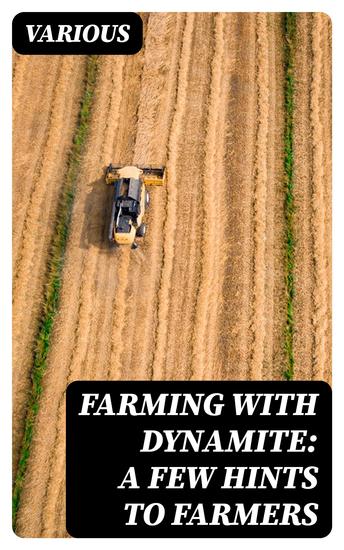
Farming with Dynamite: A Few Hints to Farmers - cover

Farming with Dynamite: A Few Hints to Farmers

Various Various

Publisher: DigiCat

  • 0
  • 0
  • 0

Summary

"Farming with Dynamite: A Few Hints to Farmers" is a pioneering text that emerged at the turn of the 20th century, where agricultural innovation intersected with practical advice. Composed by a collection of various authors, the book employs a direct, instructional style that reflects the vibrant agricultural discourse of its time. It artfully combines scientific techniques with hands-on farming wisdom, emphasizing the transformative power of dynamite in enhancing agricultural productivity. This work not only addresses the pressing challenges of land cultivation but also serves as a historical document, capturing the zeitgeist of an era marked by mechanization and modernization in farming practices. The contributors to this book are rooted in a rich history of agricultural development, likely compiled by knowledgeable farmers and agricultural scientists who sought to share their insights with a broader audience. Their experiences during a time of significant agricultural change, influenced by advances in technology and shifts in economic frameworks, shaped their perspectives on how dynamite could revolutionize farming methods, promoting efficiency and effectiveness in land use. For readers interested in the evolution of agricultural practices and the impact of technology on rural life, "Farming with Dynamite" is an indispensable resource. It offers valuable insights into how novel practices were adopted and adapted, shedding light on the continuous quest for innovation in farming. This essential text will resonate with both historians and modern agriculturalists aiming to understand the roots of contemporary farming techniques.
Available since: 07/20/2022.
Print length: 8 pages.

Other books that might interest you

  • Fermi Remembered - cover

    Fermi Remembered

    James W. Cronin

    • 0
    • 0
    • 0
    Nobel laureate and scientific luminary Enrico Fermi (1901-54) was a pioneering nuclear physicist whose contributions to the field were numerous, profound, and lasting. Best known for his involvement with the Manhattan Project and his work at Los Alamos that led to the first self-sustained nuclear reaction and ultimately to the production of electric power and plutonium for atomic weapons, Fermi's legacy continues to color the character of the sciences at the University of Chicago. During his tenure as professor of physics at the Institute for Nuclear Studies, Fermi attracted an extraordinary scientific faculty and many talented students—ten Nobel Prizes were awarded to faculty or students under his tutelage. Born out of a symposium held to commemorate the hundredth anniversary of Fermi's birth, Fermi Remembered combines essays and newly commissioned reminiscences with private material from Fermi's research notebooks, correspondence, speech outlines, and teaching to document the profound and enduring significance of Fermi's life and labors. The volume also features extensives archival material—including correspondence between Fermi and biophysicist Leo Szilard and a letter from Harry Truman—with new introductions that provide context for both the history of physics and the academic tradition at the University of Chicago. Edited by James W. Cronin, a University of Chicago physicist and Nobel laureate himself, Fermi Remembered is a tender tribute to one of the greatest scientists of the twentieth century. Contributors: Harold Agnew Nina Byers Owen Chamberlain Geoffrey F. Chew James W. Cronin George W. Farwell Jerome I. Friedman Richard L. Garwin Murray Gell-Mann Maurice Glicksman Marvin L. Goldberger Uri Haber-Schaim Roger Hildebrand Tsung Dao Lee Darragh Nagle Jay Orear Marshall N. Rosenbluth Arthur Rosenfeld Robert Schluter Jack Steinberger Valentine Telegdi Al Wattenberg Frank Wilczek Lincoln Wolfenstein Courtenay Wright Chen Ning Yang Gaurang Yodh
    Show book
  • Walking Wild - Hiking the length of the Kruger National Park - cover

    Walking Wild - Hiking the length...

    Jose A Neves

    • 0
    • 0
    • 0
    "A must-read for anyone who loves Kruger and adventure." - Tony Park 
    WALKING WILD is not your typical safari - no game drives, no cool sundowners and definitely no fences. Instead, it's 605 km of dust, sweat and unforgettable moments as an unlikely group of strangers sets out to walk the entire length of Kruger National Park. Over six stages and three years, they walked from Crooks' Corner in the far north to Malelane in the south, averaging 20 km a day with heavy backpacks and only the wild for company. 
    Led by two armed guides, they braved blistering heat and violent storms. At night, as hyenas nosed their tents and lionesses strolled right through camp, some slept soundly - others lay wide eyed, waiting for dawn. They drank from murky trickles in dry riverbeds, navigated thick riverine bush teeming with hippo, buffalo and crocodiles, and slowly learnt to read the bush - from the smallest antlion to the distant roar of a lion. 
    But Kruger's wilderness is not without its challenges. Poachers - both criminal syndicates and those in search of bushmeat - move in the shadows, rivers bring pollution from beyond its borders, and conservation battles rage on. WALKING WILD captures the magic and the madness of life on foot in one of the world's most iconic national parks. It's a story of adventure, camaraderie and deep immersion in the wild - a journey that leaves no one unchanged. 
    WALKING WILD is a testament to resilience, discovery and the deep connection between people and nature. If you've ever dreamt of experiencing Kruger beyond the safari vehicle, this book is your ticket to the trail.
    Show book
  • Robotics and Automation - Shaping the Future of Work - cover

    Robotics and Automation -...

    Craig Dames

    • 0
    • 0
    • 0
    Robotics and automation have rapidly evolved from niche technological concepts to central pillars of modern industry and society. What once belonged to the realm of science fiction is now an integral part of how we produce, communicate, transport, and even care for one another. Understanding the foundations of these technologies is essential to grasp how they are reshaping the future of work. 
    The journey of robotics dates back to ancient times with early mechanical inventions, but it wasn’t until the 20th century that programmable machines began to take shape. The term "robot" gained popularity in the early 1920s, yet the real development of industrial robotics didn’t gain momentum until the 1960s, when the first robotic arms were introduced into assembly lines. Since then, robotics has grown exponentially, encompassing everything from humanoid robots to autonomous drones and AI-driven service machines. 
    Automation, often linked closely with robotics, refers to the use of technology to perform tasks with minimal human intervention. While automation began with simple mechanical devices, today it incorporates advanced software, machine learning algorithms, and sensor networks. Modern automation extends beyond factories and is now seen in financial services, healthcare, logistics, agriculture, and even our homes. From smart thermostats to self-checkout systems, the influence of automation is becoming ever more visible in daily life.
    Show book
  • Chaos and Nonlinear Dynamics - Understanding Complex Systems and Behavior - cover

    Chaos and Nonlinear Dynamics -...

    Mark Hedges

    • 0
    • 0
    • 0
    Chaos and nonlinear dynamics are fundamental concepts in understanding the behavior of complex systems. Unlike linear systems, which exhibit proportionality and predictability, nonlinear systems often display unexpected, highly sensitive, and seemingly random behaviors. This unpredictability, despite being governed by deterministic rules, is the hallmark of chaos theory. 
    The study of chaos and nonlinear dynamics has evolved over centuries, but it gained prominence in the 20th century with the advent of modern computing. One of the most well-known figures in this field is Edward Lorenz, a meteorologist who, in the 1960s, discovered that small changes in initial conditions could lead to vastly different outcomes in weather models. This phenomenon, later termed the "butterfly effect," became a defining feature of chaotic systems. Lorenz’s discovery challenged the classical notion that the universe operates like a clockwork mechanism, reinforcing the idea that certain systems, though deterministic, are inherently unpredictable. 
    Nonlinear dynamics appear in a wide array of disciplines, from physics and engineering to biology and economics. In physics, chaotic motion is evident in fluid turbulence, celestial mechanics, and quantum systems. Engineering applications include secure communication systems that exploit chaotic signals for encryption. Biological systems, such as neural activity in the brain and heartbeat irregularities, also follow nonlinear principles. Ecological systems, particularly predator-prey relationships and population dynamics, demonstrate chaotic fluctuations over time. Even in finance, stock market movements and economic cycles exhibit nonlinear behaviors that make precise long-term predictions nearly impossible.
    Show book
  • Minnie - The remarkable story of a true trailblazer who found freedom and adventure in the outback - cover

    Minnie - The remarkable story of...

    Marianne van Velzen

    • 0
    • 0
    • 0
    The inspiring story of a feisty pioneering woman who sought freedom and adventure in the outback and became the first woman to work as an opal miner in Australia. 
     
    People always asked her if she was ever afraid, living out in the desert alone with all those rough and scruffy men. But Minnie Berrington was not the faint-hearted type, and never had been. Being tough came naturally to her, growing up with three brothers and a family that went from riches to ruins. 
     
    Only a slip of a girl, Minnie could match any man in stamina, perseverance and strength. She arrived in Coober Pedy when camels still brought in essential supplies, and water was so scarce that no-one washed. Together with the other miners, she braved the heat, the flies and the dust. Every day she waited for that special sound the pick made when it cracked opal. 
     
    The first woman to dig her own shafts in the Australian opal fields, Minnie began her working life as a typist in London. But she and her younger brother, Victor, sought freedom and adventure in the 1920s and found plenty of it in the outback. 
     
    'Destined to become an outback classic' LIZ HARFULL, bestselling author of Women of the Land 
     
    'Minnie brings to life a gutsy, independent woman living a remarkable but simple life in the harshest of conditions' JULIET WILLS, author of The Diamond Dakota Mystery
    Show book
  • Data-Intensive Applications - Mastering Data-Intensive Applications Design Scale and Optimization - cover

    Data-Intensive Applications -...

    James Ferry

    • 0
    • 0
    • 0
    In an era dominated by big data, mastering the art of building and maintaining data-intensive applications is crucial for any technology professional. "Mastering Data-Intensive Applications: Design, Scale, and Optimization" is a comprehensive guide that delves into the architectures, technologies, and practices essential for handling massive datasets efficiently and reliably. 
    This book begins by defining what makes an application data-intensive and explores the key challenges such as scalability, reliability, efficiency, and maintainability. Readers will learn about various storage options—from traditional relational databases to innovative NoSQL solutions—and understand when and how to use them effectively. The discussion extends to data distribution techniques, including partitioning and replication, essential for building fault-tolerant systems that can scale. 
    Further chapters focus on the nuts and bolts of data-intensive operations, including indexing, search, caching, batch and stream processing, and data integration. Each topic is covered with clear explanations, practical examples, and real-world case studies to demonstrate the application of these technologies in today’s leading companies. 
    Security and compliance are not overlooked; the book provides a thorough overview of the necessary practices to keep data secure and applications compliant with global regulations. Additionally, readers are equipped with strategies for scalability and performance tuning, helping them to improve existing systems and build efficient new systems from the ground up. 
    "Mastering Data-Intensive Applications" is an invaluable resource for software engineers, system architects, data scientists, and IT managers. Whether you are looking to deepen your existing knowledge or venturing into the field of data-intensive applications for the first time, this book offers the insights and tools needed to excel in this dynamic field. 
     
    Show book