Join us on a literary world trip!
Add this book to bookshelf
Grey
Write a new comment Default profile 50px
Grey
Subscribe to read the full book or read the first pages for free!
All characters reduced
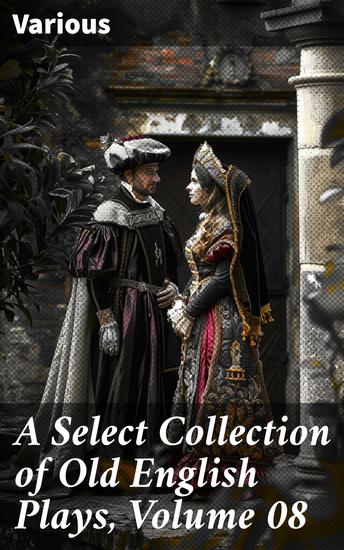
A Select Collection of Old English Plays Volume 08 - Exploring the Richness of Old English Dramatic Tradition - cover

A Select Collection of Old English Plays Volume 08 - Exploring the Richness of Old English Dramatic Tradition

Various Various

Publisher: Good Press

  • 0
  • 0
  • 0

Summary

This pivotal volume of "A Select Collection of Old English Plays, Volume 08" showcases an impressive array of dramatic works from the medieval period to the early modern era, highlighting the rich tapestry of themes and styles that characterize English theatrical traditions. Compiled by various editors, the anthology juxtaposes both well-known and lesser-known plays, offering modern readers remarkable insight into the evolution of narrative techniques, character development, and the societal context of the time. The literary style is marked by linguistic diversity, often blending poetic elements with colloquial dialogue, which reflects the cultural and historical intricacies of Elizabethan and Jacobean England. The anonymity surrounding many of the included works often belies the passionate voices of their authors, who were likely influenced by the cultural turbulence of their times'Äîa period rife with political strife, religious upheaval, and burgeoning nationalism. Through this collection, readers can begin to understand the collaborative nature of early theater, where playwrights, actors, and audiences interacted in a vibrant social milieu, shaping the landscape of English literature. For scholars, theater enthusiasts, and casual readers alike, this anthology serves as an invaluable resource that invites exploration into the world of early English drama. It is a compelling compendium for anyone seeking to appreciate the complexity of historical narratives and their resonance in contemporary themes.
Available since: 08/12/2023.
Print length: 293 pages.

Other books that might interest you

  • Things Hidden Since the Foundation of the World - cover

    Things Hidden Since the...

    Javaad Alipoor

    • 0
    • 0
    • 0
    'Fereydoun Farrokhzad is invisible to everyone apart from, mostly, Iranians, because nobody apart from them ever has to think about him.'
    It's the 1970s, and Fereydoun Farrokhzad's star is blazing bright – he's a sex symbol and chart-topping pop singer. Imagine an Iranian Tom Jones. A decade on and he's living in political exile in Germany, though still selling out the Royal Albert Hall. Then, on 7 August 1992, he's found brutally murdered. The neighbours said his dogs had been barking for two nights. The case has never been solved.
    Things Hidden Since the Foundation of the World is an investigation into the nature of investigation; part free-wheeling lecture, part podcast and part play. It is a thrilling ride down the rabbit hole of Wikipedia and true-crime podcasts, sorting through the tangle of information available online to reveal the limits of the search engines in solving a decades-old cold case.
    Originally produced by The Javaad Alipoor Company in 2022, this witty, fast-paced and cutting-edge play, by Javaad Alipoor with Chris Thorpe, was co-commissioned by HOME and the National Theatre of Parramatta. It has toured worldwide, including a run at the Traverse Theatre, Edinburgh, during the 2023 Festival Fringe.
    Show book
  • Mishkât Al-Anwar (The Niche For Lights) - The classic work of Sufi mystical thinking - cover

    Mishkât Al-Anwar (The Niche For...

    Al- Ghazzali, WHT Gairdner

    • 0
    • 0
    • 0
    The classic work of Sufi mystical thinking from 1100CE, available in audiobook for the first time. It is also known as A Niche of Lamps. In the middle ages, Sufi scholars reconciled rationality and faith, both of which were ascendant in the empires of the time. This is one of the great philosophical and theological works from that period, and shows another side to Islam than the doctrinaire version that is more commonly spoken of. Al-Ghazali is often called "the proof of Islam" (hujjat al-islam), because he tried to bridge inquiry, legislation and mystical practice. One could call al-Ghazali the prototype Muslim intellectual.This translation was done in 1823 by WHT Gairdner, who also includes a commentary upon the ideas that Al-Ghazzali presents.The Niche of Lights, written near the end of his life, is about the need for balance between the authority of the divine and reason, seeing both as essential to real spiritual development.
    Show book
  • Born in the USA - The Massachusetts Poets - Exploring America in poems - cover

    Born in the USA - The...

    Ralph Waldo Emerson, Emily...

    • 0
    • 0
    • 0
    1 - Born in the USA - The Massachusetts Poets - An Introduction 
    2 - June by Horatio Alger Jr 
    3 - America the Beautiful by Katharine Lee Bates 
    4 - Beyond by Katharine Lee Bates 
    5 - Come Unto Me by Katherine Lee Bates 
    6 - Turn Me to My Yellow Leaves by William Stanley Braithwaite 
    7 - Hymn to the North Star by William Cullen Bryant 
    8 - Song of Marion's Men by William Cullen Bryant 
    9 - October by William Cullen Bryant 
    10 - The Death of Slavery by William Cullen Bryant 
    11 - Hope is the Thing With Feathers by Emily Dickinson 
    12 - I Measure Every Grief by Emily Dickinson 
    13 - Where Roses Would Not Dare to Go by Emily Dickinson 
    14 - A Light Exists in Spring by Emily Dickinson 
    15 - This Was a Poet - It Is That by Emily Dickinson 
    16 - Credo by W E B Du Bois 
    17 - Concord Hymn by Ralph Waldo Emerson 
    18 - Letters by Ralph Waldo Emerson 
    19 - Water by Ralph Waldo Emerson 
    20 - A Nation's Strength by Ralph Waldo Emerson 
    21 - Fate by Ralph Waldo Emerson 
    22 - The Eyes of My Regret by Angelina Weld Grimké 
    23 - The Black Finger by Angelina Weld Grimke 
    24 - Tenebris by Angelina Weld Grimké 
    25 - In the Reading Room of the British Museum by Louise Imogen Guiney 
    26 - Forms of Heroes by Nathaniel Hawthorne 
    27 - The Ocean by Nathamiel Hawthorne 
    28 - Address to the Moon by Nathaniel Hawthorne 
    29 - The Old Man of the Sea by Oliver Wendell Holmes 
    30 - Hymm for the Celebration at the Laying of the Cornerstone of Harvard Memorial Hall, Cambridge, October 6th 1870 by Oliver Wendell Holmes 
    31 - Old Ironsides by Oliver Wendell Holmes 
    32 - A Calendar of Sonnets - February by Helen Hunt Jackson 
    33 - A Calender of Sonnets - May by Helen Hunt Jackson 
    34 - A Calender of Sonnets - November by Helen Hunt Jackson 
    35 - The Fir Tree and the Brook by Helen Hunt Jackson 
    36 - The Poet by Amy Lowell 
    37 - Meeting House Hill by Amy Lowell 
    38 - Madonna of the Evening Flowers by Amy Lowell 
    39 - Late September by Amy Lowell 
    40 - Lilacs by Amy Lowell 
    41 - Midnight by James Russell Lowell 
    42 - A Contrast by James Russell Lowell 
    43 - Winter Evening Hymn to My Fire by James Russell Lowell 
    44 - Threnodia by James Russell Lowell 
    45 - A Requiem by James Russell Lowell 
    46 - To My Mother by Edgar Allan Poe 
    47 - In Youth I Have Known One by Edgar Allan Poe 
    48 - The Raven by Edgar Allan Poe 
    49 - A Dream Within a Dream by Edgar Allan Poe 
    50 - Alone by Edgar Allan Poe 
    51 - Here by the Brimming April Streams by Phillip Henry Savage 
    52 - On the 10th October by Phillip Henry Savage 
    53 - November Blind by Phillip Henry Savage 
    54 - Casey at the Bat by Ernest L Thayer 
    55 - The Summer Rain by Henry David Thoreau 
    56 - Woof of the Sun by Henry David Thoreau 
    57 - Pray to What Earth Does This Sweet Cold Belong by Henry David Thoreau 
    58 - What's the Railroad to Me by Henry David Thoreau 
    59 - A Day by John Greenleaf Whittier 
    60 - The Pumpkin by John Greenleaf Whittier 
    61 - The Hunters of Men by John Greenleaf Whittier 
    62 - The Farewell of a Virginia Slave Mother by John Greenleaf Whittier 
    63 - I H B Died August 11th 1898 by William Winter
    Show book
  • The Kingdom of Surfaces - Poems - cover

    The Kingdom of Surfaces - Poems

    Sally Wen Mao

    • 0
    • 0
    • 0
    In The Kingdom of Surfaces, award-winning poet Sally Wen Mao examines art and history—especially the provenance of objects such as porcelain, silk, and pearls—to frame an important conversation on beauty, empire, commodification, and violence. In lyric poems and wide-ranging sequences, Mao interrogates gendered expressions such as the contemporary “leftover women,” which denotes unmarried women, and the historical “castle-toppler,” a term used to describe a concubine whose beauty ruins an emperor and his empire. These poems also explore the permeability of object and subject through the history of Chinese women in America, labor practices around the silk loom, and the ongoing violence against Asian people during the COVID-19 pandemic. 
     
    At its heart, The Kingdom of Surfaces imagines the poet wandering into a Western fantasy, which covets, imitates, and appropriates Chinese aesthetics via Chinamania and the nineteenth-century Aesthetic Movement, while perpetuating state violence upon actual lives. The title poem is a speculative recasting of Through the Looking-Glass, set in a surreal topsy-turvy version of the eponymous China-themed 2015 Metropolitan Museum of Art Gala. The Kingdom of Surfaces is a brilliantly conceived call for those who recognize the horrors of American exceptionalism to topple the empire that values capital over lives and power over liberation.
    Show book
  • Catastrophic Molting - cover

    Catastrophic Molting

    Amy Shimshon-Santo

    • 0
    • 0
    • 0
    CATASTROPHIC MOLTING (FlowerSong Press) Amy Shimshon-Santo uses the tools of language to remind readers there is power in repudiation, comfort in collective mourning, and possibility in reimagining. The book title is inspired by the molting ritual of sea elephants (Mirounga Angustirostris) along the California coast. The mirounga rest together on the shore as social protection from violence when they are the most vulnerable. Only through these periods of dramatic change can they grow sleek new coats. The book’s journey begins with “Contagion,” revealing a world split in half like a calabash by a virus. “Beating, trembling,” a woman pleads for mercy while the poems confront the liminality of profound change. “A new cycle had begun / I would never be the same again.” The second section, Sangue, gives voice to mourning and rage. “when you murder the future of music / you are conjuring extinction.” Dysfunction on planet Earth reverberates from the street into the expansive galaxy. Refusing to normalize violence, the poet gathers war inside her own body to detonate it, then blows “tsunami-wind / to rattle clear the desks.” With the verve of Oya, the goddess of ancestral and radical change, the book claims ground for empathy and inter-being. The collection asks readers to imagine: “what if we were a part of a whole / that loved us without ceasing?” Catastrophic Molting breaks from inertia and seeks new ground. Our “foremothers greet the unborn” and are “betrothed to a story that doesn’t wish us dead.” Shimshon-Santo suggests that “stepping off might actually be, stepping in / turning away might actually be, turning toward.”
    Show book
  • Milk Snake - Poems - cover

    Milk Snake - Poems

    Toby Buckley

    • 0
    • 0
    • 0
    In Milk Snake, Toby Buckley invites us to look at the world from a slightly different angle, where small things become unsettling if you look closely enough. The poet explores queerness, displacement and trauma through clear-voiced, deceptively gentle poems about fishermen, maggots and bees.
    bleary
    from sleep and warm
    water and no glasses
    i spot an uncertain comma
    sliding
    he drags his tail up my
    shower wall cumbersome
    and not unmaggotesque and i
    can see
    his guts
    or maybe it's
    his dinner
    
    - from 'companion'
    Show book