Junte-se a nós em uma viagem ao mundo dos livros!
Adicionar este livro à prateleira
Grey
Deixe um novo comentário Default profile 50px
Grey
Assine para ler o livro completo ou leia as primeiras páginas de graça!
All characters reduced
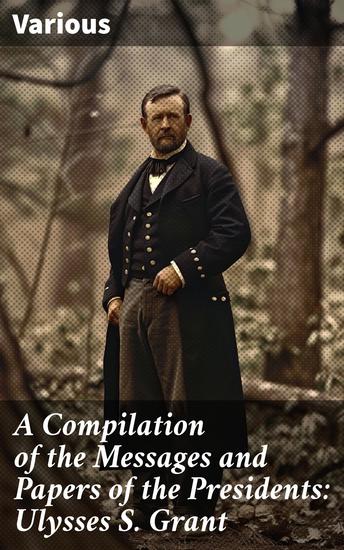
A Compilation of the Messages and Papers of the Presidents: Ulysses S Grant - Insights into Grant's Presidency: Presidential Messages and Historical Documents - cover
LER

A Compilation of the Messages and Papers of the Presidents: Ulysses S Grant - Insights into Grant's Presidency: Presidential Messages and Historical Documents

Various Various

Editora: Good Press

  • 0
  • 0
  • 0

Sinopse

A Compilation of the Messages and Papers of the Presidents: Ulysses S. Grant meticulously curates the significant writings and proclamations of the 18th President of the United States, Ulysses S. Grant. The text is structured to provide a comprehensive overview of Grant's administration from 1869 to 1877, presenting a blend of formal speeches, state papers, and correspondence that reflect the literary gravitas of the period. This compilation not only sheds light on the political climate following the Civil War but also frames Grant'Äôs vision for a unified nation grappling with profound socio-economic changes. Its scholarly rigor and chronological arrangement allow for an insightful exploration of the complexities of presidential governance during a pivotal time in American history. Ulysses S. Grant, renowned for his pivotal role as a Union general during the Civil War, transitioned from military leadership to political office, embodying the tumultuous spirit of Reconstruction. His background as a soldier and statesman profoundly influenced his approach to governance, focusing on civil rights for freedmen and enforcement of law in a fractured nation. However, his presidency also faced significant challenges, including corruption scandals and economic hardship, making his written communications all the more important for understanding his legacy. This compilation is an essential resource for historians, students, and general readers alike, offering a profound insight into the mind of one of America's most complex leaders. Those interested in political history and presidential studies will find this work invaluable, as it not only illuminates Grant's presidency but also serves as a mirror to the evolving American identity in the post-Civil War era.
Disponível desde: 12/08/2023.
Comprimento de impressão: 536 páginas.
Outros livros que poderiam interessá-lo

  • Chin Hairs and Other Things Mama Didn't Tell You - From Surviving to Thriving in Your 20s and 30s - cover

    Chin Hairs and Other Things Mama...

    Kelly L. Knowles

    • 0
    • 0
    • 0
    Are you just surviving the day? Month? Year? Entering the new territory of your 20s, 30s or beyond? 
    In this engaging audiobook, author Kelly L. Knowles explains how you can go from surviving to thriving! If you are in a new season of life or expecting to be, you’re in for a treat with this book! You will find tips and ideas that make sense, funny stories, and inspiration that will lead you to the action you need to move forward into your purpose. 
    And, if you have passed the 20s or 30s, congratulations! You will still find this book relevant and engaging for the next decades!
    Ver livro
  • The American Imperative - Reclaiming Global Leadership through Soft Power - cover

    The American Imperative -...

    Daniel F. Runde

    • 0
    • 0
    • 0
    It's time for America to get back in the international leadership game. 


    What should our global strategy look like in an age of renewed great power competition? And what must America offer to a newly empowered developing world when we're no longer the only major player? 


    In The American Imperative, international development expert Daniel Runde makes the case for building a new global consensus through vigorous internationalism and the judicious use of soft power. Runde maps out many of the steps that we need to take—primarily in the non-military sphere—to ensure an alliance of stable and secure, like-minded, self-reliant partner nations in order to prevent rising authoritarian powers such as China from running the world.
    Ver livro
  • The 1960's - A Decade of Change Revolution Resistance and Reform - cover

    The 1960's - A Decade of Change...

    Harry Montgomery

    • 0
    • 0
    • 0
    The 1960s opened with a sense of cautious optimism in America. Following the stability of the postwar 1950s, the country was on the brink of transformation. The seeds of change were being planted by a young and increasingly restless population. The rise of youth culture signaled a break from the conservatism of their parents’ generation. Young people began questioning authority, traditional values, and the social norms that had shaped American life for decades. Television became a powerful force in shaping ideas, music spread messages of rebellion, and college campuses buzzed with debates over justice and freedom. Teenagers and young adults embraced new forms of expression, setting the stage for a cultural revolution. 
    At the heart of this evolving decade was the civil rights movement, which had already begun stirring in the 1950s. In the early years of the sixties, the push for racial justice gained momentum, marked by nonviolent protests, sit-ins, and mass marches. African Americans, particularly in the South, fought against systemic racism and demanded equal treatment under the law. Martin Luther King Jr. became a prominent voice during this time, advocating for civil disobedience and peaceful protest. As the movement grew, so did the urgency for legislation that would challenge segregation and discrimination. The activism of this period began to awaken a broader consciousness about social injustice, laying the groundwork for other rights movements to follow. 
    On the global stage, the Cold War continued to cast a long shadow over American life. The rivalry between the United States and the Soviet Union defined much of the political atmosphere. The threat of nuclear conflict loomed, and the government’s efforts to contain communism influenced both foreign and domestic policy.
    Ver livro
  • Peninsula Campaign The: The History and Legacy of the Union’s Failed Attempt to Capture Richmond in 1862 - cover

    Peninsula Campaign The: The...

    Editors Charles River

    • 0
    • 0
    • 0
    As Union commander George McClellan moved the Army of the Potomac up the Peninsula in early 1862, the Union army still had a nearly 2-1 advantage in manpower, so Army of Northern Virginia commander Joseph E. Johnston continued to gradually pull his troops back to a line of defense nearer Richmond as McClellan advanced. In conjunction, the Union Navy began moving its operations further up the James River, until it could get within 7 miles of the Confederate capital before being opposed by a Southern fort. McClellan continued to attempt to turn Johnston’s flank, until the two armies were facing each other along the Chickahominy River. At this point, the Union army was close enough to Richmond that they could see the city’s church steeples, but they would come no closer. By the end of May, Stonewall Jackson had startlingly defeated three separate Northern armies in the Shenandoah Valley, inducing Lincoln to hold back the I Corps from McClellan. When McClellan was forced to extend his line north to link up with troops that he expected to be sent overland to him, Johnston learned that McClellan was moving along the Chickahominy River.  
    The fate of the Confederacy would hang in the balance that summer, and in addition to having a direct impact on the rest of the fighting in 1862, the Peninsula Campaign would remain in the minds of Union soldiers and leaders over the next few years. Lincoln’s frustrations with different generals in the Army of the Potomac led to his promotion of Ulysses S. Grant as chief of all armies ahead of the Overland Campaign of 1864. When the Army of the Potomac was thwarted at the Battle of the Wilderness in early May 1864, it found itself in a similar position as Hooker at Chancellorsville, McClellan on the Peninsula, and Burnside after Fredericksburg. Union soldiers got the familiar dreadful feeling that they would retreat back toward Washington, as they had too many times before. This time, however, Grant kept moving south.
    Ver livro
  • Goose Green - The decisive battle of the Falklands War – by the British troops who fought it - cover

    Goose Green - The decisive...

    Nigel Ely

    • 0
    • 0
    • 0
    *As featured in the landmark BBC2 documentary Our Falklands War: A Frontline Story*Published to mark the fortieth anniversary of the Falklands war'There was a time when we did extraordinary things.' On 28 May 1982, 450 men of the 2nd Battalion, the Parachute  Regiment - 2 Para - went into action to retake the settlement of  Goose Green on East Falkland, where more than 1,000 Argentine  soldiers were holding 119 Falkland Islanders - men, women,  children and one baby - in squalid conditions. Forty years on, Goose Green is still the biggest and bloodiest  battle the British Army has fought in modern times. This book  is the living narrative of the battle told by the very men who  fought it; not just the soldiers of 2 Para, but also the SAS, the  Royal Navy and Merchant Navy, and others, in more than a hundred exclusive and untold personal accounts.Some are extremely funny, some touching, and some heart-breaking. All were recorded face to face, the speakers' own  words adding a gritty authenticity to each account and  conveying the confusion and terror of battle, as well as the courage and selflessness of men in action.  Goose Green is a book that goes beyond the official histories and the many memoirs to bring to life the first and, as it turned  out, the decisive battle of this country's outstanding campaign  to retake the Falkland Islands from a foreign invader. This is a true story of a great victory against all the odds, told by the men who fought it.
    Ver livro
  • How to Get a Car Loan: A Beginner’s Guide to Financing Buying and Driving Your First Vehicle with Confidence - cover

    How to Get a Car Loan: A...

    Johnny Nelson

    • 0
    • 0
    • 0
    Buying your first car? Worried about interest rates, credit scores, or getting ripped off at the dealership? How to Get a Car Loan is the ultimate beginner’s guide to financing your first vehicle—confidently, affordably, and without regret. 
    This audiobook walks you step-by-step through everything you need to know before you walk onto a lot, apply for financing, or sign any paperwork. Learn how car loans work, what lenders look for, how to check and improve your credit score, and how to get pre-approved for the best possible rate—even if you have no credit history. 
    You’ll discover how to compare financing options from banks, credit unions, and dealerships, understand loan terms and hidden fees, avoid common traps like extended warranties and add-ons, and calculate what you can actually afford based on your income and expenses. This guide also covers buying new vs. used, leasing vs. financing, and the pros and cons of zero-down offers and cosigners. 
    Ideal for students, first-time buyers, recent graduates, or anyone who wants to make a smart vehicle purchase without stress. Whether you're shopping for your first car or rebuilding your credit with a second chance loan, this audiobook gives you the knowledge to negotiate with confidence and drive away with a great deal. 
    If you’ve searched for how to get a car loan, how to buy your first car, or how to finance a vehicle with no credit, this audiobook gives you the answers—clearly, simply, and step-by-step.
    Ver livro