Join us on a literary world trip!
Add this book to bookshelf
Grey
Write a new comment Default profile 50px
Grey
Subscribe to read the full book or read the first pages for free!
All characters reduced
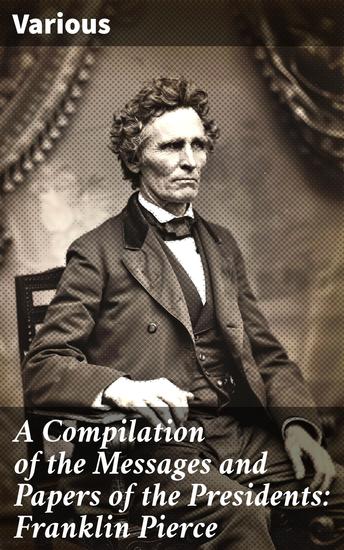
A Compilation of the Messages and Papers of the Presidents: Franklin Pierce - Exploring Mid-19th Century Presidential Policies and Politics - cover

A Compilation of the Messages and Papers of the Presidents: Franklin Pierce - Exploring Mid-19th Century Presidential Policies and Politics

Various Various

Publisher: Good Press

  • 0
  • 0
  • 0

Summary

In "A Compilation of the Messages and Papers of the Presidents: Franklin Pierce," readers are presented with a meticulous chronicle of the presidential communications and significant legislative acts during Franklin Pierce's tumultuous administration (1853-1857). This collection, crafted with scholarly precision, offers insights into the political, economic, and social dilemmas of mid-19th century America. The literary style is characterized by a formal tone, reflecting the protocols of presidential correspondence and framing the historical context with clarity that serves both academic study and general interest. Through careful curation, the compilation highlights Pierce's controversial stance on issues such as the Kansas-Nebraska Act, providing invaluable perspectives on his leadership and the pressing issues of his time. Franklin Pierce, the 14th President of the United States, was a figure of complex contradictions, navigating a nation on the brink of civil conflict. His background as a Democrat in a polarized political landscape deeply informed his approach to governance and the accompanying rhetoric found in his communications. The compilation is shaped by contributions from various historians and editors, all committed to preserving the nuances of Pierce's presidency and contextualizing it within the broader spectrum of American history. This compilation is a crucial resource for historians, students, and anyone interested in understanding the complexities of American presidential history. It sheds light on the intricate web of political decision-making and the consequences that reverberated throughout the country. For readers curious about the challenges of leadership during a pivotal era, this work enriches the discourse surrounding antebellum America and the legacies of its leaders.
Available since: 08/12/2023.
Print length: 283 pages.

Other books that might interest you

  • The Essential Questions - Interview Your Family to Uncover Stories and Bridge Generations - cover

    The Essential Questions -...

    PhD Elizabeth Keating

    • 0
    • 0
    • 0
    Uncover new sides of family members you've known your entire life with this indispensable guide. 


    Just as the oral histories of people around the world are disappearing amid rapid change, there is a risk that your family's personal stories, too, will be lost forever. In The Essential Questions, anthropologist Elizabeth Keating helps you to uncover the unique memories of your parents and grandparents and to create lasting connection with them in the process. 


    As you seek to learn more about your family history, how do you get beyond familiar anecdotes and avoid the frustration of oppositional generational attitudes? By asking questions that make the familiar strange, anthropologists are able to see entirely different perspectives and understand new cultures. Drawing on her lifelong work in this field, Keating has developed a set of questions that treat your parents and grandparents not just as the people who raised you, but as individuals of a certain society and time, and as the children, teenagers, and young adults they once were. The Essential Questions helps you to learn about the history of your elders, to see the world through their eyes, and to honor the language they choose to describe their experiences.
    Show book
  • The One Armed Whiskey Man of Jackass Canyon - The Unbelievably True Life and Times of Bay Area Pioneer Thomas D Carneal III - cover

    The One Armed Whiskey Man of...

    Thomas C Reinstein

    • 0
    • 0
    • 0
    The One Armed Whiskey Man of Jackass Canyon daylights a newly excavated vein in the Golden State of mind. It follows the unbelievably true life and times of accidental California pioneer Thomas D Carneal III. His prominent Northern Kentucky clan carved an ironic notch into the whiskey rebellion of 1790's and beyond. Out of the blue, tragedy struck, and the family legacy ricocheted off to the wilds of 1850’s Northern California, landing on a historic rancho, shortly after California statehood. It’s a fun, whiskey fueled romp that details a broad swath of Nor Cal history from the Gilded Age to the Progressive Era. This unbelievably true story concludes with the zeitgeist of creative lawlessness rampant in 1920’s Bay Area, where prohibition just never caught on.  A companion PDF is available on select platforms that provides historical photos relating to each chapter.
    Show book
  • The New Dress - cover

    The New Dress

    Virginia Woolf

    • 0
    • 0
    • 0
    She enters the room—and instantly wishes she hadn't.
    At an elegant party in London, Mabel wears a dress she believed would make her feel confident and admired. Instead, surrounded by polished guests and unspoken judgments, she spirals into doubt, self-consciousness, and quiet despair. In a single evening, Woolf exposes how society's smallest moments can wound the deepest parts of the self.
    
    Acclaimed as "one of Woolf's most devastatingly precise short stories," this work captures the inner turbulence hidden beneath polite smiles. Through fluid thought and emotional intensity, Woolf reveals how identity, class, and insecurity shape human experience.
    
    If you love introspective fiction, modernist insight, and stories that say everything in a few pages, this unforgettable short story will linger in your mind.
    
    Open the book—and step into a moment where appearance becomes fate.
    Show book
  • Western Allies’ Procurement of Nazi Germany’s Technology The: The History of British and American Operations to Capture Nazi Scientists and Equipment - cover

    Western Allies’ Procurement of...

    Editors Charles River

    • 0
    • 0
    • 0
    After the last shots of World War II were fired and the process of rebuilding Germany and Europe began, the Western Allies and the Soviet Union each tried to obtain the services of the Third Reich's leading scientists, especially those involved in rocketry, missile technology, and aerospace research. Naturally, this was a delicate affair due to the fact many of the German scientists were not only active Nazis but had helped the Nazi war machine terrorize the world. At the same time, by the late war period, the Anglo-American Allies formed a clear picture of the Soviet state. Though forced to ally with the USSR's dictator, Josef Stalin, the West came to understand Communist Russia represented yet another hungry totalitarian power, and thus a very real threat to an independent Europe. British Prime Minister Winston Churchill realized the menacing character of the Soviets from the Katyn Forest Massacre of Polish army officers, if not before, while the Americans only gradually shed a naïve assumption of continued Russian friendliness after the war. 
    The result was the American-led “Operation Paperclip” on the Western side, which resulted in German scientists putting their expertise at the disposal of the U.S. and other NATO members. Operation Paperclip aimed not only to obtain the benefits of German scientific advances for the United States but also to deny them to the potentially hostile Soviets. 
    The Western approach, however self-interested, typically met with voluntary compliance on the German scientists' parts. In contrast, the Soviet answer to Paperclip, Operation Osoaviakhim, used the implied threat of imprisonment, torture, and death, the characteristic tools of Stalinist Russia, to coerce assistance from German scientists and engineers following the war. These men yielded rich dividends to the Soviet state in terms of achieving at least temporary technical parity with the USSR's western rivals.
    Show book
  • No One Left Alone - A Story of How Community Helps Us Heal - cover

    No One Left Alone - A Story of...

    Liz Walker, Father Gregory Boyle

    • 0
    • 0
    • 0
    As the first Black woman to anchor the Boston-area evening news, Liz Walker found herself in an industry that defined the neighborhood of Roxbury largely by violence. But when she became a pastor there, Walker grew close to households marked not only by trauma but by courage—including the family of Cory Johnson, a young father who was murdered. In the wake of their worst nightmare, the family reached out for help. 


    As Walker's congregation invited neighbors to gather, they created soft spaces for others' grief to land. There, in the stories told, the meals shared, the tears shed, and the silences kept, people found a space to receive their sorrow. Out of this ministry grew a grassroots trauma-healing program, one now being replicated across the country. 


    Through this groundbreaking book, begin to imagine what story-sharing groups might look like in your context. Face the disparity of grief that comes from racism and systemic inequality, and learn to confront legacies of harm. Discover the healing power of listening, as well as the art and skills of accompanying someone in pain. Further, grasp how caregivers, pastors, counselors, and other healers—many with their own wounds—can benefit from soft spaces too.
    Show book
  • The Tao of Physics - An Exploration of the Parallels between Modern Physics and Eastern Mysticism - cover

    The Tao of Physics - An...

    Fritjof Capra

    • 0
    • 0
    • 0
    "Science does not need mysticism and mysticism does not need science, but man needs both."  —Fritjof Capra, Ph.D.Their paths to the truth could not be more different—but the amazing thing is that, in their own ways, the mystics and the scientists are discovering the same truths about our world. In non-technical language, with no complex mathematics or formulae, this thought-provoking program explores the main concepts and theories of modern physics, the revelations coming from particle accelerators and laboratories—and compares them with the ancient tenets of Hinduism, Buddhism and Taoism. In the process, we gain a clear and fascinating picture of how such seemingly disparate areas of thought are ultimately quests for the same kind of understanding.
    Show book