¡Acompáñanos a viajar por el mundo de los libros!
Añadir este libro a la estantería
Grey
Escribe un nuevo comentario Default profile 50px
Grey
Suscríbete para leer el libro completo o lee las primeras páginas gratis.
All characters reduced
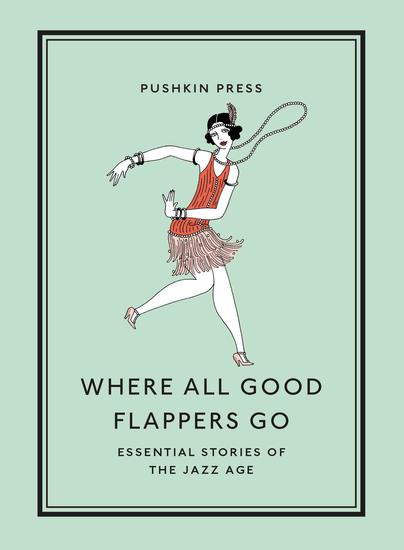
Where All Good Flappers Go - Essential Stories of the Jazz Age - cover

Lo sentimos, pero por derechos de la editorial este libro no puede leerse desde el país desde el que te conectas.

Where All Good Flappers Go - Essential Stories of the Jazz Age

Various Authors

Editorial: Pushkin Press

  • 0
  • 1
  • 0

Sinopsis

'I believe in the flapper as an artist in her particular field, the art of being - being young, being lovely' Zelda FitzgeraldVivacious, charming, irreverent, the flapper is a girl who knows how to have a roaring good time. In this collection of short stories, she's a partygoer, a socialite, a student, a shopgirl, and an acrobat. She bobs her hair, shortens her skirt, searches for a husband and scandalises her mother. She's a glittering object of delight, and a woman embracing a newfound independence.Bringing together stories from widely adored writers and newly discovered gems, principally sourced from the magazines of the period, this collection is a celebration of the outrageous charm of an iconic figure of the Jazz Age.Featuring works from F. Scott Fitzgerald, Zelda Fitzgerald, Dana Ames, Rudolph Fisher, John Watts, Dorothy Parker, Katherine Bush, Gertrude Schalk, Dawn Powell, Vina Delmar, Guy Gilpatric, Anita Loos and Zora Neale Hurston.
Disponible desde: 29/06/2023.
Longitud de impresión: 240 páginas.
Otros libros que te pueden interesar

  • Cordelia the Crude - From their pens to your ears genius in every story - cover

    Cordelia the Crude - From their...

    Wallace Thurman

    • 0
    • 0
    • 0
    The bookshelves of American literature are incredible collections that have gathered together centu-ries of very talented authors.  From this continent their fame spread and whilst among their number many are now forgotten or neglected their talents endure.  Among them is Wallace Thurman.
    Ver libro
  • The Adventure of Black Peter - cover

    The Adventure of Black Peter

    Arthur Conan Doyle

    • 0
    • 0
    • 0
    The Adventure of Black Peter is a Sherlock Holmes story by Arthur Conan Doyle. This tale is in the collection The Return of Sherlock Holmes, but was published originally in 1904 in the Strand Magazine and Collier's.Forest Row in the Weald is the scene of a harpoon murder, and a young police inspector, Stanley Hopkins, asks Holmes, whom he admires, for help. Holmes has already determined that it would take a great deal of strength and skill to run a man through with a harpoon and embed it in the wall behind him.Peter Carey, the 50-year-old victim and former master of the Sea Unicorn of Dundee, who lived with his wife and daughter, had a reputation for being violent. Carey did not sleep in the family house, but in a small cottage that he built some distance from the house, whose interior he had decorated to look like a sailor's cabin on a ship. This is where he was found harpooned. Hopkins could find no footprints or other physical evidence. However, a tobacco pouch made of sealskin and with the initials "P.C." was found at the scene, which was full of strong ship's tobacco. This is rather unusual, as Peter Carey—or "Black Peter" as people called him—seldom smoked. Indeed, Hopkins found no pipe in the cabin. Carey was found fully dressed, suggesting that he was expecting a visitor, and there was some rum laid out along with two dirty glasses...Famous works of the author Arthur Conan Doyle: A Study in Scarlet, The Sign of the Four, The Adventures of Sherlock Holmes, The Memoirs of Sherlock Holmes, The Hound of the Baskervilles, The Return of Sherlock Holmes, The Valley of Fear, His Last Bow, The Case-Book of Sherlock Holmes, Stories of Sherlock Holmes, The Lost World.
    Ver libro
  • War and Peace (Book Three: 1805) - cover

    War and Peace (Book Three: 1805)

    Leo Tolstoy

    • 0
    • 0
    • 0
    War and Peace is a literary work mixed with chapters on history and philosophy by the Russian author Leo Tolstoy. It was first published serially, then published in its entirety in 1869. It is regarded as one of Tolstoy's finest literary achievements and remains an internationally praised classic of world literature.
    Book 3: 1805: Prince Vasíli was not a man who deliberately thought out his plans. Still less did he think of injuring anyone for his own advantage. He was merely a man of the world who had got on and to whom getting on had become a habit.
    Ver libro
  • Human Adventure The (Unabridged) - cover

    Human Adventure The (Unabridged)

    H. G. Wells

    • 0
    • 0
    • 0
    Herbert George Wells (21 September 1866 - 13 August 1946) was an English writer. Prolific in many genres, he wrote dozens of novels, short stories, and works of social commentary, history, satire, biography and autobiography. His work also included two books on recreational war games. Wells is now best remembered for his science fiction novels and is often called the "father of science fiction", along with Jules Verne and the publisher Hugo Gernsback.
    THE HUMAN ADVENTURE: Alone among all the living things this globe has borne, man reckons with destiny. All other living things obey the forces that created them; and when the mood of the power changes, submit themselves passively to extinction Man only looks upon those forces in the face, anticipates the exhaustion of Nature's kindliness, seeks weapons to defend himself.
    Ver libro
  • Beowulf - cover

    Beowulf

    Unknown Unknown

    • 0
    • 0
    • 0
    Beowulf is an Old English epic poem in the tradition of Germanic heroic legend consisting of 3,182 alliterative lines. It is one of the most important and most often translated works of Old English literature. The date of composition is a matter of contention among scholars; the only certain dating is for the manuscript, which was produced between 975 and 1025. Scholars call the anonymous author the "Beowulf poet". The story is set in pagan Scandinavia in the 6th century. Beowulf, a hero of the Geats, comes to the aid of Hrothgar, the king of the Danes, whose mead hall in Heorot has been under attack by the monster Grendel. After Beowulf slays him, Grendel's mother attacks the hall and is then defeated. Victorious, Beowulf goes home to Geatland and becomes king of the Geats. Fifty years later, Beowulf defeats a dragon but is mortally wounded in the battle. After his death, his attendants cremate his body and erect a tower on a headland in his memory. Scholars have debated whether Beowulf was transmitted orally, affecting its interpretation: if it was composed early, in pagan times, then the paganism is central and the Christian elements were added later, whereas if it was composed later, in writing, by a Christian. Beowulf is written mostly in the West Saxon dialect of Old English, but many other dialectal forms are present, suggesting that the poem may have had a long and complex transmission throughout the dialect areas of England.No definite sources or analogs of the poem can be proven, but many suggestions have been made, including the Icelandic Grettis saga, the Norse story of Hrolf Kraki and his bear-shapeshifting servant Bodvar Bjarki, the international folktale the Bear's Son Tale, and the Irish folktale of the Hand and the Child. Persistent attempts have been made to link Beowulf to tales from Homer's Odyssey or Virgil's Aeneid. More definite are Biblical parallels, with clear allusions to the books of Genesis, Exodus, and Daniel.
    Ver libro
  • Lazarus - cover

    Lazarus

    Leonid Andreyev

    • 0
    • 0
    • 0
    What did Lazarus see beyond the veil of death?
    In this haunting masterpiece of psychological and philosophical fiction, Leonid Andreyev conjures a vision of resurrection unlike any ever imagined. Lazarus is not a tale of triumph over death—but of what death leaves behind.
    Strange, unsettling, and metaphysical, this is the story of a man raised from the grave only to cast a cold, unblinking gaze back upon the living. Wherever he walks, beauty withers, joy dissolves, and the veneer of meaning slips away. Those who look into his eyes do not die—they unravel.
    Written in a feverish prose that borders on the ecstatic and apocalyptic, Lazarus is a hypnotic meditation on the abyss that separates existence from extinction—and the unspeakable truth that might wait on the other side.
    Perfect for listeners drawn to existential horror, metaphysical fiction, or the eerie brilliance of Dostoevsky, Kafka, or Poe.
    Ver libro