¡Acompáñanos a viajar por el mundo de los libros!
Añadir este libro a la estantería
Grey
Escribe un nuevo comentario Default profile 50px
Grey
Suscríbete para leer el libro completo o lee las primeras páginas gratis.
All characters reduced
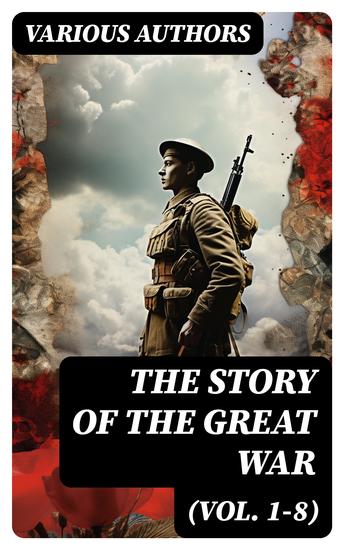
The Story of the Great War (Vol 1-8) - Complete Edition - cover

The Story of the Great War (Vol 1-8) - Complete Edition

Various Authors

Editorial: DigiCat

  • 0
  • 0
  • 0

Sinopsis

The multi-volume anthology "The Story of the Great War" offers an extensive examination of World War I, capturing the complex tapestry of human experience during one of history's most devastating conflicts. Through a diverse range of narratives, essays, and personal accounts, this collection weaves together the political, social, and military dimensions of the war, all presented in a rich literary style that balances meticulous research with heartfelt storytelling. The varied perspectives—including frontline soldiers, nurses, and civilians—serve to provide a comprehensive view of the war's multifaceted impacts on lives and nations, situating the narrative within the broader historical context of early 20th-century global upheaval. Composed by various esteemed authors—including historians, journalists, and soldiers—this anthology reflects the diverse influences that shaped early 20th-century literature and historical writing. Each contributor brings unique insights shaped by their personal experiences or scholarly pursuits, resulting in a collaborative work that not only seeks to inform but also to evoke empathy and understanding for those who lived through the war. The book illustrates a collective effort to process the trauma and consequences of a world irrevocably altered by conflict. I highly recommend "The Story of the Great War" to both history enthusiasts and general readers interested in understanding the complexities of World War I. Its accessible yet profound narrative style invites readers to engage with the past, offering a thorough exploration that will resonate with anyone seeking to grasp the depth of human resilience and tragedy in the face of unparalleled adversity.
Disponible desde: 15/11/2023.
Longitud de impresión: 3768 páginas.

Otros libros que te pueden interesar

  • Confessions of a Former Ivy League Rebel - Discover 'Confessions of a Former Ivy League Rebel' with immersive audio designed for maximum impact Listen and transform! - cover

    Confessions of a Former Ivy...

    Thane Whitaker

    • 0
    • 0
    • 0
    Confessions of a Former Ivy League Rebel 
    ⭐⭐ Simplified Guide & Explanations Included ⭐⭐ 
    Are you looking to progress in your career and solidify your knowledge by embracing authenticity and discovering untold truths? 
    Seeking a comprehensive guide that provides all necessary elements to challenge norms and embrace authenticity? 
    Your search ends here! 
    This guide serves as your definitive companion for deepening your understanding, applying your skills, and engaging in hands-on exercises. With this, you're geared for success. 
    Updated for the Challenge Norms 2024-2025 Structure. 
    Key features of this enriched guide: 
    - Profound insights about challenging norms and embracing authenticity 
    - Detailed explanation of discovering untold truths 
    - Fruitful strategies for preparation and tackling exam challenges 
    Our guide distinguishes itself through comprehensive coverage, which is essential for your success. Concepts aren't merely skimmed; they are delved into with precision. 
    Please note that this guide is not affiliated with any official entity and is purely an independent resource for your benefit. 
    Designed with a clear structure and easy-to-understand language, our guide ensures smooth transitions between topics. Say goodbye to dense jargon and welcome clear, precise, and technically accurate content. 
    So, why wait? Click the BUY NOW button, secure your guide, and begin your journey to success with challenging norms and embracing authenticity!
    Ver libro
  • The Alamo - The Fight for Texas - cover

    The Alamo - The Fight for Texas

    Nova Ashford

    • 0
    • 0
    • 0
    The Battle of the Alamo, fought in 1836, is one of the most iconic events in American history. Situated in the heart of modern-day Texas, the Alamo has come to symbolize sacrifice, courage, and defiance. To understand the significance of the battle, it is essential to first explore the events that led to this dramatic confrontation. The road to the Alamo was shaped by a series of political, social, and military tensions that spanned several years. 
    The conflict between Mexico and the growing population of Anglo settlers in Texas began with the Mexican War of Independence (1810-1821), which freed Mexico from Spanish rule. However, the new Mexican government struggled to control its vast northern territories, including Texas. In the early 1820s, Mexico encouraged settlement in Texas to help secure the region and promote economic development. Anglo settlers, many from the United States, flocked to Texas, hoping for fertile land and opportunities for growth. Over time, these settlers outnumbered the native Mexican population, and cultural tensions began to rise. 
    In 1829, Mexico, under President Vicente Guerrero, passed laws to curb slavery, which greatly alarmed many of the settlers who depended on slave labor. By the mid-1830s, tensions had escalated, as settlers pushed for greater autonomy from the central government in Mexico City, which they felt was increasingly distant and unresponsive to their needs. Meanwhile, Mexico’s leadership was determined to maintain control over Texas and prevent it from slipping into rebellion.
    Ver libro
  • Sundaland and Doggerland: The History and Mysteries of the Sunken Landmasses in Asia and Europe - cover

    Sundaland and Doggerland: The...

    Editors Charles River

    • 0
    • 0
    • 0
    By the time the Pleistocene Epoch ended around 12,000 years ago, Homo sapiens had become one of the most significant species on the planet. 	It was also near the end of that period of time that modern humans began to gradually populate what would become Europe, Asia, and the Americas, eventually becoming the inheritors of the Paleolithic era and the only human species to make it into the Neolithic era. 	The cold Pleistocene temperatures lowered water levels across the planet, exposing land that was not there before or after the period. At the same time, significant regions of the planet were very different during the Pleistocene, including Southeast Asia, particularly the modern islands of Bali, Borneo, Sumatra, and the Malay Peninsula, roughly equivalent to parts of Indonesia, Malaysia, and Thailand. This region, which modern scholars refer to as Sunda or Sundaland, was unique because all of it was connected by land, meaning today’s islands were once part of a contiguous subcontinent, and in terms of the people, flora, and fauna, it was very different than it is today.  
    Among the most significant water displacement phenomena in the Western world was Doggerland on the northern European continent. The notable inundation occurred in both a steady and eruptive fashion covering a vast stretch of former tundra, a land bridge between today’s British Isles and the European continent. The event brought about the modern English Channel and an expanded North Sea, and unlike the early supercontinents, the inundation of Doggerland took place after the appearance of people. Incrementally submerged since roughly 18,000 years ago as the climate warmed, the patch of sea between Britain and Europe is the subject of much recent scientific scrutiny. 
    Ver libro
  • How to Stop a Conspiracy - An Ancient Guide to Saving a Republic - cover

    How to Stop a Conspiracy - An...

    Sallust, Josiah Osgood

    • 0
    • 0
    • 0
    In 63 BC, frustrated by his failure to be elected leader of the Roman Republic, the aristocrat Catiline tried to topple its elected government. Backed by corrupt elites and poor, alienated Romans, he fled Rome while his associates plotted to burn the city and murder its leading politicians. The attempted coup culminated with the unmasking of the conspirators in the Senate, a stormy debate that led to their execution, and the defeat of Catiline and his legions in battle. In How to Stop a Conspiracy, Josiah Osgood presents a brisk, modern new translation of the definitive account of these events, Sallust's The War with Catiline. 


    In a taut, jaw-dropping narrative, Sallust combines juicy details about Catiline and his louche associates with highly quotable moral judgments and a wrenching description of the widespread social misery they exploited. Along the way, we get unforgettable portraits of the bitter and haunted Catiline, who was sympathetic to the plight of Romans yet willing to destroy Rome; his archenemy Cicero, who thwarts the conspiracy; and Julius Caesar, who defends the conspirators and is accused of being one of them. Complete with an introduction that discusses how The War with Catiline has shaped and continues to shape our understanding of how republics live and die, this volume makes Sallust's gripping history more accessible than ever before.
    Ver libro
  • Populism Vs Liberalism - A Comparative Analysis of Political Ideologies - cover

    Populism Vs Liberalism - A...

    Arlo Holders

    • 0
    • 0
    • 0
    Political ideologies form the foundation of how societies organize governance, economics, and social structures. They are systems of ideas and beliefs that provide a framework for political thought and action, influencing policies, institutions, and the behavior of individuals and groups. Among the diverse range of ideologies, populism and liberalism have emerged as two of the most significant and often opposing forces in modern political discourse. This chapter introduces the concepts of populism and liberalism, highlights their importance, and sets the stage for the comparative analysis that follows. 
    Populism is a political approach that champions the rights and concerns of the common people against an established elite. It is often characterized by a rhetoric that emphasizes “the people” as a unified and virtuous entity, contrasted with a corrupt and self-serving elite. While populism can manifest across the political spectrum, its appeal lies in its simplicity and directness, offering solutions that often resonate with those who feel excluded or marginalized by traditional institutions. Populist movements frequently arise in periods of social upheaval or economic insecurity, presenting themselves as corrective forces against perceived injustices. 
    In contrast, liberalism is a political ideology rooted in the principles of individual rights, equality, and the rule of law. It advocates for democratic governance, free markets, and the protection of civil liberties. Liberalism’s historical development is closely linked with movements such as the Enlightenment and the rise of constitutional democracies. As a flexible and adaptive ideology, liberalism has evolved to address modern issues such as social justice, environmental concerns, and global cooperation while maintaining its foundational emphasis on freedom and equality.
    Ver libro
  • But Whose Fault? - The AK-47 Found - cover

    But Whose Fault? - The AK-47 Found

    AMOS ASEMONE

    • 0
    • 0
    • 0
    Do you keep an eye on world events through mainstream media? If so, chances are you have missed out on many essential news stories from countries around the world. 
    While many news outlets will cover European, U.K., and U.S. news in great detail, they often leave out essential news from other continents, especially Africa. 
    And yet, that doesn’t mean that newsworthy events occur there every day, just like in the UK. 
    In fact, some of the most newsworthy stories have occurred in Africa in recent years. 
    If you want to learn more about the conflicts of African communities, you have come to the right place. 
    Introducing, But, Whose Fault? Part One, a true story based in Ghana, where two AK-47s mysteriously vanished before reappearing without ammunition. 
    Not only does this book shed light on an incident that is still to be answered to this day, but it also highlights one of the many conflicts that African communities go through and are never displayed on the big screen. 
    In many ways, the conflict surrounding the missing rifles is a point of convergence of the exploitation of Africa and the negligence shown toward the local people and their value to the world. 
    It is one of the main reasons it continues to go unnoticed in many countries, yet it is a story that must be told. 
    Inside, But, Whose Fault? Part One, discover: 
    ●	essential background information about the local people and community 
    ●	the political context behind the events that unfolded 
    ●	the initial factors that influenced the confrontation 
    ●	the company behind the Nguvu mining project 
    ●	the disappearance, search, and fallout from the missing rifles 
    If you are at all interested in the rich history and real-life stories of Africa, this book is a must-read. 
    Grab a copy of But, Whose Fault? Part One today!
    Ver libro