Junte-se a nós em uma viagem ao mundo dos livros!
Adicionar este livro à prateleira
Grey
Deixe um novo comentário Default profile 50px
Grey
Assine para ler o livro completo ou leia as primeiras páginas de graça!
All characters reduced
Moment Pressure - cover
LER

Moment Pressure

Valeria Cortland

Tradutor A AI

Editora: Publifye

  • 0
  • 0
  • 0

Sinopse

Moment Pressure explores the science behind thriving in high-pressure situations, revealing how cognitive adaptability, emotional regulation, and strategic improvisation are key to real-time decision-making. It delves into how individuals rapidly adjust their mental models under stress and manage emotions that can impair judgment. Contrary to the idea that excelling under pressure is an innate trait, the book emphasizes that these skills can be developed through specific cognitive strategies and training, offering a framework for improving resilience.

 
 The book uniquely combines insights from psychology, neuroscience, and field studies spanning emergency medicine, aviation, and competitive sports, using real-time physiological and behavioral data. It progresses by first introducing core concepts, then expanding through case studies and research, before presenting a high-performance decision-making model. This approach makes complex information accessible, providing actionable insights for business management and beyond.
Disponível desde: 06/05/2025.
Comprimento de impressão: 97 páginas.


Outros livros que poderiam interessá-lo

  • Benito Mussolini - The Doctrine Of Fascism & Mussolini Revealed in His Political Speeches - cover

    Benito Mussolini - The Doctrine...

    Benito Mussolini

    • 0
    • 0
    • 0
    “It’s better to live one day as a lion than 100 years as a sheep.” 
     
    "I am the most terrible animal that's ever existed." 
     
    "Democracy is beautiful in theory; in practice, it is a fallacy. You in America will see that someday." 
     
    "It's good to trust others but, not to do so is much better." 
     
    “I feel, when we have no friends upon whom to lean, or to look for moral guidance." (Mussolini) 
     
    Benito Amilcare Andrea Mussolini, born on July 29, 1883, who went by the nickname “Il Duce” (“the Leader”), was a deeply unbalanced tyrannical Italian dictator who created the dreaded Fascist Party in 1919. Eventually, he held all power in Italy as the country’s prime minister from 1922 to 1943. An ardent socialist as a youth, Mussolini followed in his father's political footsteps but was expelled by the party for his overt support of World War I. As an evil dictator during World War II (even murdering his own son by lethal injection) he greatly overextended his forces and was eventually killed by his own people in Mezzegra, Italy. Here, for the first time, are the words of the great dictator himself in his twisted manifesto on the political movement he started and is still so feared to this very day. 
     
    In this dynamic audiobook, the specter of Benito Mussolini comes alive. Wrought in painstaking detail as to the historical and controversial nature of this work here is the larger-than-life presence of Il Duce (The Boss) who lorded over Italy as a ruthless dictator from 1925 to 1945. Here is the ultimate look at the life of one of the 20th century's most compelling and troubling figures. An amazing audiobook adventure from start to finish.
    Ver livro
  • John Pierpont Morgan: A short biography - 5 Minutes: Short on time - long on info! - cover

    John Pierpont Morgan: A short...

    5 Minutes, 5 Minute Biographies,...

    • 0
    • 0
    • 0
    John Pierpont Morgan, banking legend: Life and work in a short biography! Everything you need to know, brief and concise. Infotainment, education and entertainment at its best!
    Ver livro
  • Superbloom - How Technologies of Connection Tear Us Apart - cover

    Superbloom - How Technologies of...

    Nicholas Carr

    • 0
    • 0
    • 0
    From the author of The Shallows, a bracing exploration of how social media has warped our sense of self and society. 
      
    From the telegraph and telephone in the 1800s to the internet and social media in our own day, the public has welcomed new communication systems. Whenever people gain more power to share information, the assumption goes, society prospers. Superbloom tells a startlingly different story. As communication becomes more mechanized and efficient, it breeds confusion more than understanding, strife more than harmony. Media technologies all too often bring out the worst in us. 
      
    A celebrated commentator on the human consequences of technology, Nicholas Carr reorients the conversation around modern communication, challenging some of our most cherished beliefs about self-expression, free speech, and media democratization. He reveals how messaging apps strip nuance from conversation, how “digital crowding” erodes empathy and triggers aggression, how online political debates narrow our minds and distort our perceptions, and how advances in AI are further blurring the already hazy line between fantasy and reality. Even as Carr shows how tech companies and their tools of connection have failed us, he forces us to confront inconvenient truths about our own nature. The human psyche, it turns out, is profoundly ill-suited to the “superbloom” of information that technology has unleashed. 
      
    With rich psychological insights and vivid examples drawn from history and science, Superbloom provides both a panoramic view of how media shapes society and an intimate examination of the fate of the self in a time of radical dislocation. It may be too late to change the system, Carr counsels, but it’s not too late to change ourselves.
    Ver livro
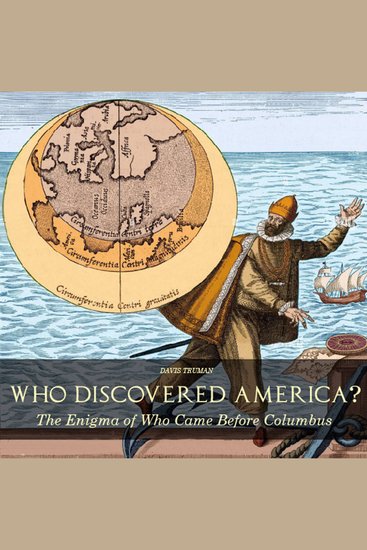
  • Who Discovered America? - The Enigma of Who Came Before Columbus - cover

    Who Discovered America? - The...

    Davis Truman

    • 0
    • 0
    • 0
    In the heart of history's greatest enigma lies an untold tale, an ancient mystery that has captivated the imagination of generations. "Who Discovered America? The Enigma of Who Came Before Columbus" delves deep into the realms of forgotten civilizations and the whispers of a forgotten past. 
    Journey through time and across continents as this captivating narrative unravels the web of secrets surrounding the discovery of America. Was Columbus the first to set foot upon these hallowed shores, or were there intrepid explorers whose names have long been lost to the annals of time? 
    Immerse yourself in the stories of fearless voyagers whose daring escapades carried them to the distant shores of the New World. From the Vikings of the North to the mysterious Phoenicians, each chapter paints a vivid portrait of these brave souls who may have paved the way for Columbus' epic voyage. 
    So, join us on this extraordinary journey as we venture into the forgotten footprints of history, piecing together the puzzle of America's true discoverers and unlocking the secrets of an enigma that has fascinated humanity for generations.
    Ver livro
  • Yugoslavian Genocide - Causes Facts Death Toll and War Criminals - cover

    Yugoslavian Genocide - Causes...

    Kelly Mass

    • 0
    • 0
    • 0
    The Yugoslavian Genocide is hard to explain. So many factors have contributed to the war, and eventually, the genocide in Bosnia, that many UN soldiers didn’t even know what to do with it. A lack of response, though, made the problem worse. And looking back on some of the cowardice and indifference, I’m sure many countries involved would like to go back in time and do it over. A combination of historical aspects such as the division of religion, the world wars, the Iron Curtain, and the fall of the Soviet Union were part of what led to a conflict that lasted for years in this sensitive region in Europe. 
    Throughout the Bosnian War of 1992-- 1995, the Yugoslavian or Bosnian genocide describes either the Srebrenica massacre or the larger criminal activities against mankind and ethnic cleaning project performed by the Army of Republika Srpska (VRS) in areas controlled by the Army of Republika Srpska (VRS) More than 8,000 Bosniak (Bosnian Muslim) men and boys were killed in Srebrenica in the year 1995, while another 25,000-- 30,000 Bosniak people were by force expelled. 
    Bosniaks and Bosnian Croats were targeted in ethnic cleaning in VRS-controlled areas. Extermination, illegal confinement, mass rape, sexual assault, abuse, ransack and damage of personal and public property, and inhumane treatment of people; targeting of politicians, intellectuals, and experts; illegal deportation and transfer of citizens; illegal appropriation and plunder of real and personal effects; damage of houses and services The activities met the requirements for "guilty acts" of genocide, and "certain physical criminals had the purpose to physically get rid of the safeguarded populations of Bosnian Muslims and Croats," according to the report. 
    Let’s take a look at what happened, what caused it, and what it led to.
    Ver livro
  • René Descartes - Rationalism and Meditations on First Philosophy - cover

    René Descartes - Rationalism and...

    Hector Davidson

    • 0
    • 0
    • 0
    René Descartes, often regarded as the father of modern philosophy, revolutionized the intellectual landscape of the seventeenth century. His groundbreaking ideas in mathematics, metaphysics, and epistemology laid the foundation for a new way of thinking, challenging the dominance of Aristotelian scholasticism. Born in 1596 in La Haye en Touraine, France, Descartes displayed an early aptitude for learning. He was educated at the Jesuit College of La Flèche, where he received a rigorous grounding in classical philosophy and mathematics. However, dissatisfied with the prevailing methods of acquiring knowledge, he sought a more systematic and rational approach, leading to his development of the Method of Doubt. 
    Descartes' intellectual pursuits extended beyond philosophy. His contributions to mathematics were equally significant, particularly in the creation of Cartesian geometry, which established a link between algebra and geometry through the use of coordinate planes. This innovation became a cornerstone of modern mathematics and physics, influencing generations of scientists. His emphasis on deduction and reason over mere observation shaped the trajectory of scientific inquiry, reinforcing the idea that true knowledge must be derived from fundamental principles. 
    His most famous philosophical work, Meditations on First Philosophy, published in 1641, sought to establish an unshakable foundation for human knowledge. In this work, he introduced the concept of radical skepticism, questioning the reliability of sensory perception and challenging assumptions about reality. Through this process, he arrived at his famous conclusion, "Cogito, ergo sum" (I think, therefore I am), which he considered the first indubitable truth. From this foundation, Descartes attempted to prove the existence of God and the distinction between mind and body, a theory known as Cartesian dualism.
    Ver livro