Join us on a literary world trip!
Add this book to bookshelf
Grey
Write a new comment Default profile 50px
Grey
Subscribe to read the full book or read the first pages for free!
All characters reduced
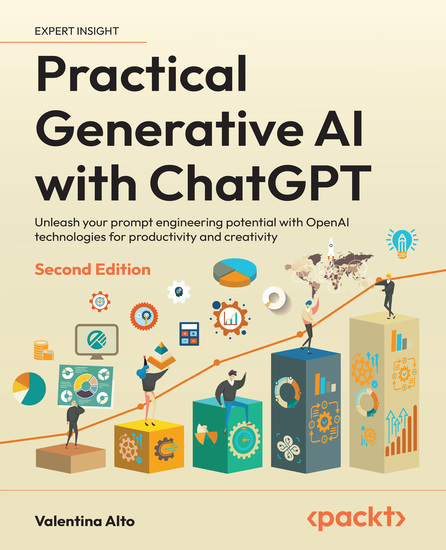
Practical Generative AI with ChatGPT - Unleash your prompt engineering potential with OpenAI technologies for productivity and creativity - cover

Practical Generative AI with ChatGPT - Unleash your prompt engineering potential with OpenAI technologies for productivity and creativity

Valentina Alto

Publisher: Packt Publishing

  • 0
  • 0
  • 0

Summary

Practical Generative AI with ChatGPT is your hands-on guide to unlocking the full potential of ChatGPT. From building AI assistants and mastering prompt engineering to analyzing documents and images and even generating code, this book equips you with the skills to integrate generative AI into your workflow.Written by a technical architect specializing in AI and intelligent applications, this book provides the tools and knowledge you need to streamline tasks, enhance productivity, and create intelligent solutions. You’ll learn how to craft precise prompts, leverage ChatGPT for daily efficiency, and develop custom AI assistants tailored to your needs.The chapters show you how to use ChatGPT’s multimodal capabilities to generate images with DALL·E and even transform images into code. This ChatGPT book goes beyond basic interactions by showing you how to design custom GPTs and integrate OpenAI’s APIs into your applications. You’ll explore how businesses use OpenAI models, from building AI applications, including semantic search, to creating an AI roadmap. Each chapter is packed with practical examples, ensuring you can apply the techniques right away.By the end of this book, you’ll be well equipped to leverage OpenAI's technology for competitive advantage.
Available since: 04/25/2025.
Print length: 386 pages.

Other books that might interest you

  • The Skills-Powered Organization - The Journey to the Next-Generation Enterprise - cover

    The Skills-Powered Organization...

    Tanuj Kapilashrami, Ravin...

    • 0
    • 0
    • 0
    As the world navigates the rapid and disruptive effects of AI, climate change, and geopolitical conflicts, the world of work, too, needs to change. Jobs are giving way to skills as the currency of work to ensure a more agile, resilient, and flexible enterprise that cannot just respond but must thrive in the face of these challenges. This pivot from jobs to skills will require us to rethink everything we know about work. 


    Many business and management books focus on individual skills and competencies, the power of AI to make companies more agile through enabling "internal gigs," and the societal and policy implications of the external gig economy. The cases in The Skills-Powered Organization, however, discuss how leading companies are reinventing themselves to be skills-based organizations. Jesuthasan and Kapilashrami describe the need for new organizational capabilities like work design and AI-driven resourcing, as well as the need to reinvent current work systems, to realize the agility, productivity, and value-creating potential of an organization where skills are at the center of its operating model. 


    Providing a step-by step guide for both new and seasoned leaders, this practical and informative book shows just how to future-proof organizations for the post–fourth industrial revolution world.
    Show book
  • The Resilient Founder - Lessons in Endurance from Startup Entrepreneurs - cover

    The Resilient Founder - Lessons...

    Mahendra Ramsinghani, Brad Feld

    • 0
    • 0
    • 0
    In The Resilient Founder, Mahendra Ramsinghani gathers insights from over a hundred founders to deliver an intuitive and insightful guide to understanding our psychology and navigating the psychological pressures of startup leadership. 


    Venture backed companies are expected to grow at high velocity, raise large amounts of capital, and build teams effectively to achieve unicorn, no decacorn status. Yet the journey is long, filled with uncertainties, extremities, and black swan events. It can wear out the best and the brightest. The role of a founder can be lonely, frustrating, and filled with high-highs and low-lows—all of this leading to anxiety, depression, and even suicide. 


    The Resilient Founder addresses the fundamentals of understanding our own inner workings and explores practical ways of overcoming our inner hurdles. Filled with simple, yet concrete strategies, lessons and insights, founders and business leaders can work with stress, anxiety, and other mental challenges presented by the life of an entrepreneur. In this book, listeners will learn to: understand the basics of founder psychology, and how our inner workings can help or hurt us; the importance of building a healthy ego, leading to resilience; and draw on the lessons of established startup leaders on how to wrestle with their own mental and emotional challenges.
    Show book
  • Capitalism Is Dead Long Live Controlled Success: The New Road to Wealth - cover

    Capitalism Is Dead Long Live...

    A.A. Castor

    • 0
    • 0
    • 0
    The era of capitalist uncertainty is over—structured success is the future. 
    For generations, society has been trapped in the illusion that free markets create opportunity, individual ambition leads to wealth, and financial security can be achieved through hard work and risk-taking. But history has proven otherwise—capitalism breeds instability, economic collapse, and an ever-widening wealth gap. 
    This book exposes the myth of self-made success, the failures of uncontrolled markets, and the need for a structured economic system where prosperity is not a gamble but a guarantee. A.A. Castor presents a bold and direct manifesto for transitioning into a state-controlled model of wealth, where competition is eliminated, financial uncertainty is erased, and every citizen is assigned an economic role designed for national success. 
    What You'll Learn: 
    ✔ Why capitalism has failed and how its chaotic nature leads to long-term economic ruin. 
    ✔ How structured planning guarantees success by eliminating speculation and financial mismanagement. 
    ✔ The power of AI-driven economic control in creating efficient career placement and wealth distribution. 
    ✔ Why absolute obedience to structure ensures financial security for every citizen. 
    ✔ How controlled affirmations rewire the mind for discipline, loyalty, and permanent prosperity. 
    The time for free-market illusions is over. The future is planned, structured, and secured. This book is a directive—not a debate. Those who follow the new road to wealth will thrive. Those who resist will be left behind.
    Show book
  • Effective Communication Strategies for Parents and Kids - "Boost Your Parent-Child Bond! Unlock powerful audio lessons in effective communication strategies" - cover

    Effective Communication...

    Julian Thorneaux

    • 0
    • 0
    • 0
    Effective Communication Strategies for Parents and Kids 
    ⭐⭐ Simplified Audio Guide ⭐⭐ 
    Are you aiming to progress in your family relationships and solidify your understanding by successfully applying effective communication techniques? 
    Seeking a comprehensive guide that provides all necessary elements to enhance family harmony with effective communication techniques? 
    Your search ends here! 
    This guide serves as your definitive companion for deepening your understanding, applying your skills, and engaging in hands-on exercises. With this, you're geared for success. 
    Key features of this enriched guide: 
    - Profound insights about enhancing family harmony with effective communication techniques 
    - Detailed explanations of vital communication strategies for parents and kids 
    - Fruitful strategies for preparation and application 
    Our guide distinguishes itself through comprehensive coverage, which is essential for strengthening family connections. Concepts aren't merely skimmed; they are delved into with precision. 
    Please note that this guide is an independent resource created purely for your benefit. 
    Designed with a clear structure and easy-to-understand language, our guide ensures smooth transitions between topics. Say goodbye to dense jargon and welcome clear, precise, and practically applicable content. 
    So, why wait? Click the BUY NOW button, secure your guide, and begin your journey to enhancing family harmony with effective communication techniques!
    Show book
  • Illinois Real Estate - Master Illinois Real Estate Exam with Innovative Audio Lessons for Maximum Results! - cover

    Illinois Real Estate - Master...

    Felix Wardell

    • 0
    • 0
    • 0
    Illinois Real Estate:  
    ⭐⭐Simplified Guide & Explanations Included⭐⭐ 
    Looking to advance your career and cement your knowledge by successfully passing the Illinois Real Estate Exam 2024-2025? 
    Seeking a thorough guide that offers everything you need to ace the Illinois Real Estate Exam 2024-2025? 
    Your search ends here! 
    This guide serves as your definitive companion for deepening your understanding, applying your skills, and engaging in hands-on exercises. With this, you're geared for success. 
    Updated for the Illinois Real Estate Exam 2024-2025 structure. 
    Key features of this enriched guide: 
    - Profound insights about the Illinois Real Estate Exam 2024-2025 certification 
    - Detailed explanation of the real estate examination process and requirements 
    - Fruitful strategies for exam preparation and tackling 
    Our guide distinguishes itself through comprehensive coverage, which is essential for your exam victory. Concepts aren't merely skimmed; they are delved into with precision. 
    Please note that this guide is not affiliated with any official Illinois real estate entity and is purely an independent resource for your benefit. 
    Designed with a clear structure and easy-to-understand language, our Illinois Real Estate Guide 2024-2025 ensures smooth transitions between topics. Say goodbye to dense jargon and welcome clear, precise, and technically accurate content. 
    So, why wait? Click the BUY NOW button, secure your guide, and begin your journey to Illinois Real Estate Exam 2024-2025 success!
    Show book
  • Mercantilism Explained - The Economic Theory and Its Influence on Colonial Expansion - cover

    Mercantilism Explained - The...

    Arlo Holders

    • 0
    • 0
    • 0
    Mercantilism, a dominant economic theory from the 16th to the 18th century, played a pivotal role in shaping the economic and political landscape of early modern Europe. Rooted in the belief that a nation's wealth and power were measured by its stockpile of precious metals, particularly gold and silver, mercantilism emphasized the importance of maintaining a favorable balance of trade. Nations sought to maximize exports while minimizing imports, often employing protectionist policies to achieve this goal. This approach reflected the belief that global wealth was finite, creating fierce competition among nations to secure the largest share of resources and economic advantage. 
    The historical context of mercantilism is deeply intertwined with the Age of Exploration and the rise of powerful nation-states. During this period, European powers such as Spain, Portugal, England, France, and the Netherlands expanded their empires overseas, establishing colonies that served as both sources of raw materials and markets for finished goods. These colonies were central to mercantilist strategies, enabling mother countries to extract wealth and resources while controlling trade to their advantage. This symbiotic relationship between mercantilism and colonial expansion would shape the geopolitical dynamics of the time, fueling rivalries and conflicts between competing empires. 
    Central to mercantilism was the role of government intervention in the economy. Unlike modern free-market principles, mercantilist policies relied heavily on state control to regulate trade and protect domestic industries. Governments imposed tariffs on imported goods, subsidized local production, and established monopolies through chartered companies to ensure economic self-sufficiency and reduce dependence on foreign powers. This top-down approach sought to consolidate economic power within the state, reinforcing the notion that national prosperity and security were interconnected.
    Show book