Begleiten Sie uns auf eine literarische Weltreise!
Buch zum Bücherregal hinzufügen
Grey
Einen neuen Kommentar schreiben Default profile 50px
Grey
Jetzt das ganze Buch im Abo oder die ersten Seiten gratis lesen!
All characters reduced
General William Booth Enters into Heaven and Other Poems - cover

General William Booth Enters into Heaven and Other Poems

Vachel Lindsay

Verlag: DigiCat

  • 0
  • 0
  • 0

Beschreibung

In "General William Booth Enters into Heaven, and Other Poems," Vachel Lindsay employs a unique blend of rhythmic verse and vivid imagery to explore the spiritual dimensions of American life and the struggles of the human condition. This collection includes the renowned title poem, which portrays the posthumous journey of the Salvation Army founder, merging themes of faith, redemption, and social justice with Lindsay's characteristic exuberance and musicality. The work is reflective of the early 20th-century literary movement that sought to elevate poetry away from the confines of elitism, aiming to capture the voice of the common man through accessible language and energetic rhythms. Vachel Lindsay, often considered the "poet of the American people," was deeply influenced by his own experiences with social issues and his passion for justice. Emerging from the Midwest, Lindsay was a fervent advocate of the arts as a catalyst for social change and was directly inspired by the tenets of spiritualism and the growing Progressive movement of his time. His background in art, music, and performance poetry also shaped his distinctive style, marrying visual elements with lyrical expression in a way that resonated with a diverse audience. This collection is highly recommended for readers interested in the intersection of spirituality and social advocacy in literature. Those who appreciate a dynamic and rhythmic approach to poetry will find Lindsay's work both refreshing and thought-provoking. "General William Booth Enters into Heaven, and Other Poems" serves not only as a work of art but also as a call to action, celebrating the resilient spirit of humanity.
Verfügbar seit: 16.09.2022.
Drucklänge: 31 Seiten.

Weitere Bücher, die Sie mögen werden

  • The Poetry of Michael Drayton - Collection of poems from renowned Elizabethan poet - cover

    The Poetry of Michael Drayton -...

    Michael Drayton

    • 0
    • 0
    • 0
    Michael Drayton was born in 1563 at Hartshill, near Nuneaton, Warwickshire, England. The facts of his early life remain unknown.  
    Drayton first published, in 1590, a volume of spiritual poems; The Harmony of the Church.  Ironically the Archbishop of Canterbury seized almost the entire edition and had it destroyed. 
    In 1593 he published Idea: The Shepherd's Garland, 9 pastorals celebrating his own love-sorrows under the poetic name of Rowland. This was later expanded to a 64 sonnet cycle. 
    With the publication of The Legend of Piers Gaveston, Matilda and Mortimeriados, later enlarged and re-published, in 1603, under the title of The Barons' Wars. His career began to gather interest and attention.  
    In 1596, The Legend of Robert, Duke of Normandy, another historical poem was published, followed in 1597 by England's Heroical Epistles, a series of historical studies, in imitation of those of Ovid. Written in the heroic couplet, they contain some of his finest writing. 
    Like other poets of his era, Drayton wrote for the theatre; but unlike Shakespeare, Jonson, or Samuel Daniel, he invested little of his art in the genre. Between 1597 and 1602, Drayton was a member of the stable of playwrights who worked for Philip Henslowe. Henslowe's Diary links Drayton's name with 23 plays from that period, and, for all but one unfinished work, in collaboration with others such as Thomas Dekker, Anthony Munday, and Henry Chettle. Only one play has survived; Part 1 of Sir John Oldcastle, which Drayton wrote with Munday, Robert Wilson, and Richard Hathwaye but little of Drayton can be seen in its pages. 
    By this time, as a poet, Drayton was well received and admired at the Court of Elizabeth 1st. If he hoped to continue that admiration with the accession of James 1st he thought wrong.  In 1603, he addressed a poem of compliment to James I, but it was ridiculed, and his services rudely rejected.  
    In 1605 Drayton reprinted his most important works; the historical poems and the Idea. Also published was a fantastic satire called The Man in the Moon and, for the for the first time the famous Ballad of Agincourt. 
    Since 1598 he had worked on Poly-Olbion, a work to celebrate all the points of topographical or antiquarian interest in Great Britain. Eighteen books in total, the first were published in 1614 and the last in 1622.  
    In 1627 he published another of his miscellaneous volumes.  In it Drayton printed The Battle of Agincourt (an historical poem but not to be confused with his ballad on the same subject), The Miseries of Queen Margaret, and the acclaimed Nimphidia, the Court of Faery, as well as several other important pieces. 
    Drayton last published in 1630 with The Muses' Elizium.  
    Michael Drayton died in London on December 23rd, 1631.  He was buried in Westminster Abbey, in Poets' Corner.  A monument was placed there with memorial lines attributed to Ben Jonson. 
     This volume comes to you from Portable Poetry, a specialized imprint from Deadtree Publishing.  Our range is large and growing and covers single poets, themes, and many compilations.
    Zum Buch
  • The Dymock Poets - Meeting of the minds - cover

    The Dymock Poets - Meeting of...

    Anonym

    • 0
    • 0
    • 0
    In the village of Dymock, just by the river Leadon in Gloucester, in the years that were leading up to the Great War, six poets were creating literary history.   
    Living, visiting, reading and writing in this small area their friendships, as they intermingled and influenced each other’s lives, would create the enduring legacy of The Dymock Poets. 
    And these were not just run of the mill scribes.  Included in their number were Robert Frost, Edward Thomas and Rupert Brooke.  These three, together with John Drinkwater, Lascelles Abercrombie and Wilfrid Wilson Gibson, were the beating heart of the group.    
    In his volume we gather together some of their finest verse to best illustrate their poetical careers as well as including poems from the visiting Eleanor Farejon, a close friend of Thomas and his wife.
    Zum Buch
  • Fast Talking PI & Other Poems - cover

    Fast Talking PI & Other Poems

    Selina Tusitala Marsh

    • 0
    • 0
    • 0
    A selection of Selina Tusitala Marsh' s most beloved poems, set to music and performed by the poet herself.
    ' She blows in like a song carried on a powerful current: a wild-haired woman, larger than life, carrying a tall carved stick. She loses things in that hair, she says; finds pens in there days after they went missing.'
    — from ' Never Piss Off a Poet' , The Guardian
    Selina Tusitala Marsh is a celebrated poet and performer from Aotearoa New Zealand. Professor and poet laureate, a Pasifika woman who has performed for queens and presidents, Selina says ' poetry is a way to tell our stories and make the invisible visible.'
    This audiobook features the poet performing thirty-six of her most powerful poems, both occasional pieces and selections from the collections Fast Talking PI, Dark Sparring and Tightrope. In ' Guys like Gaugin' and ' Kickboxing Cancer' , ' Airport Road to Apia' and ' Fast Talking PI' , and many more, Selina brings whole new worlds to life.
    All poems written and performed by Selina Tusitala Marsh; all music composed, produced and engineered by Tim Page.
    Zum Buch
  • Woman Eat Me Whole - Poems - cover

    Woman Eat Me Whole - Poems

    Ama Asantewa Diaka

    • 0
    • 0
    • 0
    A bold, mesmerizing debut collection exploring womanhood, the body, mental illness, and what it means to move between cultures  
    Renowned for her storytelling and spoken-word artistry, Ama Asantewa Diaka is also an exultant, fierce, and visceral poet whose work leaves a lasting impact. 
    Touching on themes from perceptions of beauty to the betrayals of the body, from what it means to give consent to how we grapple with demons internal and external, Woman, Eat Me Whole is an entirely fresh and powerful look at womanhood and personhood in a shifting world. Moving between Ghana and the United States, Diaka probes those countries’ ever-changing cultural expectations and norms while investigating the dislocation and fragmentation of a body—and a mind—so often restless or ill at ease. 
    Vivid and bodily while also deeply cerebral, Woman, Eat Me Whole is a searing debut collection from a poet with an inimitable voice and vision. 
    Zum Buch
  • Rhyme A Dozen A - Trains - 12 Poets 12 Poems 1 Topic - cover

    Rhyme A Dozen A - Trains - 12...

    Damon Runyon, Walt Whitman,...

    • 0
    • 0
    • 0
    ‘A dime a dozen’ as known in America, is perhaps equal to the English ‘cheap as chips’ but whatever the lingua franca of your choice in this series we hereby submit ‘A Rhyme a Dozen’ as 12 poems on many given subjects that are a well-rounded gathering, maybe even an essential guide, from the knowing pens of classic poets and their beautifully spoken verse to the comfort of your ears. 
     
    01 - A Rhyme A Dozen - 12 Poems, 12 Poets, 1 Topic - Trains - An Introduction 
    02 - A Song of the Rails by Damon Runyon 
    03 - Song of a Train by John Davidson 
    04 - Song of the Rail by Ella Wheeler Wilcox 
    05 - To a Locomotive in Winter by Walt Whitman 
    06 - Faintheart in a Railway Train by Thomas Hardy 
    07 - From a Railway Carriage by Robert Louis Stevenson 
    08 - An Incident in a Railroad Car by James Russell Lowell 
    09 - What's the Railroad to Me by Henry David Thoreau 
    10 - On the Engine by Night by Alexander Anderson 
    11 - Adlestrop by Edward Thomas 
    12 - In the Train and At Versailles by Dante Gabriel Rossetti 
    13 - The Railway Train by Emily Dickinson
    Zum Buch
  • Poets & Their Inner Demons – Depression - Poems by poets all linked by suffering similar issues - cover

    Poets & Their Inner Demons –...

    William Blake, Edgar Allan Poe,...

    • 0
    • 0
    • 0
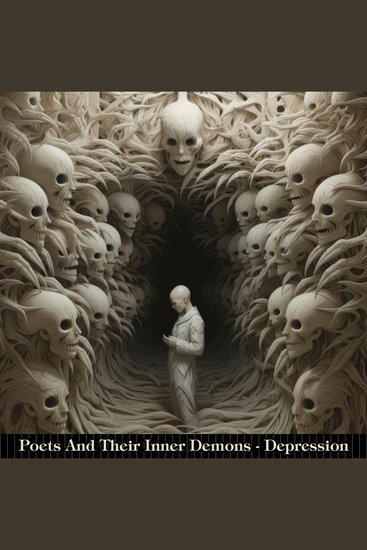
    The stereotypical image of a poet is one of unknown talent starving in a garret and who’s faithfulness and legacy to the art is discovered only after their death. 
    In some cases this is undoubtedly true, but Poets being human and with the same building blocks of physical and mental health as the rest of us, also had the same afflictions and problems as the rest of us.   
    The long roll call of names and the truncated legacies that were left behind is filled with these lost talents. 
    In this volume we bring together the poems and verse of those wordsmiths whose lives were corroded by depression and the black moods it wrapped them in.  For many the condition would return again and again often deepening into other more malign conditions as well.   
    The long roll call of names and the truncated legacies that were left behind is filled with these lost talents.
    Zum Buch