Junte-se a nós em uma viagem ao mundo dos livros!
Adicionar este livro à prateleira
Grey
Deixe um novo comentário Default profile 50px
Grey
Assine para ler o livro completo ou leia as primeiras páginas de graça!
All characters reduced
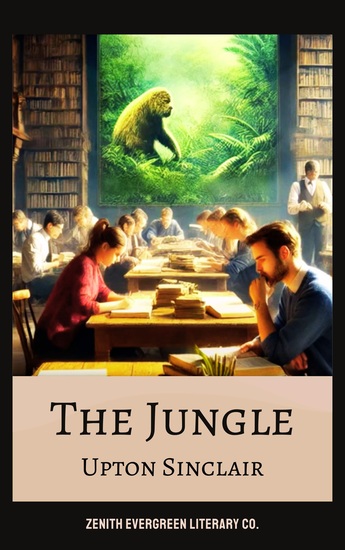
The Jungle - A Powerful Exposé of Labor Corruption and the American Dream - cover
LER

The Jungle - A Powerful Exposé of Labor Corruption and the American Dream

Upton Sinclair, Zenith Evergreen Literary Co.

Editora: Zenith Evergreen Literary Co.

  • 0
  • 0
  • 0

Sinopse

Behind every product lies a hidden cost—human lives, broken dreams, and silent suffering.

The Jungle by Upton Sinclair is a bold, eye-opening novel that exposed the shocking conditions of meatpacking plants and the brutality of industrial capitalism in early 20th-century America. Told through the tragic journey of Jurgis Rudkus, a Lithuanian immigrant who seeks the American dream and finds only exploitation, this landmark work sparked national outrage and catalyzed food safety laws.

More than a novel, The Jungle is a wake-up call on labor rights, corporate greed, and the resilience of the human spirit.

💬 "A novel that changed America's laws and conscience forever."

🧾 Why This Classic Still Matters:
A pillar of muckraking journalism and political fiction

Ideal for fans of 1984, Steinbeck, and Sinclair Lewis

Required reading for history, sociology, and economic policy courses

📣 Read the Book That Changed the Way America Eats.
Buy The Jungle today and uncover the story that shocked a nation—and still echoes today.
Disponível desde: 24/04/2025.
Comprimento de impressão: 179 páginas.

Outros livros que poderiam interessá-lo

  • Beowulf - cover

    Beowulf

    Unknown Unknown

    • 0
    • 0
    • 0
    Beowulf is an Old English epic poem in the tradition of Germanic heroic legend consisting of 3,182 alliterative lines. It is one of the most important and most often translated works of Old English literature. The date of composition is a matter of contention among scholars; the only certain dating is for the manuscript, which was produced between 975 and 1025. Scholars call the anonymous author the "Beowulf poet". The story is set in pagan Scandinavia in the 6th century. Beowulf, a hero of the Geats, comes to the aid of Hrothgar, the king of the Danes, whose mead hall in Heorot has been under attack by the monster Grendel. After Beowulf slays him, Grendel's mother attacks the hall and is then defeated. Victorious, Beowulf goes home to Geatland and becomes king of the Geats. Fifty years later, Beowulf defeats a dragon but is mortally wounded in the battle. After his death, his attendants cremate his body and erect a tower on a headland in his memory. Scholars have debated whether Beowulf was transmitted orally, affecting its interpretation: if it was composed early, in pagan times, then the paganism is central and the Christian elements were added later, whereas if it was composed later, in writing, by a Christian. Beowulf is written mostly in the West Saxon dialect of Old English, but many other dialectal forms are present, suggesting that the poem may have had a long and complex transmission throughout the dialect areas of England.No definite sources or analogs of the poem can be proven, but many suggestions have been made, including the Icelandic Grettis saga, the Norse story of Hrolf Kraki and his bear-shapeshifting servant Bodvar Bjarki, the international folktale the Bear's Son Tale, and the Irish folktale of the Hand and the Child. Persistent attempts have been made to link Beowulf to tales from Homer's Odyssey or Virgil's Aeneid. More definite are Biblical parallels, with clear allusions to the books of Genesis, Exodus, and Daniel.
    Ver livro
  • Crooked Cross - cover

    Crooked Cross

    Sally Carson

    • 0
    • 0
    • 0
    "Sally Carson’s prescient novel offers an unflinching look at the early days of Nazism, resonating with today’s fears of lost boys, strong men and old hatreds... A remarkable novel: chilling, compelling, contained..." The Times"...warrants a permanent place in the growing canon of World War Two literature." Clare McHugh, BBC CultureIt is Christmas Eve 1932, and the Kluger family are celebrating at home. Their only daughter Lexa is excited about her upcoming summer wedding to Moritz Weissmann, a promising young doctor. 
    Lexa has many admirers, but her heart belongs to Moritz, who is initially welcomed by her parents and two brothers, Helmy and Erich. As the year progresses, Lexa enjoys skiing, swimming and going to parties with Moritz and her friends. But little by little Moritz is excluded from the pool, the library, and eventually his own home.As support for the Nazi Party grows rapidly across the country, Lexa’s own brothers, now fervent members of the Nazi Youth, turn against Moritz. Under immense pressure and desperate to be together, Lexa and Moritz have to meet in secret.By midsummer, the once close-knit Kluger family are now fractured by irreconcilable beliefs and differing loyalties. When legislation strips the town’s Jewish citizens of their rights and their livelihoods, Lexa remains steadfast in her determination to stay true to Moritz.Crooked Cross is part of the Persephone Audiobook Collection, a series of forgotten classics including neglected fiction and non-fiction by women writers. This novel was first published in 1934.
    Ver livro
  • The Man in the Moon - cover

    The Man in the Moon

    Andrew Barrow

    • 0
    • 0
    • 0
    Are all aspiring stand-up comics as tragic as Baby Reindeer? If William is anything to go by, the answer is possibly ‘yes’. Nostalgic, razor-sharp and deliciously peculiar, this is a weird but wonderful comedy of manners by the award-winning author of The Tap Dancer. 
    William is a lonely young man on the loose in the late 1960s. A disastrous appearance as a stand-up comic in a pub called The Man In the Moon is only the start of his adventures, in which he consorts with theatrical types, frenzied advertising men and accident-prone lodgers. 
    William’s exploits lead him eventually to the consulting rooms of a Harley Street psychiatrist, where his delusions that he is a comic genius can finally be laid bare. 
    Andrew Barrow’s second – and so far last – novel, first published in 1996, is a hilariously bittersweet comedy that follows in the footsteps of last year’s sensational reissue of The Tap Dancer, which drew praise from Alan Bennett (‘my favourite novel’), Craig Brown (‘sublime comedy’) and India Knight (‘hilariously funny’). 
    In this classic, humorous narrative, William's coming of age journey is a top pick for those seeking a literary fiction that is both unique and engaging. His life, filled with theatrical types and frenzied advertising men, is a testament to the unpredictable nature of growing up. 
    For fans of Alan Bennett (The Laying On Of Hands), Anne Tyler (Vinegar Girl), Nina Stibbe (One Day I Shall Astonish the World), Rose Tremain (Absolutely and Forever), and India Knight (Darling). 
    HarperCollins 2024
    Ver livro
  • Anna Karenina (Part 8) - cover

    Anna Karenina (Part 8)

    Leo Tolstoy

    • 0
    • 0
    • 0
    Part 8: Sergei Ivanovich's (Kostya's brother) latest book is ignored by readers and critics and he participates in the Russian commitment to Pan-Slavism. Stiva gets the post he desired so much, and Karenin takes custody of Vronsky and Anna's baby, Annie. A group of Russian volunteers, including the suicidal Vronsky, depart from Russia to fight in the Orthodox Serbian revolt that has broken out against the Turks, more broadly identified as the Russo-Turkish War (1877–1878). - A lightning storm occurs at Kostya's estate while his wife and newborn son are outdoors and, in his fear for their safety, Kostya realizes that he does indeed love his son as much as he loves Kitty. Kitty's family is concerned that a man as altruistic as her husband does not consider himself to be a Christian.
    Anna Karenina is a novel by the Russian author Leo Tolstoy, first published in book form in 1878. Many writers consider Anna Karenina the greatest work of literature ever, and Tolstoy himself called it his first true novel. It was initially released in serial installments from 1873 to 1877 in the periodical The Russian Messenger.
    Ver livro
  • God the Invisible King (Unabridged) - cover

    God the Invisible King (Unabridged)

    H. G. Wells

    • 0
    • 0
    • 0
    This book sets out as forcibly and exactly as possible the religious belief of the writer. That belief is not orthodox Christianity; it is not, indeed, Christianity at all; its core nevertheless is a profound belief in a personal and intimate God. There is nothing in its statements that need shock or offend anyone who is prepared for the expression of a faith different from and perhaps in several particulars opposed to his own.
    Ver livro
  • Diplomacy - From their pens to your ears genius in every story - cover

    Diplomacy - From their pens to...

    Lafcadio Hearn

    • 0
    • 0
    • 0
    Lafcadio Hearn was born on the 27th June 1850 on the Ionian isle of Levkás in Greece to a British Army officer and a Greek Mother. 
    His father, fearing for his career prospects at being married to a Greek Orthodox wife, sent them to Dublin whilst he continued to advance his career with further postings.  Life there was difficult for mother and son.  His father returned, wounded and traumatised, when Lafcadio was three.  He annulled the marriage and she remarried but had to give up care of Lafcadio to her sister-in law.   
    After brief periods for Catholic education in England and France he emigrated to Ohio in the United States when he was 19, taking on a series of casual jobs before embarking on a career as a journalist, publishing poems and essays in Cincinnati.  It was whilst here that he began a side-line in translating, starting with Gautier and Flaubert.  He married in 1874 to a 20 year old African-American woman in violation of Ohio's anti-miscegenation law.  The marriage soon failed. 
    In 1877 he relocated to New Orleans to write on a variety of themes before picking up a two year assignment from Harper’s to write in the West Indies, where he also wrote his first novel. 
    In 1890 Harper’s sent him to Japan.  Here he left journalism and took the remarkable decision to become a schoolteacher in the north of Japan.   Enraptured by the culture he was driven to explain it in various Western publications to those who had little, if any, knowledge of its culture.  Within the year he had fallen in love with, and married, a high-born Japanese lady, together they would have four children.   
    In 1895 he became a Japanese national and took the name Koizumi Yakumo, Koizumi being his wife’s family name. 
    The following few years, whilst a professor of Literature at the Imperial University of Japan, were his most creative and admired period.   
    Lafcadio Hearn died of heart failure on the 26th of September 1904, in Tokyo, Japan shortly before leaving to deliver a series of lectures at Cornell University in New York State.  He was 54.
    Ver livro