Junte-se a nós em uma viagem ao mundo dos livros!
Adicionar este livro à prateleira
Grey
Deixe um novo comentário Default profile 50px
Grey
Assine para ler o livro completo ou leia as primeiras páginas de graça!
All characters reduced
American Naval Participation in the Great War - World War 1 - With Special Reference to the European Theater of Operations - cover
LER

American Naval Participation in the Great War - World War 1 - With Special Reference to the European Theater of Operations

United States Navy, Dudley W. Knox

Editora: Madison & Adams Press

  • 0
  • 0
  • 0

Sinopse

"American Naval Participation in the Great War" by Dudley W. Knox is a comprehensive examination of the United States Navy's role in World War I, with a particular focus on its operations in European waters. The book is a detailed account that offers insight into the strategic, operational, and logistical aspects of the U.S. Navy's involvement in the conflict.  Knox, who was a naval officer and historian, offers a perspective that combines first-hand experience with scholarly research. His work not only documents the tactical and strategic aspects of the Navy's involvement but also delves into the broader implications of the U.S. naval participation on the outcome of the war and its influence on international naval power dynamics in the post-war period.
Contents:
General Situation in April 1917
Escorting Convoys
Naval Transport and Supply Service
Activities of American Battleships
Mine Barrages
Submarine Hunting
Naval Aviation in the European Area
Augmenting the American Army With Marine and Naval Artillery
Disponível desde: 27/11/2023.
Comprimento de impressão: 77 páginas.
Outros livros que poderiam interessá-lo

  • The Power of Magic - cover

    The Power of Magic

    Raphael Terra

    • 0
    • 0
    • 0
    This audiobook has been recorded using Text to speech (TTS). 
     
    The great Manly P. Hall once said: “To live in the world without becoming aware of the meaning of the world is like wandering about in a great library without touching the books.” 
     
    Magic is key to understanding our existence and Manly P. Hall knew this. It is is much more than the tricks of a children’s entertainer. Magic is all there is. In fact the word comes down to us originally from Old Persian and means “to have power”. Understanding true magic brings us power. 
     
    There are many things we can learn from our foray into the world of magic. Of these many things, this film will focus in on the mystical world, the magical world, the strange and wonderful. Within magic we will find reality like never before. It is the very fabric of the universe in which we live out our lives. 
     
    For us to be able to understand magic, we have to understand the science behind the fabric of existence. It is within the mind expanding complexities of quantum physics that we will discover the truth behind the secrets of magic that our ancestors searched for. Knowledge is magic and magic is powerful. 
     
    Prepare to be empowered.
    Ver livro
  • Chile's Economic Journey - From Colonial Time to Present - cover

    Chile's Economic Journey - From...

    Anya Solace

    • 0
    • 0
    • 0
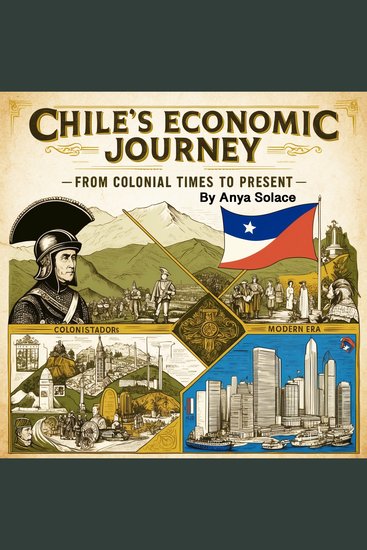
    Chile’s economic history is a complex tale of growth, struggle, and transformation, reflecting the broader trajectory of Latin America. From its colonial roots to its modern-day status as one of South America’s most stable economies, Chile has undergone significant changes, shaped by internal dynamics and global forces. This chapter provides an overview of Chile’s economic evolution, emphasizing the historical context that has influenced its development. 
    The story begins with the Spanish colonization of Chile in the 16th century. During the colonial period, the economy was primarily centered around the extraction of natural resources, particularly silver and gold, though these industries were not as developed as in other parts of Latin America. Instead, Chile’s economic foundation rested on agriculture, particularly the production of crops such as wheat and the raising of livestock. The Spanish settlers also introduced a feudal landholding system, which entrenched social hierarchies that persisted long after independence. 
    Chile's path to independence in the early 19th century marked the beginning of its economic transition. As the country sought to build its identity and self-sufficiency, early economic policies focused on fostering local industries. However, the nation faced significant challenges, including political instability, internal conflicts, and a lack of infrastructure. These early years were marked by attempts to diversify the economy, but Chile's reliance on agriculture, particularly wheat exports, continued to dominate.
    Ver livro
  • Slave Girls: The Shrinking Girl - cover

    Slave Girls: The Shrinking Girl

    Louise Allen

    • 0
    • 0
    • 0
    Slave Girls, a new series by bestselling author Louise Allen, reveals a shocking modern-day scandal of County Lines – the single most dangerous form of systematic child abuse prevalent today.
    Ver livro
  • Don't You Ever - My Mother and Her Secret Son - cover

    Don't You Ever - My Mother and...

    Anônimo

    • 0
    • 0
    • 0
    From a prizewinning journalist, Mary Carter Bishop, a moving and beautifully rendered memoir about the half-brother she didn’t know existed that hauntingly explores family, class, secrets, and fate. 
    Applying for a passport as an adult, Mary Carter Bishop made a shocking discovery. She had a secret half-brother. Her mother, a farm manager’s wife on a country estate, told Mary Carter the abandoned boy was a youthful ""mistake"" from an encounter with a married man. There’d been a home for unwed mothers; foster parents; an orphanage. 
    Nine years later, Mary Carter tracked Ronnie down at the barbershop where he worked, and found a near-broken man—someone kind, and happy to meet her, but someone also deeply and irreversibly damaged by a life of neglect and abuse at the hands of an uncaring system. He was also disfigured because of a rare medical condition that would eventually kill him, three years after their reunion. During that window, Mary Carter grew close to Ronnie, and as she learned more about him she became consumed by his story. How had Ronnie’s life gone so wrong when hers had gone so well? How could she reconcile the doting, generous mother she knew with a woman who could not bring herself to acknowledge her own son? 
    Digging deep into her family’s lives for understanding, Mary Carter unfolds a sweeping story of religious intolerance, poverty, fear, ambition, class, and social expectations. Don’t You Ever is a modern Dickensian tale about a child seemingly cursed from birth; a woman shattered by guilt; a husband plagued by self-doubt; a prodigal daughter whose innocence was cruelly snatched away—all living in genteel central Virginia, a world defined by extremes of rural poverty and fabulous wealth. 
    A riveting memoir about a family haunted by a shameful secret, Don’t You Ever is a powerful story of a woman’s search for her long-hidden sibling, and the factors that profoundly impact our individual destinies.
    Ver livro
  • The Chinese Great Leap Forward Famine - A Social and Political Catastrophe - cover

    The Chinese Great Leap Forward...

    Sarah Willards

    • 0
    • 0
    • 0
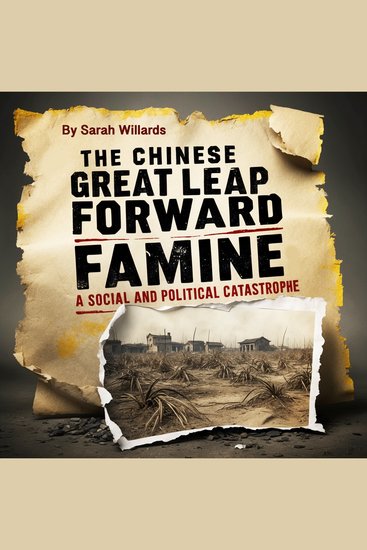
    The origins of the Great Leap Forward are deeply rooted in the political ambition and ideological vision of Mao Zedong, the founding leader of the People’s Republic of China. Following the success of the Communist revolution in 1949, Mao sought not only to rebuild a war-torn nation but to rapidly transform it into a socialist utopia capable of rivaling the industrial powers of the West. By the mid-1950s, China had already launched its First Five-Year Plan, modeled after the Soviet approach to centralized economic planning. Encouraged by early gains in heavy industry, Mao envisioned a second phase of development that would leap over traditional stages of economic growth. 
    At the heart of this vision was a push for mass mobilization. Mao believed that the sheer size of China's population could be harnessed as a revolutionary force capable of achieving miraculous feats. The Great Leap Forward, initiated in 1958, was designed to propel China into a modern communist society by emphasizing agricultural collectivization and rural industrialization simultaneously. Rather than relying on expert knowledge or slow-paced industrial planning, Mao favored decentralized enthusiasm and ideological commitment, trusting that the collective will of the people would overcome any technical limitations. 
    One of the most radical elements of this plan was the establishment of people’s communes, which replaced the traditional family unit and private farming with large-scale collective labor. Households were merged into communes comprising thousands of individuals, who would eat, sleep, and work under strict communal arrangements. The idea was to increase efficiency and free up labor for industrial production, especially in rural areas where backyard furnaces were set up to produce steel. This was accompanied by an aggressive campaign to eliminate what were seen as capitalist tendencies, including private plots and individual incentives.
    Ver livro
  • Learn Swahili With Music - cover

    Learn Swahili With Music

    Innovative Language Learning, ...

    • 0
    • 0
    • 0
    Can learning Swahili be as simple as listening to music? 


    And as easy as remembering song lyrics?


    Just think. You remember song lyrics because lyrics are catchy, repeated throughout the song, and go with the music, right? Now, if you stuck in Swahili, you’d easily learn Swahili words and phrases the same way! 


    So, yes, learning Swahili is as easy as listening to music… with the Learn Swahili With Music Audiobook.


    Just press play, and you’ll hear Swahili words and phrases repeated to the beat of upbeat and cheerful music. And… follow along!


    You’ll learn 180+ most common Swahili words and phrases… while relaxing at home, or while driving to work.


    Learn Swahili With Music is the easiest way to start learning Swahili.. without getting overwhelmed by complicated explanations. Perfect for new learners with little to no language learning experience.


    What will you learn?
     
    180+ Words & Phrases Including...
     
    • Basic Greetings
     
    • Numbers
     
    • Common Questions and Answers
     
    • Parts of the Body & Talking About Your Wellbeing
     
    • Common Hobbies
     
    • And much more


    Learn Swahili With Music includes...
     
    • 15 Songs/Lessons Inside (Each is about 7 minutes long)
     
    • Fast-Paced Review Section at the End of Each Lesson
     
    • 1 Hour 50 Minutes in Total
     
    • Accompanying PDF eBook with the Words, Phrases and Translations


    Download the PDF and read along
    Ver livro