Junte-se a nós em uma viagem ao mundo dos livros!
Adicionar este livro à prateleira
Grey
Deixe um novo comentário Default profile 50px
Grey
Assine para ler o livro completo ou leia as primeiras páginas de graça!
All characters reduced
Data Science and Artificial Neural Networks - A Practical Guide for Everyone - cover
LER

Data Science and Artificial Neural Networks - A Practical Guide for Everyone

Umar Tabbsum

Editora: Publishdrive

  • 0
  • 0
  • 0

Sinopse

Data is everywhere. AI is shaping our lives. This book is your guide to understanding the science behind intelligent systems, without getting lost in code. Explore neural networks, data patterns, and real-world applications that impact your work, health, and everyday decisions.
Disponível desde: 19/08/2025.
Comprimento de impressão: 40 páginas.

Outros livros que poderiam interessá-lo

  • Democracy in America - cover

    Democracy in America

    Alexis de Toqueville, Harvey C....

    • 0
    • 0
    • 0
    Alexis de Tocqueville (1805-59) came to America in 1831 to see what a great republic was like. What struck him most was the country’s equality of conditions, its democracy. The book he wrote on his return to France, Democracy in America, is both the best ever written on democracy and the best ever written on America. It remains the most often quoted book about the United States, not only because it has something to interest and please everyone, but also because it has something to teach everyone. 
      
    When it was published in 2000, Harvey Mansfield and Delba Winthrop’s new translation of Democracy in America—only the third since the original two-volume work was published in 1835 and 1840—was lauded in all quarters as the finest and most definitive edition of Tocqueville’s classic thus far. Mansfield and Winthrop have restored the nuances of Tocqueville’s language, with the expressed goal “to convey Tocqueville’s thought as he held it rather than to restate it in comparable terms of today.” The result is a translation with minimal interpretation, but with impeccable annotations of unfamiliar references and a masterful introduction placing the work and its author in the broader contexts of political philosophy and statesmanship.
    Ver livro
  • Nourishing Narratives - The Power of Story to Shape Our Faith - cover

    Nourishing Narratives - The...

    Jennifer L. Holberg

    • 0
    • 0
    • 0
    Humans are story-shaped creatures.
    We make sense of our world, pattern our lives, and reflect on what is ultimately significant through language and the words that compose our stories. But how does this relate to the narrative of the Bible and the story that God is writing through history?
    In Nourishing Narratives, writer and professor Jennifer Holberg engages with words from the likes of Dante, Gerard Manley Hopkins, Flannery O'Connor, Marilynne Robinson, and more while also offering some of her own stories to reflect on the importance of story to our lives and our faith.
    Here, readers are encouraged not only to understand how stories nourish our faith, but to discover how our stories are part of God's great story.
    Ver livro
  • Urbanization and Its Impact - Understanding City Growth - cover

    Urbanization and Its Impact -...

    Lyric Vale

    • 0
    • 0
    • 0
    Urbanization refers to the process by which an increasing proportion of a population comes to reside in urban areas, often transforming rural landscapes into bustling cities. It is a complex and multidimensional phenomenon that encompasses social, economic, cultural, and environmental changes. The rapid expansion of urban areas is one of the most defining features of modern society, reflecting humanity's growing tendency to cluster in cities for opportunities, convenience, and better access to resources. 
    Historically, urbanization began with the establishment of early agricultural settlements, which served as hubs for trade and governance. Over time, these settlements grew into cities as advancements in technology, transportation, and infrastructure facilitated their expansion. The Industrial Revolution, in particular, marked a pivotal moment in the history of urbanization, drawing large numbers of people into urban centers in search of work and prosperity. Today, urbanization continues at an unprecedented pace, driven by industrial growth, globalization, and population migration from rural to urban regions. 
    The scope of urbanization extends far beyond the mere growth of cities. It profoundly influences nearly every aspect of human life, from economic development to social interactions and environmental sustainability. Economically, cities serve as engines of growth, innovation, and creativity, offering concentrated markets, skilled labor, and access to advanced infrastructure. Socially, urban areas often promote cultural exchange and diversity, creating spaces where people from different backgrounds can interact and collaborate. However, this growth also comes with challenges, such as overcrowding, inequality, and the strain on public services and infrastructure.
    Ver livro

  • America’s Most Notorious Frontier Massacres: The History and Legacy of Shocking Attacks between Native Americans and Settlers - cover

    America’s Most Notorious...

    Editors Charles River

    • 0
    • 0
    • 0
    From the “Trail of Tears” to Wounded Knee and Little Bighorn, the narrative of American history is incomplete without the inclusion of the Native Americans that lived on the continent before European settlers arrived in the 16th and 17th centuries. Since the first contact between natives and settlers, tribes like the Sioux, Cherokee, and Navajo have both fascinated and perplexed outsiders with their history, language, and culture.  
    	Though they are not as well known as tribes like the Sioux or Cherokee, the Creek are one of the oldest and most important Native American tribes in North America. With roots that tie them to the Ancient Moundbuilders, the Natchez were one of the most established groups in the Southeastern United States, and came to be known as one of the Five Civilized Tribes. It’s also believed that they were among the first natives encountered by Spanish explorer Hernando De Soto’s historic expedition in the mid-16th century.  
    	Like various other indigenous groups, the Natchez quickly found themselves in conflict with European powers, most notably the French, who they engaged in a series of battles with during the early 18th century. The French decimated the tribe and led to the dispersal of their dwindling numbers, but the Natchez continue to occupy popular imaginations because of several unique features that make them stand out from other groups. 
    The ongoing fighting between white settlers, militias, Army units, and Native Americans not only bled into the War of 1812 but was one of the main causes of it. Many Americans chaffed at the fact that along the Northwestern frontier, the British in Canada were supporting Indian resistance to American settlement.  
    Ver livro
  • China's 2030 Blueprint: How Beijing Plans to Overtake America - "Unlock your understanding of China’s strategy with engaging audio lessons for effective learning!" - cover

    China's 2030 Blueprint: How...

    Orson Merrick

    • 0
    • 0
    • 0
    China's 2030 Blueprint: How Beijing Plans to Overtake America 
    Are you eager to enhance your career and solidify your understanding of the strategies shaping global leadership dynamics for tomorrow? 
    Looking for an all-encompassing guide that equips you with everything necessary to navigate the complexities of international relations and governance by 2030? 
    Your search ends here! 
    This guide is your essential companion for deepening your knowledge, applying your insights, and engaging in practical exercises. With this resource, you're poised for success. 
    Updated for the 2024-2025 Global Leadership Landscape. 
    Key features of this enriched guide include: 
    - In-depth insights into the strategies that will shape global leadership dynamics for tomorrow 
    - Comprehensive explanations of critical concepts relevant to today's geopolitical climate 
    - Effective strategies for preparing for the challenges ahead and navigating them successfully 
    Our guide stands out through its thorough coverage, ensuring you're well-equipped for the global landscape of 2030. Topics are explored in detail rather than just touched upon. 
    Structured clearly and written in accessible language, our guide ensures seamless transitions between topics. Say farewell to confusing jargon and embrace clear, concise, and technically sound explanations. 
    So, why wait? Click the BUY NOW button, secure your copy, and embark on your journey toward understanding the global dynamics that will define our future! 
    Dive into this essential audiobook and prepare to navigate the landscape of 2030 with confidence!
    Ver livro
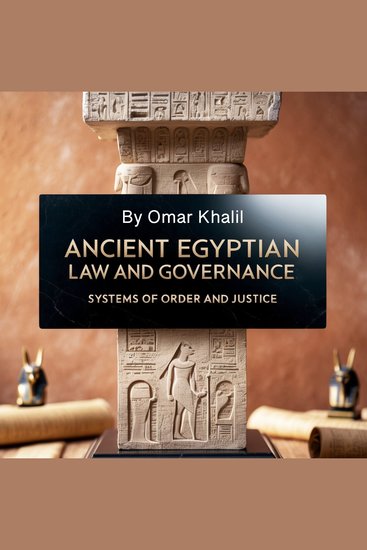
  • Ancient Egyptian Law and Governance - Systems of Order and Justice - cover

    Ancient Egyptian Law and...

    Omar Khalil

    • 0
    • 0
    • 0
    Ancient Egyptian law was deeply rooted in the concept of Ma’at, the divine order that governed the universe and ensured balance, truth, and justice. This principle was not just a philosophical ideal but a practical guide for governance and social conduct. The legal system in Egypt was designed to maintain harmony within society, regulate disputes, and uphold the authority of the ruling elite. Unlike modern legal frameworks based on written statutes, Egyptian law was a combination of tradition, royal decrees, and religious doctrines. It was adaptable, relying on the wisdom of judges and officials rather than rigid legal codes. 
    The origins of legal traditions in ancient Egypt can be traced back to the early dynastic period when the first centralized state emerged. As society became more complex, a structured system of governance was necessary to manage resources, trade, and interpersonal conflicts. The earliest evidence of legal practice comes from administrative records, tomb inscriptions, and temple documents, which indicate that law was an integral part of daily life. While no single codified legal text has survived, references to decrees issued by pharaohs suggest that laws were issued and enforced at the highest levels of authority. 
    At the heart of Egyptian governance was the role of Ma’at, which extended beyond ethical conduct to legal proceedings. Ma’at represented a cosmic balance that rulers were duty-bound to uphold. The pharaoh, as the earthly representative of the gods, was seen as the ultimate source of justice. His decrees and judgments set legal precedents, shaping the administration of law across the kingdom. This divine connection made Egyptian law unique, as it blended religious principles with practical governance, ensuring that justice was not only a human responsibility but also a sacred duty.
    Ver livro