Junte-se a nós em uma viagem ao mundo dos livros!
Adicionar este livro à prateleira
Grey
Deixe um novo comentário Default profile 50px
Grey
Assine para ler o livro completo ou leia as primeiras páginas de graça!
All characters reduced
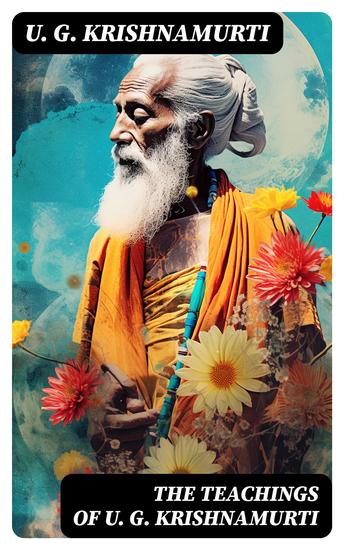
The Teachings of U G Krishnamurti - Collected Works: The Mystique of Enlightenment Courage to Stand Alone Mind is a Myth The Natural State - cover
LER

The Teachings of U G Krishnamurti - Collected Works: The Mystique of Enlightenment Courage to Stand Alone Mind is a Myth The Natural State

U.G. Krishnamurti

Editora: DigiCat

  • 0
  • 0
  • 0

Sinopse

In "The Teachings of U. G. Krishnamurti," the author presents a profound exploration of self-realization and the nature of thought. Through a series of dialogues and discourses, Krishnamurti articulates his radical perspective on enlightenment, challenging conventional spiritual practices and emphasizing the necessity of innate understanding over intellectual comprehension. The text is marked by a conversational literary style that invites readers into the immediacy of his insights, making the complex nature of existence accessible. With a critical lens on societal norms and organized religion, the book provides a stark, yet liberating, view of human consciousness and its limitations. U. G. Krishnamurti, often referred to as the 'anti-guru,' emerged from a background steeped in the spiritual inquiries of India, yet he broke away from traditional frameworks. His experiences, including a transformative event that dramatically changed his perception of reality, inform his approach to spirituality. This life-altering moment led Krishnamurti to reject normative philosophical systems, carving out a distinctive path that prioritizes direct experience and personal insight above doctrines. This book is highly recommended for those seeking an authentic understanding of self and reality beyond conventional spirituality. Readers will find a refreshingly candid and unorthodox perspective that encourages deep introspection and challenges assumptions about enlightenment. "The Teachings of U. G. Krishnamurti" stands as a significant contribution to modern philosophy and spiritual thought, making it essential reading for both seekers and skeptics alike.
Disponível desde: 13/11/2023.
Comprimento de impressão: 667 páginas.

Outros livros que poderiam interessá-lo

  • The Beauty Of Being Old - The Buddhist View - cover

    The Beauty Of Being Old - The...

    Sripad Jagannatha Dasa

    • 0
    • 0
    • 0
    As you stand before the mirror, you may glimpse something unexpected—a reflection that feels familiar and strange. The face staring back at you shows the subtle marks of time. The youthful smoothness is replaced with the creases of age, and hair that once held vibrant color now carries a shade of gray. The body that once moved with ease now speaks in aches and fatigue. With each passing day, it may feel like something is being taken away—a vitality that once felt eternal and is now slipping away. But what if this view of aging is not the full truth? What if, instead of fearing it, we could embrace it? The Buddha often spoke of impermanence, the truth that everything in life always changes. "All conditioned things are impermanent," he taught, and when we see this with wisdom, we can turn away from suffering. In Buddhist thought, aging is not something to resist, but a natural part of life's unfolding. The more we resist it, the more we suffer, because we are fighting against the natural way of the world. It is not aging that causes pain, but our attachment to the belief that things should remain as they were. The fear of aging comes from our desires, from longing for the way things once were. Time moves forward, and so must we. The Buddha reminds us that nothing in this world is permanent, and all things arise and pass away. When we accept this reality, we are free to live with grace and peace. Aging becomes a part of the natural rhythm of life, not something to fear. It is through this acceptance that we find wisdom. As we grow older, we understand that those ahead of us on this journey are simply at a different stage, not different from us. And as we age, we shed the past and move forward with deeper wisdom. The Buddha teaches that the body is not the self, and it is this deeper truth that helps us find peace in the midst of change.
    Ver livro
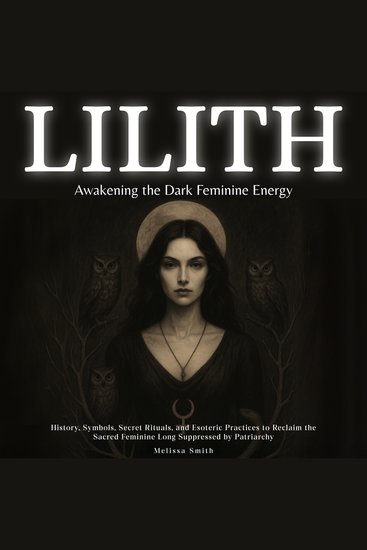
  • Lilith - Awakening The Dark Feminine Energy - History Symbols Secret Rituals and Esoteric Practices to Reclaim the Sacred Feminine Long Suppressed by Patriarchy - cover

    Lilith - Awakening The Dark...

    Melissa Smith

    • 0
    • 0
    • 0
    Are you ready to explore the untamed forces that patriarchy tried to erase?  
    Have you ever wondered what Lilith truly represents beyond myths and distortions? 
    Do you feel the call of the sacred feminine that refuses to be silenced?  
    Would you dare to meet the part of yourself that never asked for permission?  
    Inside this book, you will uncover:Lilith’s true origins in ancient Mesopotamian and Judaic traditionsHer transformation through Kabbalah, demonology, and European folkloreThe resurgence of Lilith in twentieth-century feminism, psychology, and pop cultureSecret rituals, spells, and practices to reconnect with the forgotten sacred feminineA deep exploration of lunar phases and the cycle of the feminineThe hidden face of desire that refuses to be domesticatedPractical offerings and meditations to reclaim your voice and your space 
    Lilith: Awakening the Dark Feminine Energy is not a guide for worship, nor a manual of folkloric magic. 
    It is a call to remembrance, to unfiltered clarity, to the unapologetic existence of a sacred force long suppressed. 
    You will not find promises of empowerment through ritual alone—you will find tools to strip away the expectations that have muted your presence, and practices to confront the uncomfortable truths buried beneath silence and compliance. 
    Lilith does not offer comfort. 
    She offers recognition. 
    A recognition of the voice you have silenced, the strength you have negotiated away, and the autonomy you were told to fear. 
    If you are ready to awaken the sacred feminine within you, to stand without apology, and to reclaim what was taken, Lilith is already waiting on the threshold. Step through.
    Ver livro
  • White Supremacy - From Eugenics to Grand Replacement - cover

    White Supremacy - From Eugenics...

    Gavin Evans

    • 0
    • 0
    • 0
    White Supremacy begins with the anatomy of the murder of 10 black people in Buffalo, New York in 2022. The killer, 18-year old Payton Gendron, says he was driven by 'Great Replacement' - the conspiracy theory that a Jewish-led elite is replacing white people with black and brown people. This, and a spate of similar hate crimes, begs the question: what are the origins of such behaviour? 
     
    Gavin Evans traces the historical roots of white supremacy. He begins in the 19th century with Charles Darwin and his cousin Francis Galton's race-based theories before looking at the spread of eugenics ideas throughout the UK, Europe and the United States, their Holocaust-prompted decline after World War 2, and their revival in a different guise through the promotion of race science from the late 20th century. Evans also examines the hatching of 'Great Replacement' conspiratorial ideas in the 21st century - and their expression via alt-right forums to the minds of troubled young men with access to assault rifles. 
     
    White Supremacy breaks new ground in showing the links between mainstream 'Replacement Theory' and the terrorist version cited by far-right killers. It also traces the thread between these ideas and the race science promoted both by the far right and establishment figures. It looks at what these ideas have in common with those promoted by, for example, the founder of eugenics.
    Ver livro
  • I Won't Shut Up - Finding Your Voice When the World Tries to Silence You - cover

    I Won't Shut Up - Finding Your...

    Ally Henny, Danielle Coke

    • 0
    • 0
    • 0
    Being Black in a society developed by white men to benefit white men means constantly pushing back against systems that were not constructed for your flourishing. White privilege. White cultural norms. White beauty standards. White noise. You're made to feel that your life doesn't matter, your opinions aren't valid, and your entire existence is too loud. It can feel like the whole world is telling you to shut up. 


    To these forces, Ally Henny is here to say, "No. I am a loud Black woman, and I won't shut up." Ally knows what it's like to navigate racism and racialized sexism, having spent most of her life in predominantly white spaces. She's not taking it anymore, and she's calling you to join her in resisting racism by speaking the truth—no matter the cost. In this compelling book, Ally tells her own story of finding her voice, pushing back against oppression, and embracing her unique perspective as a loud Black woman. And she invites you to find your voice in a world that tries to silence you. 


    If you're tired of feeling silenced, misunderstood, and abused by society, you'll find here powerful words of liberation that will empower you to find—and use—your voice.
    Ver livro
  • Kant Today - A Survey - cover

    Kant Today - A Survey

    Erich Przywara

    • 0
    • 0
    • 0
    In Kant Today: A Survey, Erich Przywara explores the enduring impact of the tensions inherent in Immanuel Kant’s thought on continental philosophy over nearly a century and a half. Drawing parallels to the efforts at synthesis of Thomas Aquinas, Przywara presents Kant as a thinker striving to reconcile disparate currents of contemporary thought. While Aquinas fused neo-Platonic Augustinian philosophy with the neo-Aristotelianism of the Parisian Arts Faculty, Kant sought to harmonize continental idealism with the skepticism and empiricism exemplified by a British thinker like David Hume.   Aquinas’s synthesis maintained coherence due to his reliance on the analogia entis. In contrast, Kant’s synthesis lacked such a unifying principle, leading to the proliferation of philosophical antitheses reverberating throughout nineteenth- and early-twentieth-century Europe. Kant Today chronicles the aftermath of Kant’s tumultuous synthesis and suggests that the resolution may lie in a thinker capable of uniting Augustine’s fervent pursuit of God with Aquinas’s distinctive epistemological equilibrium—namely, John Henry Newman.  
    Ver livro
  • Ancient Greece’s Most Famous Oracles: The History of the Oracles at Delphi and Dodona - cover

    Ancient Greece’s Most Famous...

    Editors Charles River

    • 0
    • 0
    • 0
    In ancient Greece, “no other practice was so universal than the consultation of oracles.” These holy sites were found in 260 locations around the Greek-speaking world, and they were considered the “most satisfactory means of ascertaining the future.” These sanctuaries were “set apart from the profane, ordinary world” and were in the beginning restricted to natural locations where the divine was thought to be “especially present.” They were set aside for special spiritual functions, and a state of purity was generally required of its participants. A historical tendency toward providing haven for criminals was based on the fear of shedding blood in a holy place, and the “fear that the evil magic would emanate from his curse.” 
    The Oracle of Delphi was one of the greatest religious institutions in Greece and one which played a significant role not only in the formation and collective decisions of Hellenic localities and city-states but also in the personal lives of Greeks known and unknown. The site was dedicated to the god Apollo, and the Greeks believed the god spoke his oracles through his prophetess known as the Pythia. The judgments and decisions rendered by the oracle were so important to the Greeks that they often put them above all other interests, even security threats posed by the likes of the Persians, and Delphi was popular even amongst outsiders. Many authors of antiquity mention the oracle for one reason or another, and there even survive epigraphic collections that preserve the god’s words on stone. 
    The Oracle of Dodona was the oldest of all, and it was one of the few dedicated to Zeus and his consort goddess Dione. The oracular utterances heard at the oracles are generally referred to as “smokiness” in Greek, but at Dodona, the answers came in natural sounds and other peripheral phenomena.
    Ver livro