Join us on a literary world trip!
Add this book to bookshelf
Grey
Write a new comment Default profile 50px
Grey
Subscribe to read the full book or read the first pages for free!
All characters reduced
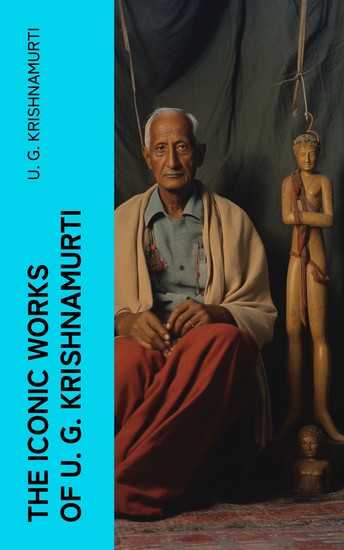
The Iconic Works of U G Krishnamurti - The Mystique of Enlightenment Courage to Stand Alone Mind is a Myth The Natural State - cover

The Iconic Works of U G Krishnamurti - The Mystique of Enlightenment Courage to Stand Alone Mind is a Myth The Natural State

U. G. Krishnamurti

Publisher: e-artnow

  • 0
  • 0
  • 0

Summary

e-artnow present to you the collected works of U. G. Krishnamurti: The Mystique of Enlightenment Courage to Stand Alone Mind is a Myth No Way Out Thought is Your Enemy The Natural State Uppaluri Gopala Krishnamurti (1918-2007), better known as U.G., was an Indian speaker who questioned the state of enlightenment as a real thing. Instead of using the word "enlightenment", he used "calamity" and "natural state" to describe an event in his life. He claimed that the return to the natural state is a rare, a causal, biological occurrence, an event which he referred to in his own life as "the calamity". Because of this, he discouraged people from pursuing the "natural state" as a spiritual goal. He rejected the very basis of thought and in doing so negated all systems of thought and knowledge. Hence he explained his assertions were experiential and not speculative – "Tell them that there is nothing to understand."
Available since: 12/11/2023.
Print length: 667 pages.

Other books that might interest you

  • Russian Politics - A Very Short Introduction - cover

    Russian Politics - A Very Short...

    Brian D. Taylor

    • 0
    • 0
    • 0
    Russia is rarely out of the news. Yet Russian politics can be difficult to understand. It is powerfully shaped by large, impersonal forces such as geography, and Russia's place in the international political and economic system. At the same time, Russia's formal political institutions, such as the Constitution and electoral procedures, are relatively weak and manipulable compared to those of stable, established democracies. Under these circumstances, powerful leaders represent a source of potential dynamism and change. 


    This Very Short Introduction provides a guide to understanding Russian Politics that goes beyond the headlines, offering a vivid account of the key forces driving Russian politics. It places Russia in a global context while explaining its internal political development. Several major themes run through the book, including the primacy of the state over society, the role of the so-called "West," which has represented a source of inspiration, of threat, and of competition for generations of Russians, and the collapse of the Soviet Union in 1991. The Soviet collapse brought about dramatic change across multiple spheres, from the nature of the political and economic system to the country's borders and who counted as a citizen. To this day, Russia is still working its way through the consequences of these transformations.
    Show book
  • When Harry Met Pablo - Truman Picasso and the Cold War Politics of Modern Art - cover

    When Harry Met Pablo - Truman...

    Matthew Algeo

    • 0
    • 0
    • 0
    Harry Truman and Pablo Picasso were contemporaries and were both shaped by and shapers of the great events of the twentieth century—the man who painted Guernica and the man who authorized the use of atomic bombs against civilians. But in most ways, they couldn’t have been more different. Picasso was a communist, and probably the only thing Truman hated more than communists was modern art. Picasso was an indifferent father, a womanizer, and a millionaire. Truman was utterly devoted to his family and, despite his fame, far from a rich man. How did they come to be shaking hands in front of Picasso’s studio in the south of France? Truman’s meeting with Picasso was quietly arranged by Alfred H. Barr Jr., the founding director of New York’s Museum of Modern Art and an early champion of Picasso. Barr knew that if he could convince these two ideological antipodes, the straight-talking politician from Missouri and the Cubist painter from Málaga, to simply shake hands, it would send a powerful message, not just to reactionary Republicans pushing McCarthyism at home but to the whole world: modern art was not evil. A rigorous history with a heartwarming center, When Harry Met Pablo intertwines the biographies of Truman and Picasso, the history of modern art, and twentieth-century American politics, but at its core, it is the touching story of two old men who meet for the first time and realize they have more in common—and are more alike—than they ever imagined.
    Show book
  • Finnish Animal Myths and Legends - cover

    Finnish Animal Myths and Legends

    Niina Niskanen

    • 0
    • 0
    • 0
    Before the arrival of Christianity, early inhabitants of Finland practised animistic nature-based belief, where everything in nature had its own place and spirit. Some of the historical artefacts show that belief in the totem animals was strong as well. Learn about the history of ancient Finland and some of the intriguing animal myths. How the cat was created in the warmth of the sauna, how northern lights are created by the magical fox and how the moose carries the sun in its antlers. Some of these stories like the bear being landed from the starry skies can be traced as far as the stone age. These stories are dreamy and magical, but they also reflect the nordic nature and how people saw animals as companions and sometimes even as gods and goddesses. Learn about the myths related to some of the most important animals in mythology. How the swan was originally a man but was turned into a bird, and it was forbidden to kill swans because they had the soul of a human. How the giant moose almost destroyed an entire land. 
    Written and narrated by Finnish folklorist Niina Niskanen.
    Show book
  • Why Do We Say That? 404 Idioms Phrases Sayings & Facts! - An American Idiom Dictionary To Become A Native Speaker By Learning Colloquial Expressions Proverbs & Slang - cover

    Why Do We Say That? 404 Idioms...

    Scott Matthews

    • 0
    • 0
    • 0
    Who decided “break a leg” was a way to say good luck? Why are you “in a pickle” when things go wrong? And why on earth do we tell people to “hold their horses” when there are no horses in sight? 
    You’ve probably used everyday idioms like “break the ice,” or “hit the nail on the head” without giving them a second thought — most of us do. But behind these quirky expressions lie fascinating facts, bizarre backstories, and cultural twists that make the English language endlessly entertaining. 
    In Why Do We Say That? — The Complete 4-in-1 Idiom Collection, you’ll explore a treasure trove of 404 popular idioms, sayings, proverbs, and expressions — all packed with fun trivia, origin stories, and strange-but-true histories. This value-packed bundle combines four best-selling books into one essential volume for curious readers, language lovers, and anyone learning English who wants to speak more naturally and confidently. 
    Each entry explains where the phrase came from, how it evolved over time, and what it really means today — making this the perfect companion for word nerds, trivia buffs, ESL learners, homeschoolers, and lifelong learners alike. 
    Inside you’ll discover: 
    ✔️ Why “kick the bucket” has nothing to do with actual buckets — and everything to do with death 
    ✔️ How “pulling someone’s leg” evolved from a sinister trick to a harmless joke 
    ✔️ What “buttering someone up” has to do with ancient rituals (and actual butter) 
    ✔️ Why we “burn the midnight oil” to work late — and where that expression really comes fromClick the Buy Now button to decode the weird, witty, and wonderful world of English idioms — one unforgettable phrase at a time.
    Show book
  • A Rare Recording of David Lloyd George - cover

    A Rare Recording of David Lloyd...

    David Lloyd George

    • 0
    • 0
    • 0
    David Lloyd George (Jan. 17, 1863 - March 26, 1945) was a British politician of great audacity, charm, wit, and mastery of the art of debate. A champion of liberal causes throughout his career, Lloyd George entered Parliament in 1890, and was later was appointed to the president of the Board of Trade in 1906. As Prime Minister, from 1916 to 1922, Lloyd George led Britain to victory in World War I. In this recording, Lloyd George discusses the famous "People’s Budget" of 1909.
    Show book
  • How to Tell a Story - An Ancient Guide to the Art of Storytelling for Writers and Readers - cover

    How to Tell a Story - An Ancient...

    Aristotle

    • 0
    • 0
    • 0
    An inviting and accessible new translation of Aristotle's complete Poetics—the first and best introduction to the art of writing and understanding stories 


    Aristotle's Poetics is the most important book ever written for writers and readers of stories—whether novels, short fiction, plays, screenplays, or nonfiction. Aristotle was the first to identify the keys to plot, character, audience perception, tragic pleasure, and dozens of other critical points of good storytelling. Despite being written more than 2,000 years ago, the Poetics remains essential reading for anyone who wants to learn how to write a captivating story—or understand how such stories work and achieve their psychological effects. Yet for all its influence, the Poetics is too little read because it comes down to us in a form that is often difficult to follow, and even the best translations are geared more to specialists than to general readers who simply want to grasp Aristotle's profound and practical insights. In How to Tell a Story, Philip Freeman presents the most accessible translation of the Poetics yet produced, making this indispensable book more engaging and useful than ever before.
    Show book