¡Acompáñanos a viajar por el mundo de los libros!
Añadir este libro a la estantería
Grey
Escribe un nuevo comentario Default profile 50px
Grey
Suscríbete para leer el libro completo o lee las primeras páginas gratis.
All characters reduced
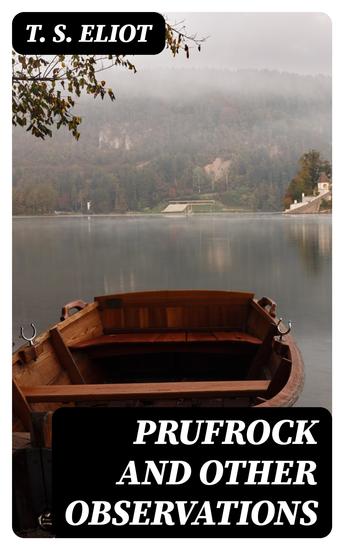
Prufrock and Other Observations - cover

Prufrock and Other Observations

T.S. Eliot

Editorial: DigiCat

  • 0
  • 0
  • 0

Sinopsis

In "Prufrock and Other Observations," T. S. Eliot presents a groundbreaking collection of modernist poetry that explores themes of alienation, self-doubt, and the disillusionment of early 20th-century urban life. The titular poem, "The Love Song of J. Alfred Prufrock," stands as a poignant introspection, employing fragmented imagery and innovative free verse to capture the psyche of a man caught in existential paralysis. Eliot's use of allusion and stream-of-consciousness invites readers to navigate a labyrinth of thoughts and emotions, reflecting the literary experimentation characteristic of the modernist movement, which sought to challenge traditional forms and conventions of poetry. T. S. Eliot, an influential figure in modernist literature, draws from his own experiences and intellectual background, including his time studying at Harvard and his exposure to various artistic movements in Europe. His work is informed by a profound understanding of human psychology and a keen awareness of societal shifts, which ultimately shaped his exploration of identity and ambiguity in "Prufrock and Other Observations." Eliot's engagement with philosophical and literary influences such as Dante, Baudelaire, and the symbolists reveals his deep commitment to the richness of poetic expression. This collection is highly recommended for readers seeking to delve into the complexities of modern sensibility and the human condition. Eliot's masterful blending of personal introspection with broader cultural critiques provides a profound insight into the anxieties of modernity. "Prufrock and Other Observations" remains an essential work for anyone interested in the evolution of poetry and the enduring exploration of self in an increasingly disconnected world.
Disponible desde: 16/09/2022.
Longitud de impresión: 109 páginas.

Otros libros que te pueden interesar

  • 50 Masterpieces you have to read before you die vol: 2 - cover

    50 Masterpieces you have to read...

    George Eliot, Charles Dickens,...

    • 0
    • 0
    • 0
    This book contains now several HTML tables of contents that will make reading a real pleasure!
    Novels
    Jerome, Jerome K.: "Three Men in a Boat"
    Joyce, James: "A Portrait of the Artist as a Young Man"
    Joyce, James: "Ulysses"
    Kingsley, Charles: "The Water-Babies"
    Kipling, Rudyard: "Kim"
    La Fayette, Madame de: "The Princess of Clèves"
    Laclos, Pierre Choderlos de: "Dangerous Liaisons"
    Lawrence, D. H.: "Sons and Lovers"
    Lawrence, D. H.: "The Rainbow"
    Le Fanu, Joseph Sheridan: "In a Glass Darkly"
    Lewis, Matthew Gregory: "The Monk"
    Lewis, Sinclair: "Main Street"
    London, Jack: "The Call of the Wild"
    Lovecraft, H. P.: "At the Mountains of Madness"
    Mann, Thomas: "Royal Highness"
    Maugham, W. Somerset: "Of Human Bondage"
    Maupassant, Guy de: "Bel-Ami"
    Melville, Herman: "Moby-Dick"
    Poe, Edgar Allan: "The Fall of the House of Usher"
    Proust, Marcel: "Swann's Way"
    Radcliffe, Ann: "The Mysteries of Udolpho"
    Richardson, Samuel: "Clarissa"
    Sand, George: "The Devil's Pool"
    Scott, Walter: "Ivanhoe"
    Shelley, Mary: "Frankenstein"
    Sienkiewicz, Henryk: "Quo Vadis"
    Sinclair, May: "Life and Death of Harriett Frean"
    Sinclair, Upton: "The Jungle"
    Stendhal: "The Red and the Black"
    Stendhal: "The Chartreuse of Parma"
    Sterne, Laurence: "Tristram Shandy"
    Stevenson, Robert Louis: "Treasure Island"
    Stoker, Bram: "Dracula"
    Stowe, Harriet Beecher: "Uncle Tom's Cabin"
    Swift, Jonathan: "Gulliver's Travels"
    Tagore, Rabindranath: "The Home and the World"
    Thackeray, William Makepeace: "Vanity Fair"
    Tolstoy, Leo: "War and Peace"
    Tolstoy, Leo: "Anna Karenina"
    Troloppe, Anthony: "The Way We Live Now"
    Turgenev, Ivan: "Fathers and Sons"
    Twain, Mark: "The Adventures of Huckleberry Finn"
    Verne, Jules: "Journey to the Interior of the Earth"
    Wallace, Lew: "Ben-Hur"
    Wells, H. G.: "The Time Machine"
    West, Rebecca: "The Return of the Soldier"
    Wharton, Edith: "The Age of Innocence"
    Wilde, Oscar: "The Picture of Dorian Gray"
    Xueqin, Cao: "The Dream of the Red Chamber"
    Zola, Émile: "Germinal"
    Ver libro
  • Apology for the Life of Mrs Shamela Andrews An - cover

    Apology for the Life of Mrs...

    Henry Fielding

    • 0
    • 0
    • 0
    An Apology for the Life of Mrs. Shamela Andrews, or simply Shamela, as it is more commonly known, is a satirical novel written by Henry Fielding and first published in April 1741 under the name of Mr. Conny Keyber. Fielding never owned to writing the work, but it is widely considered to be his. It is a direct attack on the then-popular novel Pamela (November 1740) by Fielding's contemporary and rival Samuel Richardson and is composed, like Pamela, in epistolary form. Shamela is written as a shocking revelation of the true events which took place in the life of Pamela Andrews, the main heroine of Pamela. From Shamela we learn that, instead of being a kind, humble, and chaste servant-girl, Pamela (whose true name turns out to be Shamela) is in fact a wicked and lascivious creature, scheming to entrap her master, Squire Booby, into marriage. (Summary by Wikipedia)CastNarrator: Patti CunninghamShamela: KristingjWilliams: Martin GeesonTickletext: Chuck WilliamsonLucretia: April GonzalesHenrietta: Margaret EspaillatOliver: Algy PugBooby: Herman RoskamsPuff: Bob GonzalezConny: NoelBadrianEditor: Patti Cunningham
    Ver libro
  • Snow-Flakes - cover

    Snow-Flakes

    Henry Wadsworth Longfellow

    • 0
    • 0
    • 0
    LibriVox volunteers bring you 21 recordings of Snow-Flakes by Henry Wadsworth Longfellow. This was the Weekly Poetry project for December 20th, 2009.
    Ver libro
  • Lycidas - Much shorter poem from the famed author of Paradise Lost - cover

    Lycidas - Much shorter poem from...

    John Milton

    • 0
    • 0
    • 0
    John Milton was born in Bread Street, London, on December 9th, 1608.  His early years were privately tutored before gaining a place at St Paul’s School and in 1625 he matriculated at Christ's College, Cambridge, earning a BA in 1629 and an MA in 1632. At Cambridge he had developed a reputation for poetic skill but also experienced alienation from his peers and university life as a whole.  
    The next 6 years were spent in private study. He read both ancient and modern works of theology, philosophy, history, politics, literature and science, in preparation for a poetical career.  Milton mastered Latin, Greek, Hebrew, French, Spanish, and Italian. To these he would add Old English (whilst researching his History of Britain) and also acquired more than a passing acquaintance in Dutch.  
    Although he was studying, some of his poetry from this time is remarkable; L’Allegro and Il Penseroso in 1631 and Lycidias in 1638. 
    In May 1638, Milton embarked upon a 15 month tour of France and Italy. These travels added a new and direct experience of artistic and religious traditions, especially Roman Catholicism.  He cut the journey short to return home during the summer of 1639 because of what he claimed were "sad tidings of civil war in England."  
    Once home, Milton wrote prose tracts against episcopacy, in the service of the Puritan and Parliamentary cause.  
    He married 16-year-old Mary Powell in June 1643 but she left him after only a few months during which he wrote and published several writings on divorce. Mary did return after 3 years and their life thereafter seemed harmonious.  Milton received a hostile response to the divorce tracts and drove him to write Areopagitica, his celebrated attack on pre-printing censorship.  
    With the parliamentary victory in the Civil War, Milton wrote The Tenure of Kings and Magistrates (1649) which defended popular government and implicitly sanctioned the regicide which led to his appointment as Secretary for Foreign Tongues by the Council of State.  
    On 24 February 1652 Milton published his Latin defense of the English People, Defensio Pro Populo Anglicano, also known as the First Defense. Milton's Latin prose and intellectual sweep, quickly gained him a European reputation.  
    Tragically his first wife, Mary, died on May 5th, 1652 following the birth of their fourth child.   The following year Milton had become totally blind, probably due to glaucoma.  He then had to dictate his verse and prose to helpers, one of whom was the poet Andrew Marvell.  
    He married again to Katherine Woodcock but she died in February 1658, less than four months after giving birth to a daughter, who also tragically died.  
    Though Cromwell’s death in 1658 caused the English Republic to collapse Milton stubbornly clung to his beliefs and in 1659 he published A Treatise of Civil Power, attacking the concept of a state-dominated church. Upon the Restoration in May 1660, Milton went into hiding for his life. An arrest warrant was issued and his writings burnt. He re-emerged after a general pardon was issued, but was nevertheless arrested and briefly imprisoned before influential friends, such as Marvell, now an MP, intervened 
    His third marriage was to Elizabeth Mynshull. Despite a 31-year age gap, the marriage seemed happy and Milton spent the remaining decade of his life living quietly in London, apart from a short spell in Chalfont St. Giles, during the Great Plague of London.  
    Milton was to now publish his greatest works, which had been gestating for many years.  Paradise Lost, perhaps the classic English Epic poem was originally published in 10 books in 1667.  This was followed by Paradise Regained and Samson Agonistes in 1671.  Because of his anti-monarchy views their reception was muted but over the centuries since Milton has established himself as second only to Shakespeare.  He died of kidney failure on November 8th, 1674 and was buried in the church of St Giles Cripplegate.
    Ver libro
  • Mist to Shadow To Light - Three Part Harmony - cover

    Mist to Shadow To Light - Three...

    Sharon C. Eccleston

    • 0
    • 0
    • 0
    This book is a heartfelt mixture of spiritual and encouraging poetry. Some of the poems draw from my own life experiences, spanning from childhood to adulthood. I have poured warmth, love, and care into these words, with the intention of reaching people who may be struggling with depression or hardship. My hope is to point them toward their Creator, offering comfort and understanding. I want to remind readers that everyday disappointments are a natural part of life, but we will get through them and be just fine. 
    One of the poems, “What Is The Fabric of Your Love,” explores the love between a man and a woman, highlighting the deep emotional connections we as humans need in order to feel whole. Throughout the collection, I offer analogies and perspectives that encourage us to think about the world around us and our shared humanity. It is a call to show compassion and belief in humanity—something we often forget in the busyness of our lives. My poems aim to touch the psyche, shedding light on the things we are too busy to think about, but that we all experience in one way or another. I strive to keep the work relatable and touching, offering a message that can bring a smile to your face or inspire you to bless someone else with kindness. 
    One poem that is very dear to me is a tribute to Mr. Tyre Nichols, who tragically lost his life at the hands of police. The poem, titled “My Skateboard and Me,” is a heartfelt expression of grief and reflection. Another poem, “We All Begin and End with Each Other,” calls for greater unity and connection across ethnic lines, encouraging us to reach out to our neighbors, no matter their background. In “Who’s on Third,” I reflect on the time when we all must leave this earth, while “Banana Fritters Makes Me Smile” takes the reader on a nostalgic journey back to childhood memories.
    Ver libro
  • And the World Spins Anyway - cover

    And the World Spins Anyway

    Georgie Jones

    • 0
    • 0
    • 0
    This a love letter to real life, however it shows up; an antidote to the highlight reel that is social media, a tribute to the unfinished, the unfiltered, the uncertain.
    In this debut collection of poetry, stories and questionable choices, Georgie Jones, with her signature wit and warmth, explores the exquisite messiness of modern existence and makes the chaos feel, somehow, like home. She can't promise any answers, but she can make you feel a little less alone in not having them.
    Ver libro